AI SDK Workflow Harness 1.0.158 Patch Release: The Engineering Signals Behind a Minor Version Bump

@ai-sdk/workflow-harness 1.0.158 patch release reflects the AI SDK toolchain's automated release and dependency governance practices.
The article interprets the @ai-sdk/workflow-harness 1.0.158 patch release: auto-published by github-actions, commit bb40cf0 with GitHub signature verification, the only change syncing @ai-sdk/harness@1.0.158, a patch-level adjustment under SemVer. It notes workflow-harness serves as AI workflow testing/orchestration skeleton sharing release cadence with the harness kernel, requiring compatibility checks. Since release notes lack specific fix items, the author suggests evaluating impact via commit diff, harness changelog comparison, and workflow regression tests, emphasizing clear dependency upgrade strategies over blindly following latest.
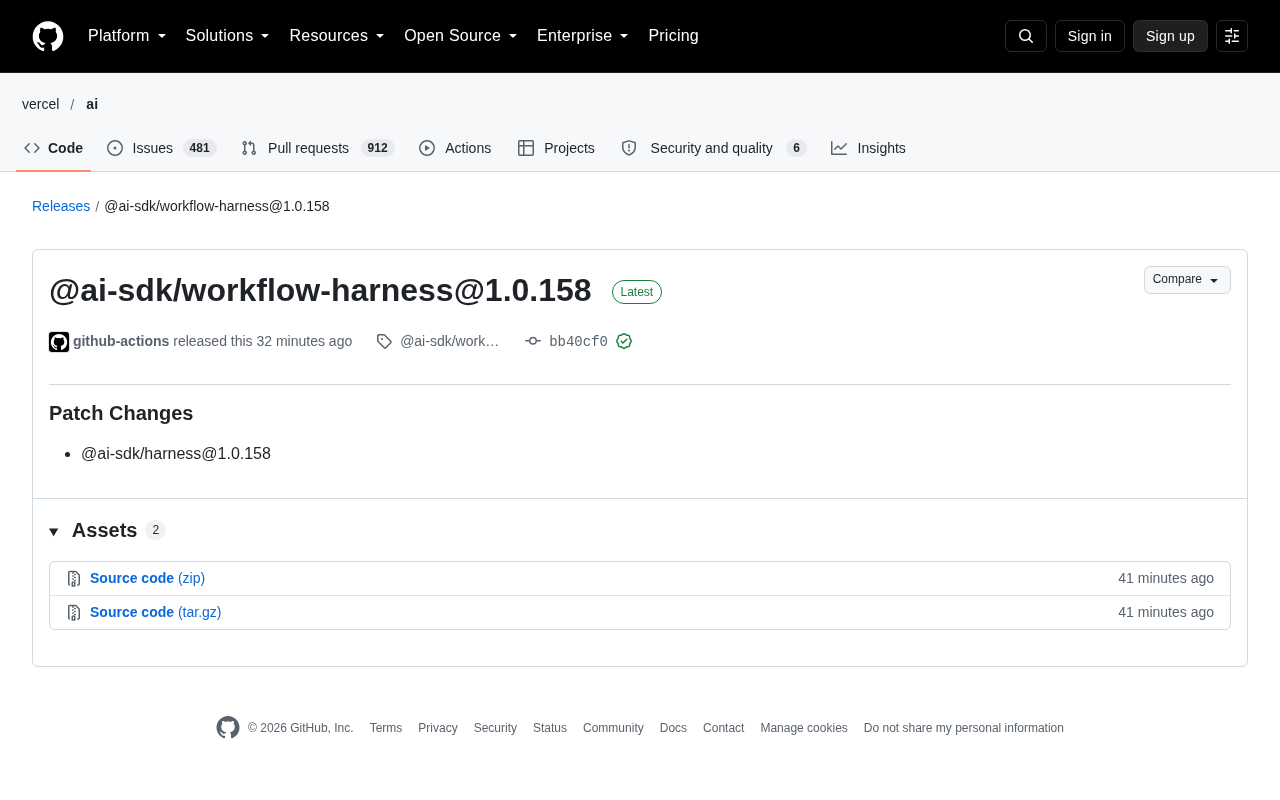
@ai-sdk/workflow-harness in the AI SDK ecosystem has released version 1.0.158. Judging from the GitHub Releases page, this is a typical patch release (Patch Changes), with the core change pointing to the same version of the @ai-sdk/harness package. For developers unfamiliar with this toolchain, this kind of "minor version number bump" release record is easy to overlook; but in the context of AI application engineering, it reveals firsthand signals about the SDK's maintenance cadence and dependency governance approach.
What a standard patch release looks like
The release record on GitHub shows that this version was automatically published by the github-actions bot on 20 Oct 18:37, with commit hash bb40cf0, and carries a GitHub verified signature (GPG key ID: B5690EEEBB952194). The only change in the release notes is Patch Changes, pointing to @ai-sdk/harness@1.0.158.
This means two things: first, the release process is fully automated, driven by a CI bot with minimal human intervention; second, this change is at the patch level, which under semantic versioning conventions typically corresponds to bug fixes, internal dependency synchronization, or non-breaking minor adjustments, rather than new features or API changes. The page itself also shows a resource loading error prompt (displaying "There was an error while loading"), which is a rendering issue with the GitHub Releases page and unrelated to the package contents.
Semantic Versioning (SemVer) is the foundational convention for this discussion: version numbers take the form MAJOR.MINOR.PATCH, corresponding respectively to incompatible API changes, backward-compatible feature additions, and backward-compatible bug fixes. Under this convention, 1.0.158 is a PATCH increment, meaning in theory there are no new APIs or breaking behavior changes. In practice, however, packages in early 1.x occasionally classify internal behavior adjustments under the patch position, so for packages used as test infrastructure, regression verification is still needed as a safety net.
Git commit signing and GPG verification are also worth explaining: GitHub displays a Verified badge for signed commits and tags, where the signature is generated by the publisher's GPG private key, and anyone can use the corresponding public key to verify that the commit contents have not been tampered with and indeed came from the holder of that key. The key ID mentioned in the article is used to identify this public key. For automated releases, signing combines "bot publishing" with "traceable origin," a common means of tamper prevention and identity confirmation in supply chain security.
Why workflow-harness deserves attention
The positioning of @ai-sdk/workflow-harness can be inferred from its name: it provides a workflow-level testing and orchestration skeleton for the AI SDK (in software engineering, harness often refers to a test fixture or runtime framework). In multi-model, multi-step AI applications, workflow reliability is often trickier than individual model calls—how state flows, how failed steps retry, how tool calls are chained—all require a reusable infrastructure to carry.
The version coupling between this package and @ai-sdk/harness indicates that the two share a release cadence and dependency baseline. For users, when locking versions you need to check the compatibility of both packages simultaneously, to avoid mismatches between the harness kernel and the workflow wrapper layer.
harness (test fixture/runtime skeleton) originates from test engineering: it refers to the layer of infrastructure that wraps the object under test, prepares the environment, drives execution, injects dependencies, and collects results. In AI workflow scenarios, a harness typically handles step orchestration, state passing, tool call stub replacement, failure injection, and retry simulation, enabling developers to reliably reproduce workflow behavior without calling real models.
The difference between workflows and single model calls lies in control flow: multi-step chains contain branches, loops, parallelism, and human intervention points, and any step's non-deterministic output can cause downstream state drift. Therefore, version coupling for such packages is not just "dependency alignment"—it relates to the consistency of test baselines. If the harness kernel adjusts retry or timeout semantics, the test conclusions of the upper-layer workflow wrapper may change accordingly.
The dependency governance approach behind automated releases
From the process of direct publishing by github-actions with signature verification, it's clear that the project adopts fairly mature supply chain practices: commit signatures are traceable, release actions are auditable, and version numbers are computed by automated tools. Such practices are gradually becoming standard in open-source AI toolchains, especially in projects with long dependency chains, effectively reducing the probability of "release incidents."
For teams, the handling strategy for such patch versions deserves clarification: if the project has high stability requirements, you can lock exact versions with periodic evaluation rather than blindly following latest; if in a rapid iteration phase, you can rely on lockfiles and CI auto-upgrades, but need to leave margin in test coverage.
Changesets is a common underlying tool for such automated release processes: developers declare in a changeset file whether the change is major/minor/patch and which packages are affected, and CI calculates version numbers, generates the CHANGELOG, and publishes accordingly. This is exactly why the release notes only say "Patch Changes" and list associated packages—it's generated from structured metadata, not hand-written.
The trade-off between lockfiles and version ranges is also worth clarifying: ^1.0.157 in package.json allows automatic acceptance of patches and minor versions within 1.x, while the lockfile pins the exact version actually resolved. If you want controllable patch updates, you can keep the range but periodically run dependency updates in CI and run full tests; if you want absolute reproducibility, you should pin exact versions and explicitly review diffs when upgrading. Neither strategy is inherently superior—the key is matching your team's test coverage.
How to assess the actual impact of this update
Looking at the release notes alone, the information content of this change is limited—it doesn't list specific fix items, only marking Patch Changes and the associated package version. To judge the actual impact, it's recommended to start from three paths: review the specific diff of commit bb40cf0; compare the changelog of @ai-sdk/harness between 1.0.157 and 1.0.158; and run a regression pass on your own workflow test cases.
Such minor version updates often don't bring significant behavioral changes, but for teams using workflow-harness as test infrastructure, any adjustment to the underlying harness can affect the stability of test results, so regression verification remains necessary.
Conclusion
@ai-sdk/workflow-harness@1.0.158 is itself a low-profile patch release, but it reflects the engineering maturity of the AI SDK toolchain in automated releases, signature verification, and version coupling. For developers, rather than chasing version numbers, what's more worthwhile is establishing a clear dependency upgrade strategy and regression verification habits—that's the right approach to handling frequent minor version releases.
One-line Summary
@ai-sdk/workflow-harness 1.0.158 patch release reflects the automated release and dependency governance practices of the AI SDK toolchain.
Paragraph Summary
The article interprets the patch version release record of @ai-sdk/workflow-harness 1.0.158: the version was automatically published by the github-actions bot, commit bb40cf0 carries GitHub signature verification, and the only change is syncing @ai-sdk/harness@1.0.158, a patch-level adjustment under semantic versioning. The article points out that workflow-harness serves as the testing and orchestration skeleton for AI workflows, sharing a release cadence with the harness kernel, and users need to check the compatibility of both. The release notes don't list specific fix items, so the author recommends assessing the actual impact through three paths: reviewing the commit diff, comparing harness changelogs, and running workflow regression tests. The article also emphasizes that teams should establish clear dependency upgrade strategies and regression verification habits rather than blindly following latest.
Related articles

Chain of Thought Isn't Just for AI: How Humans Can Use CoT to Improve Thinking Quality
Chain of Thought isn't just a prompt trick for large models. Starting from a Hacker News discussion, this article analyzes why CoT works for human thinking too, breaks down actionable ways to transfer it, and highlights the key differences between human CoT and machine CoT.
Cloudflare Teams Up with OpenAI: Closi…
Cloudflare Teams Up with OpenAI: Closing the Loop from Vulnerability Discovery to Defense with AI
Cloudflare uses OpenAI Daybreak to investigate security vulnerabilities and generate reviewable remediation plans, while developers use Codex to boost coding efficiency and quality.

Orca Multi-Agent Orchestration in Practice: A Guide to Parallel Collaboration with Claude and Codex
Orca is Stable AI's free open-source agent workbench supporting 34 agents like Claude Code and Codex in parallel. Learn its Git worktree isolation, multi-model orchestration, and mobile management.