@ai-sdk/workflow-harness 1.0.161 Released: Continuous Iteration of the AI Workflow Toolchain

@ai-sdk/workflow-harness 1.0.161 patch release continues the rapid maintenance cadence of the AI SDK workflow toolchain.
This article covers the release of `@ai-sdk/workflow-harness` 1.0.161 in the AI SDK ecosystem. It is a Patch Changes update, with the internal `@ai-sdk/harness` package upgraded in sync, automated via github-actions with a GitHub-verified signature. The release notes list no specific changes, suggesting dependency alignment, internal refactoring, or small fixes. The article explains workflow-harness as a tooling-layer component providing a unified runtime and testing scaffold for multi-step AI workflows, following "convention over configuration." The author notes that rapid small releases reflect quick responses to upstream model interface changes and recommends pinning versions and adding regression tests to CI.
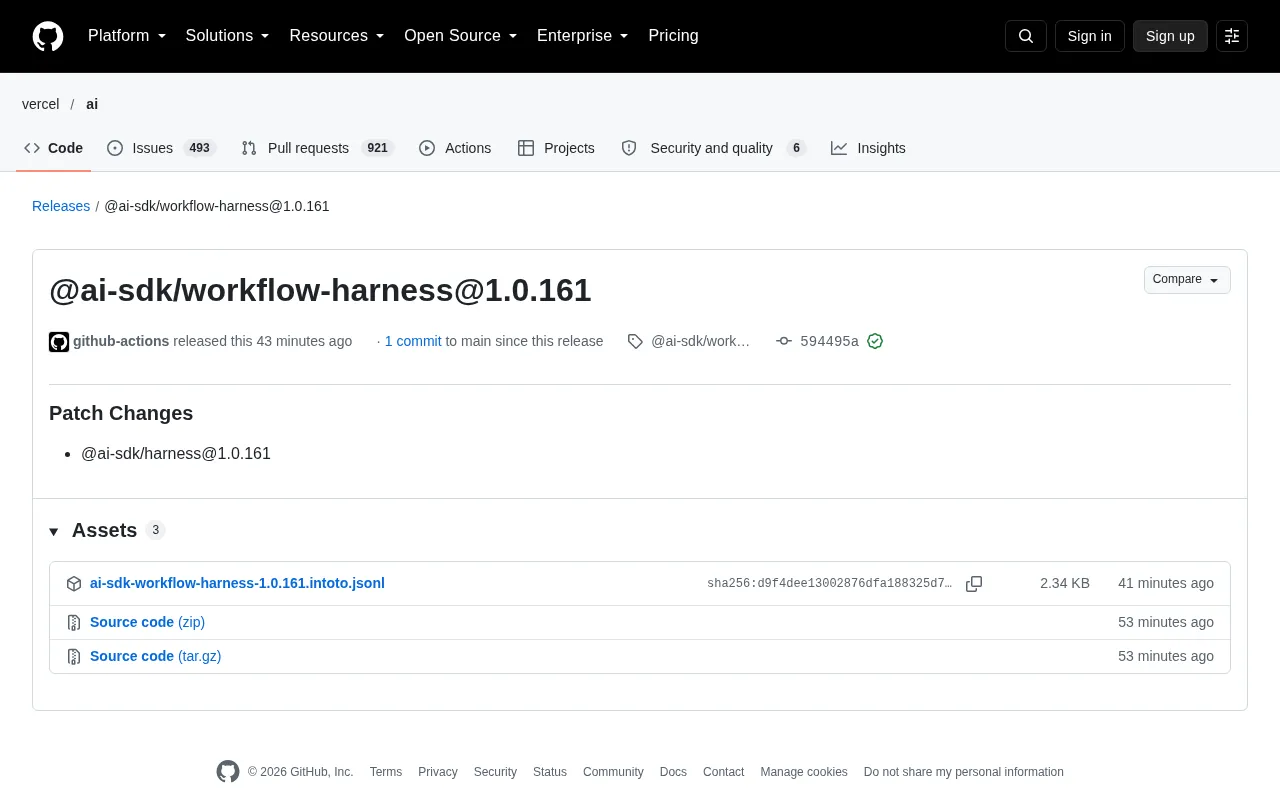
@ai-sdk/workflow-harness in the AI SDK ecosystem has released version 1.0.161, a release focused primarily on patch updates. For developers using the AI SDK to build agents and automated workflows, this kind of high-frequency iteration is itself a signal worth noting—it means the toolchain is being actively maintained, and attention to detail often determines production stability.
What's in This Release
According to the release notes on GitHub, @ai-sdk/workflow-harness@1.0.161 is a Patch Changes type release, with the internal package @ai-sdk/harness@1.0.161 upgraded in sync. The release was automated by github-actions, and the commit carries a GitHub-verified signature, indicating a standard automated release process.
Interestingly, the release notes do not list specific feature change entries, which usually means the update focuses on dependency alignment, internal refactoring, or small-scale fixes. For integrators, the upgrade cost is low, but it is still advisable to verify in a test environment that workflow execution results remain consistent.
The Role of workflow-harness in the AI SDK
workflow-harness is part of the tooling layer of the AI SDK. Its purpose is to provide a unified runtime and testing scaffold for a set of AI workflows, allowing developers to organize multiple model calls, tool calls, and conditional branches into reusable flows without rebuilding infrastructure for every project.
The value of this kind of harness package lies in "convention over configuration": it abstracts workflow orchestration, execution, and validation into standard interfaces, so that teams face a smaller change surface when switching model providers or adjusting flow logic. As AI applications move from single-turn conversations toward multi-step automation, the stability of the workflow layer will directly affect product reliability.
AI SDK is an open-source TypeScript toolkit from Vercel whose core goal is to unify the calling interface across different large model providers (such as OpenAI, Anthropic, Google, etc.) and to provide capabilities like streaming responses, tool calling, and structured output. It typically uses ai as the core package, paired with provider adapter packages such as @ai-sdk/openai and @ai-sdk/anthropic. On top of this, the AI SDK ecosystem has gradually expanded with tooling-layer packages for agents and workflows, and workflow-harness belongs to this layer. The term "harness" in software engineering generally refers to a test and runtime scaffold used to host the object under test and drive its execution, so this package's role can be understood as: providing a runnable, reproducible execution environment for multi-step AI workflows, not merely an orchestration DSL.
What High-Frequency Small Releases Mean
The version number 1.0.161 indicates that the project follows a dense small-release cadence. For an open-source AI toolchain, this cadence usually reflects two considerations: first, responding quickly to changes in upstream dependencies—model interfaces and protocols in the AI SDK ecosystem are still evolving, and the tooling layer needs to keep up; second, reducing the risk of any single upgrade through small, rapid steps, making it easier for users to pinpoint issues.
From an engineering practice perspective, frequent patch releases also require users to establish clear version pinning and upgrade strategies. It is recommended to use exact versions or lock files in package.json and to add workflow regression tests to CI, avoiding unexpected behavioral changes introduced by automatic upgrades.
Semantic Versioning (SemVer) specifies version numbers in the form major.minor.patch: a major version change indicates incompatible, breaking API changes; a minor version indicates backward-compatible new features; and a patch version contains only backward-compatible bug fixes. Therefore, a patch number like 1.0.161 itself conveys a signal of "safe to upgrade." Note, however, that Semantic Versioning is a community convention rather than an enforced standard, and in practice patch versions occasionally carry behavioral adjustments, especially in the 0.x stage or when release notes are missing. This is why the article recommends pinning versions and running regression tests—release type is only a risk indicator, not a substitute for actual verification.
How Developers Should Respond
For projects already depending on @ai-sdk/workflow-harness, this upgrade is a low-risk patch and can be handled through the normal dependency update process. Developers integrating for the first time should pay attention to its version compatibility with the AI SDK core package, keeping the entire toolchain on consistent versions to avoid interface incompatibilities caused by cross-version combinations.
Overall, this release does not bring disruptive new capabilities, but it continues the maintenance cadence of the AI SDK workflow toolchain. As AI applications become increasingly engineered, these seemingly unremarkable version updates are precisely the everyday footnotes of an ecosystem maturing.
Related articles

WebMCP Security Guide: Three Hints That Make AI Agents Safer
The Chrome team demonstrates three security hints for WebMCP tools: readOnlyHint eliminates invalid confirmation dialogs, consequentialHint forces human confirmation for high-risk operations, and untrustedContentHint defends against indirect prompt injection—improving AI agent security with one or two lines of code.

Why Turbulence Is the Hardest Problem in Fluid Mechanics — and How AI Could Crack It
Why is turbulence the hardest problem in fluid mechanics? This article, based on a Lex Fridman podcast conversation, explores turbulence's multi-scale nature, comparisons with classical thermodynamics, and how AI might simplify turbulence description by discovering coordinate transformations — examining the intersection of vortex formation with mathematics and physics.

R.L. Stine Google Talk: How the Master of Horror Ignites Kids' Passion for Reading
At a Google talk, R.L. Stine shares his accidental pivot from comedy to horror, his principles for children's horror, how phones impact storytelling, and how Goosebumps motivates kids to read.