AI SDK workflow-harness 1.0.171 Patch Released
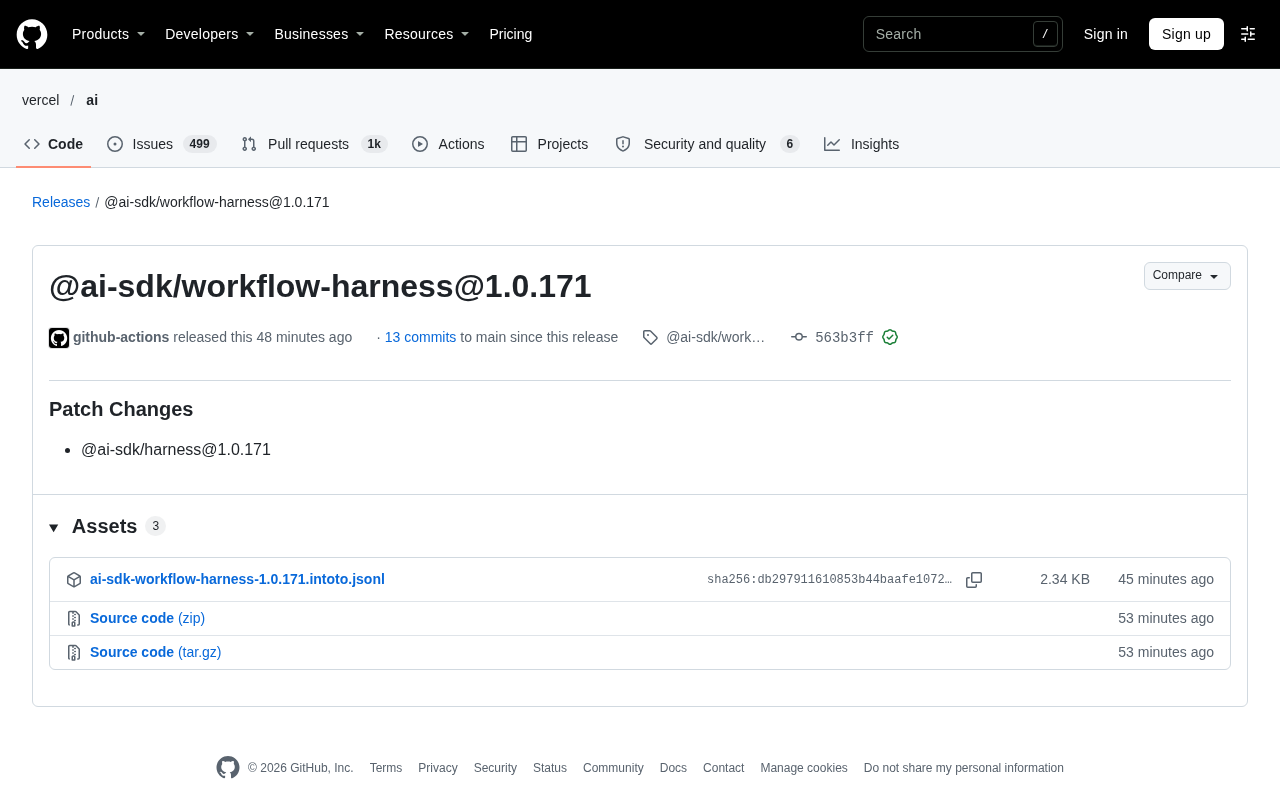
AI SDK's workflow-harness releases patch 1.0.171, iterating in sync with harness.
@ai-sdk/workflow-harness has released patch version 1.0.171, automatically published by github-actions and GPG signature verified, containing 13 commits since the previous version. The release notes are labeled Patch Changes, and the associated package @ai-sdk/harness has been updated to the same version number. The strict version synchronization reflects a common joint release strategy in monorepos: reducing dependency resolution complexity at the cost of triggering dual-package releases on any change, causing version numbers to grow quickly. Patch-level updates typically do not introduce breaking API changes, focusing on bug fixes, dependency alignment, and internal behavior adjustments, with relatively manageable risk—though custom logic depending on harness's underlying behavior still needs attention to edge-case regressions. Since this release lacks a detailed changelog, developers should examine the diffs of the 13 commits to understand specific fixes. Overall, this signal indicates that the relevant workflow abstractions are still being actively maintained and refined.
The @ai-sdk/workflow-harness package in the AI SDK ecosystem has released version 1.0.171. This is a patch update, primarily involving a synchronized version iteration of @ai-sdk/harness. For developers building workflow applications with the AI SDK, these minor version updates often determine the stability and compatibility of workflow orchestration.
Release Overview
According to the GitHub release record, @ai-sdk/workflow-harness@1.0.171 was automatically published by github-actions, with commit hash 563b3ff. It contains 13 commits since the previous version, and the commits have been verified and signed by GitHub (GPG key ID: B5690EEEBB952194). The release notes are labeled "Patch Changes", indicating a patch-level change.
From the release process perspective, this is a typical automated release: the CI bot triggers the version bump and generates the release record. This shows that the AI SDK team maintains a high iteration frequency on workflow-harness, with the patch version number having advanced to 1.0.171, reflecting that the package is in a phase of continuous maintenance and rapid fixes.
Semantic Versioning (SemVer) defines version numbers as three segments: major.minor.patch, corresponding respectively to incompatible API changes, backward-compatible feature additions, and backward-compatible bug fixes. The patch digit advancing from 0 to 171 indicates that the project has undergone numerous small, rapid-fire fixes and iterations within the 1.x major version. Complementing this is the changeset mechanism: developers declare whether a change is patch, minor, or major when submitting a PR, and CI aggregates these declarations after merging, automatically incrementing the version number and generating release notes. The github-actions automated publishing and "Patch Changes" label mentioned in the article are both products of this pipeline, which is why release records often contain only metadata without natural-language descriptions.
What the Patch Change Means
The release notes explicitly list @ai-sdk/harness@1.0.171 as an associated change. The two packages, workflow-harness and harness, maintain synchronized version numbers, suggesting they are tightly coupled in their dependency relationship; workflow-harness likely depends on harness's core capabilities to implement workflow definition, execution, or testing.
Patch-level updates typically do not introduce breaking API changes, focusing instead on bug fixes, dependency alignment, or internal behavior adjustments. For production users, the risk of such versions is relatively manageable, but it is still advisable to check whether workflow execution results meet expectations before upgrading—especially when the project relies heavily on harness's underlying behavior, where subtle patch changes may affect edge cases.
Engineering Implications of Version Synchronization
The two packages releasing version 1.0.171 in sync is a common version management strategy in monorepos. The advantage of this strategy is reduced dependency resolution complexity: when developers upgrade workflow-harness, they can be confident that the accompanying harness version has been jointly tested. The cost is that a patch in either party triggers a release of the other, causing version numbers to grow quickly.
Monorepo refers to the engineering practice of placing multiple related software packages in a single code repository for unified management, as opposed to each package having its own repository (polyrepo). Typical monorepo tools include pnpm workspace, Nx, Turborepo, and Lerna, which handle local linking between packages, build coordination, and release orchestration. In a monorepo, packages reference each other via the workspace protocol, and version numbers can be batch-incremented by tools. Common version management strategies include fixed/locked mode (all packages share one version number) and independent mode (each package determines its own version). The "two packages releasing the same version number in sync" mentioned in the article is an example of fixed mode, whose advantages are clear dependency relationships and low joint testing costs, with the drawback that version numbers advance as a whole with any package's changes.
Signature verification (in this case, GPG/SSH signed commits) is used to confirm that a code commit genuinely comes from the claimed author and has not been tampered with in transit. GitHub displays a Verified badge next to commits; the underlying mechanism is that the committer signs the commit content with a private key, and the hosting platform verifies it with the registered public key. In automated release scenarios, CI bots (such as github-actions) typically hold a separate bot identity key, and commits signed with it also show as verified. For downstream users, signature verification provides a basic supply-chain security guarantee: the released content comes from a trusted automated process rather than an impersonating third party. It is not equivalent to line-by-line review of all 13 commits, so it should still be combined with dependency locking and regression testing.
How to View This Update
Based on the available information, this release does not include detailed changelog entries, only the Patch Changes label and the associated package version. This is not uncommon in actual development—records generated by automated release pipelines often contain only metadata. Developers who need to understand the specific fixes should further examine the diffs of those 13 commits.
For teams focused on AI SDK workflow capabilities, the real value of this release is confirmation that the project is still actively maintained. Combined with the AI SDK's overall evolution in tool calling, multi-step agents, and workflow orchestration, the continuous patch updates to workflow-harness indicate that the relevant abstractions are being actively used and refined.
Upgrade Recommendations
If your project has locked the workflow-harness version, it is recommended to first verify compatibility of 1.0.171 with existing workflow definitions in a test environment, and merge only after confirming no regressions. Since this is a patch version, business code usually requires no changes, but custom logic that depends on harness's internal behavior deserves extra attention.
For teams not yet using this package, workflow-harness can be considered a candidate tool for AI SDK workflow testing and orchestration; evaluate its fit with your existing tech stack against the official documentation. Rapid version iteration is both a signal of activity and a reminder for users to establish solid dependency locking and upgrade regression processes.
Related articles

Skykea Showdown: A Hilarious Variety Show Experience of a Minecraft Airship Building Competition
Skykea Showdown is a Minecraft airship building racing variety show. This article analyzes its two-phase build + hole race format, airship mod lift physics, secret mission design, and team confrontation dynamics—ideal for game content creators.

Did the US Midterms Vote No to AI Data Centers? A Map Reveals the Truth
After the US midterms, media claimed voters rejected AI data centers, but a map shows restrictive votes are concentrated in a few Ohio townships, affecting less than 1% of US towns—the national anti-AI wave is exaggerated.

ApexW Optimizer Benchmark: Matches 8-bit AdamW in Unsloth with Lower Memory Usage
Developer shares benchmark of ApexW optimizer in Unsloth: ApexW 8bit has lower optimizer state memory (47.101 MB) and slightly better final loss than 8-bit AdamW, but similar speed. Needs independent reproduction.