@ai-sdk/workflow-harness 1.0.175 Patch Update Analysis
AI SDK workflow package 1.0.175 only syncs dependencies, highlighting key dependency governance points under high-frequency patches.
`@ai-sdk/workflow-harness` released patch version 1.0.175, with the core change being only a dependency update to specified commits, while the related package `@ai-sdk/harness` was upgraded to the same version, with no new APIs or execution logic adjustments. The article points out that such patch upgrades carry extremely low risk, but reflect the maintenance pattern of the AI SDK ecosystem: high-frequency small-step releases, tightly coupled dependency chains, and automated signatures. For developers, the two packages should be upgraded as a pair to avoid version mismatch, and it is recommended to keep workflow regression tests in CI. For dependency governance, `@ai-sdk/*` should be treated as a single version unit for unified upgrades, attention should be paid to transitive dependency changes in patches, and dependency sync should be treated as continuous engineering rather than a one-time task.
The workflow-harness package in the AI SDK ecosystem has released patch version 1.0.175. On the surface, this version appears to be just a routine dependency sync, but for developers building workflow applications with the Vercel AI SDK, it reveals an important signal about package management strategy and dependency governance.
Patch Contents: Dependency Sync, Not Feature Changes
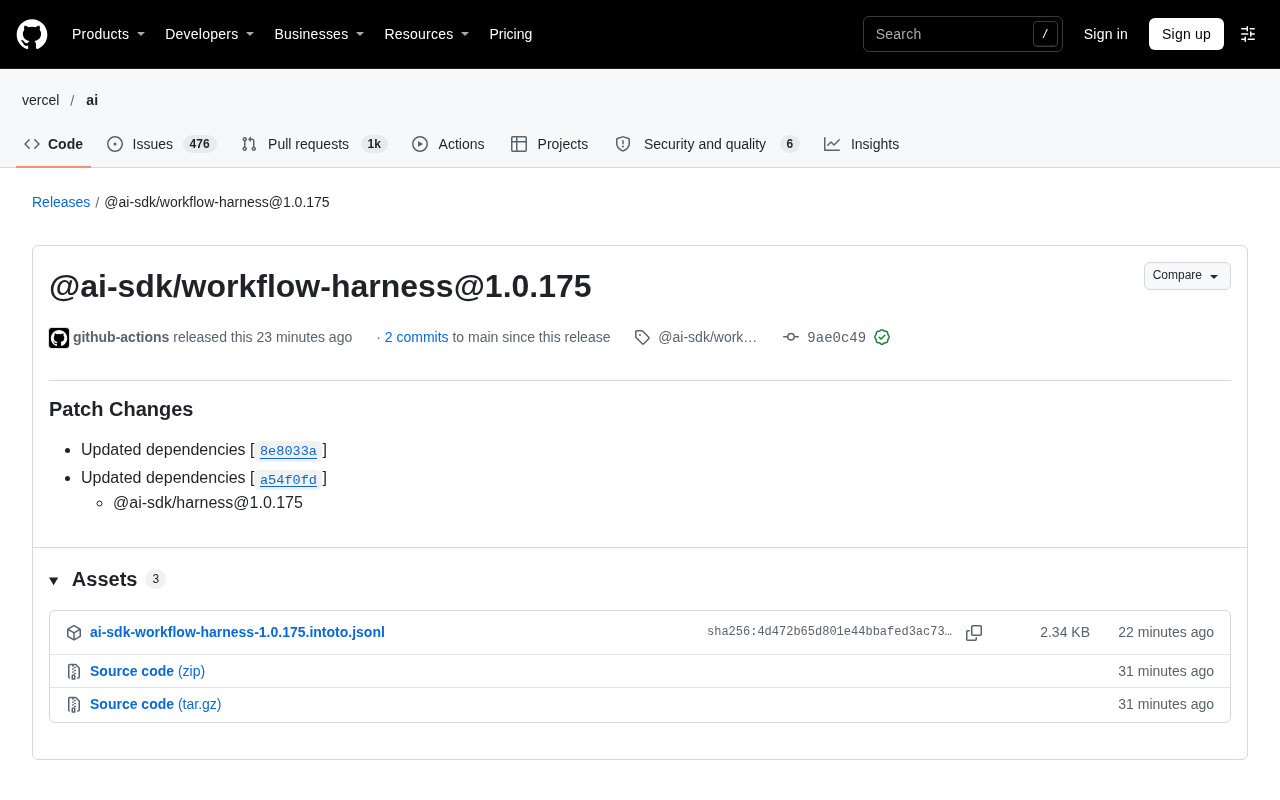
According to the release notes, the core changes in @ai-sdk/workflow-harness@1.0.175 are just two: updating dependencies to the versions corresponding to 8e8033a and a54f0fd. At the same time, the related package @ai-sdk/harness was also synced to 1.0.175.
This means the release introduced no new APIs, made no changes to workflow execution logic, and adjusted no configuration options. The version number stayed at the patch position, consistent with the nature of the change. For production projects that have pinned their versions, the upgrade risk is extremely low; for projects using ^ or ~ range dependencies, this update will be pulled automatically.
Judging from the release cadence, this package has released consecutive patch versions in a short period, indicating that upstream dependencies are still iterating rapidly. As the workflow orchestration layer, workflow-harness's stability depends directly on how well the underlying harness and AI SDK core packages work together, so keeping dependencies in sync is a necessary maintenance action.
Semantic Versioning (SemVer) is the prerequisite for understanding the nature of this release. SemVer specifies the version number format as major.minor.patch, where an increment in the patch position indicates a backward-compatible bug fix that introduces no new features or breaking changes. workflow-harness staying at the patch position of 1.0.175 exactly corresponds to a maintenance change like "dependency update only" that does not alter the public API. For projects using a ^1.0.175 range dependency, the package manager will allow automatic upgrades to any 1.x.x version, so patch updates are usually pulled silently; projects using exact versions or lockfile pinning are unaffected. Understanding this helps determine whether a release requires manual review.
The 8e8033a and a54f0fd mentioned in the notes are Git commit short SHAs, not version numbers. In monorepo or internal dependency scenarios, packages often lock upstream code by "pointing to a commit," a practice called commit pinning. Its advantage is precisely reproducing builds and avoiding drift from unpublished upstream changes; the cost is poor readability, and you cannot tell directly from the changelog what changed. When dependencies are recorded as commit hashes, understanding the specific changes requires looking back at the commit diff in the corresponding repository—which is why this release's changelog only describes it as "updating dependencies" without elaborating on details.
Practical Impact on Developers
If you are building multi-step agents or workflow applications with the AI SDK, this update will not change how you write your code. But there are a few details worth noting.
First, @ai-sdk/harness and workflow-harness keep consistent version numbers (both 1.0.175). This alignment strategy makes it easy for developers to judge compatibility—the two packages should be upgraded as a pair to avoid runtime behavior differences caused by version mismatch.
Second, the dependency update commit was completed automatically by GitHub Actions with a verified signature, indicating that the release process has been automated. Such patches usually follow upstream security fixes or internal refactoring. Even if the changelog does not elaborate on details, it is recommended to run a workflow regression test in CI before merging.
Third, if your project has pinned an older version via lockfile, you can proactively perform a dependency update to ensure synchronization with other packages in the ecosystem (especially @ai-sdk/harness).
Verified signature refers to a commit or artifact carrying a cryptographically verified signature, usually completed automatically by GitHub in an Actions workflow with a short-lived token, and displayed with a "Verified" badge in the interface. It proves that the commit was indeed produced by the specified CI pipeline and that its contents have not been tampered with, rather than being manually pushed from some local environment. For packages that rely on automated releases, the signature is part of supply chain security: combined with the lockfile's integrity hash, it can verify at install time that the downloaded tarball matches what was published, reducing the risk of dependency poisoning and man-in-the-middle substitution. Teams can incorporate signature verification into their dependency admission policy.
Lessons for Dependency Governance
From this release, we can see the maintenance pattern of AI SDK-related packages: high-frequency small-step patches, tightly coupled dependency chains, and automated releases. For teams relying on this kind of rapidly evolving toolchain, it is recommended to establish three habits.
First, treat the @ai-sdk/* series as a single version unit and handle upgrades together, rather than upgrading an individual sub-package separately. Second, pay attention to dependency changes in patch versions, because problems in workflow libraries often come from transitive dependencies rather than direct APIs. Third, keep workflow end-to-end tests in CI; although patch updates carry low risk, changes in the dependency chain can still affect execution results.
This 1.0.175 itself has no story; it is more like a reminder: in the phase of rapid iteration of AI application toolchains, dependency sync is continuous engineering, not a one-time task.
Transitive dependency refers to a package that is not directly declared by you but is indirectly introduced by a direct dependency. Problems in workflow libraries often occur at this layer: the direct API is stable, but changes in the behavior of the underlying harness or SDK core packages it references can affect execution results. When troubleshooting, you can use npm ls <package-name> or pnpm why <package-name> to locate who introduced a dependency, and use a lockfile diff to compare changes in the transitive dependency tree before and after an upgrade. This also explains why it is recommended to treat @ai-sdk/* as a single version unit—unified upgrades keep the transitive dependency tree consistent and avoid runtime differences caused by mismatched parent and child package versions.
One-line Summary
AI SDK workflow package 1.0.175 only syncs dependencies, highlighting key dependency governance points under high-frequency patches.
Paragraph Summary
@ai-sdk/workflow-harness released patch version 1.0.175, with the core change being only a dependency update to specified commits, while the related package @ai-sdk/harness was upgraded to the same version, with no new APIs or execution logic adjustments. The article points out that such patch upgrades carry extremely low risk, but reflect the maintenance pattern of the AI SDK ecosystem: high-frequency small-step releases, tightly coupled dependency chains, and automated signatures. For developers, the two packages should be upgraded as a pair to avoid version mismatch, and it is recommended to keep workflow regression tests in CI. For dependency governance, @ai-sdk/* should be treated as a single version unit for unified upgrades, attention should be paid to transitive dependency changes in patches, and dependency sync should be treated as continuous engineering rather than a one-time task.
Related articles
 Tech Frontiers
Coldframe: A Honeypot Disguised as a Supermarket Freezer Controller
Coldframe is a honeypot disguised as Danfoss AK-SM 800A and Dixell XWEB freezer controllers, built as a single Python file that detects CVE-2025-41450 attempts and is identified as real devices on Shodan.
 Tech Frontiers
GRFNet: A Lightweight PyTorch Model Designed for Multichannel Time-Series Classification
GRFNet is a lightweight PyTorch model for multichannel time-series classification, originating from EEG decoding research. With only 3,847 parameters, it is based on the ROCKET architecture, combining random convolution kernels with learnable spatial filters, supports arbitrary input lengths, and will soon be evaluated on the PhysioNet dataset.
 Tech Frontiers
CUDA-Accelerated Rocket League Simulator: A Player-Made Hardcore Experiment
A Reddit post shows a "100% Accurate" Rocket League simulator accelerated with CUDA. We analyze its technical context, CUDA's value in game physics simulation, and the significance and limitations of such community projects.