@ai-sdk/workflow-harness 1.0.196 Released: Workflow Orchestration Capabilities Upgraded Again
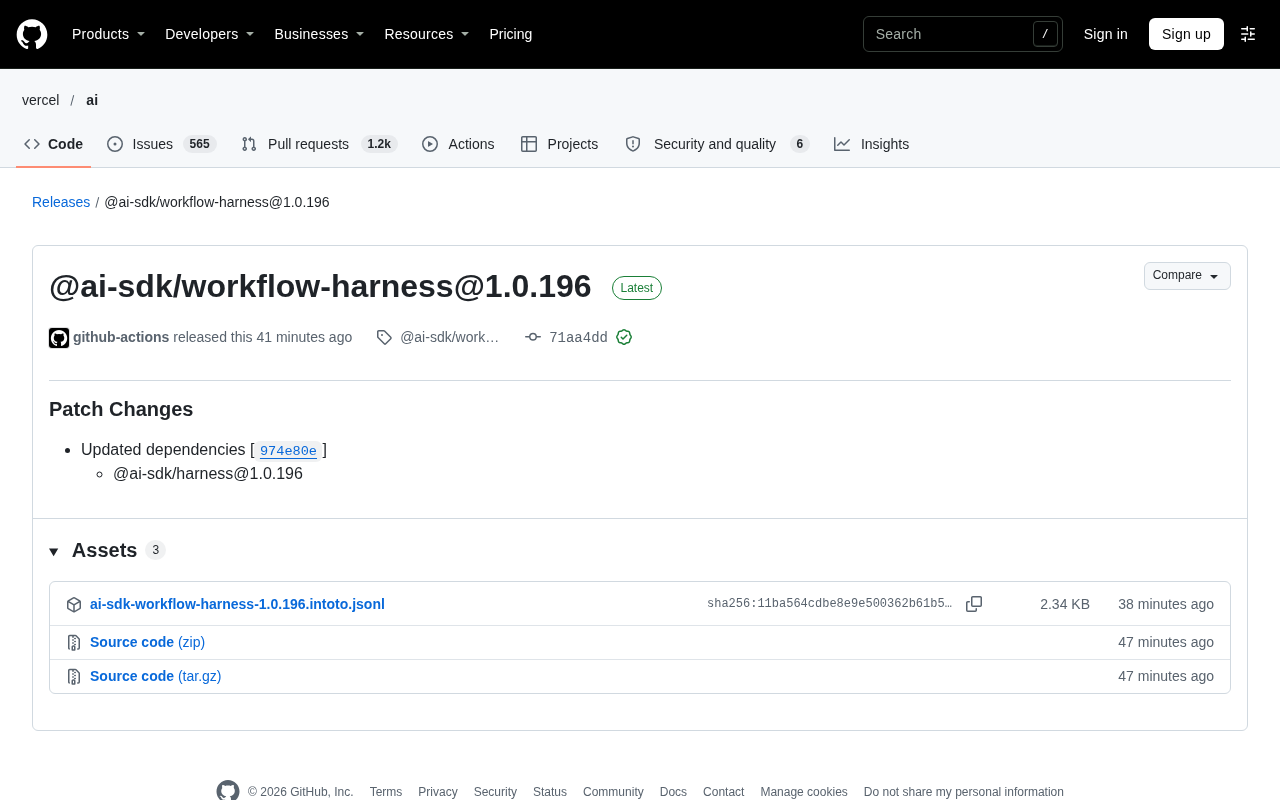
@ai-sdk/workflow-harness releases 1.0.196 patch, synchronously upgrading the underlying harness dependency.
The @ai-sdk/workflow-harness in the AI SDK ecosystem has released version 1.0.196, a patch-level update. The core change is synchronously upgrading the `@ai-sdk/harness` dependency to 1.0.196, ensuring version consistency between the workflow orchestration layer and the underlying execution layer, and avoiding compatibility issues caused by version misalignment. The release was automatically completed by GitHub Actions on November 27, with the commit carrying a verified signature, indicating a standardized process. This update does not introduce new APIs or breaking changes, and the upgrade risk is low, with the main benefit coming from the propagation of fixes in the underlying harness. The article recommends that developers first verify existing workflows in a test environment, and after confirming no regressions, synchronize to the production environment. It also notes that the package adopts a high-frequency small-version iteration strategy, and continuously tracking patches helps maintain toolchain health.
The @ai-sdk/workflow-harness package in the AI SDK ecosystem has released version 1.0.196. According to the GitHub Release page, this update is a patch-level change, with the core modification being an update to the @ai-sdk/harness dependency to version 1.0.196. For developers relying on this workflow orchestration tool, this means the fixes and improvements in the underlying harness module will take effect accordingly.
Update Details
From the Release record, the change type for this release is marked as Patch Changes. The commit message indicates that this update primarily revolves around a dependency upgrade, referencing a specific commit (974e80e) that synchronizes the @ai-sdk/harness version to 1.0.196. This kind of dependency synchronization is common in monorepo projects, typically to ensure that the workflow layer and the underlying execution layer maintain consistent versions and avoid compatibility issues caused by version misalignment.
GitHub Actions automatically completed this release on November 27 at 23:27. The commit record carries GitHub's verified signature, indicating that the release process is a standardized automated pipeline. For teams using this package, upgrading to 1.0.196 is a low-risk operation, with the main benefit coming from the propagation of fixes in the dependency chain.
monorepo refers to a project organization approach where multiple interrelated software packages are managed together in a single code repository. In ecosystems like the AI SDK, @ai-sdk/workflow-harness and @ai-sdk/harness are typically located under the same monorepo, each releasing version numbers independently but sharing build, test, and release pipelines. The direct benefit is that after the underlying package is fixed, the upper-layer package can quickly follow up with a single dependency synchronization without cross-repository coordination. The trade-off is that version alignment becomes especially important—if the upper-layer package locks an outdated underlying version, it may introduce already-fixed defects; if the version misalignment is too large, compatibility issues may arise from inconsistent internal interface assumptions. Therefore, monorepo projects commonly adopt a "synchronized version bump" practice, keeping the workflow layer and execution layer at the same version number to reduce troubleshooting complexity.
Patch Changes are the lowest-level changes in semantic versioning (SemVer), corresponding to an increment of the third digit of the version number, such as 1.0.195 to 1.0.196. According to SemVer conventions, patch versions should only contain backward-compatible bug fixes, security patches, or internal implementation adjustments, and should not add new public APIs or change existing behavioral contracts. Therefore, when upgrading patch versions, dependents theoretically do not need to modify business code—only update the lock file and reinstall dependencies. However, in practice, attention is still needed: patch versions may indirectly change the versions of transitive dependencies, or fix certain "accidental behaviors" that were previously relied upon. Although such cases do not constitute breaking changes, they may expose problems in code that depends on the old behavior—which is also why the article recommends verifying in a test environment first.
Practical Impact on Developers
If you are using @ai-sdk/workflow-harness to build AI workflows, this update will not introduce new APIs or breaking changes—the nature of a patch version means it is more about propagation of stability and fixes. What is truly worth paying attention to is the changes included in @ai-sdk/harness 1.0.196, because workflow orchestration capabilities ultimately depend on the harness's execution logic.
The recommended approach is: upgrade in a test environment first, verify that existing workflows run properly, and after confirming no regressions, synchronize to the production environment. Since it is a patch update, upgrading can be completed by updating the lock file and reinstalling dependencies, without modifying business code.
Version Strategy and Ecosystem Observations
From the version number 1.0.196, it can be seen that this package adopts a high-frequency small-version iteration strategy, with each patch version corresponding to an independent fix or dependency synchronization. This release cadence is fairly typical in AI infrastructure libraries, aimed at quickly responding to changes in underlying modules so that upper-layer workflow capabilities are always based on the latest fixes.
For developers following the AI SDK ecosystem, continuously tracking such patch releases helps maintain the health of the toolchain. Although the information content of a single patch is limited, cumulatively it reflects the project's maintenance activity and emphasis on stability.
One-line Summary
@ai-sdk/workflow-harness releases 1.0.196 patch, synchronously upgrading the underlying harness dependency.
Paragraph Summary
The @ai-sdk/workflow-harness in the AI SDK ecosystem has released version 1.0.196, a patch-level update. The core change is synchronously upgrading the @ai-sdk/harness dependency to 1.0.196, ensuring version consistency between the workflow orchestration layer and the underlying execution layer, and avoiding compatibility issues caused by version misalignment. The release was automatically completed by GitHub Actions on November 27, with the commit carrying a verified signature, indicating a standardized process. This update does not introduce new APIs or breaking changes, and the upgrade risk is low, with the main benefit coming from the propagation of fixes in the underlying harness. The article recommends that developers first verify existing workflows in a test environment, and after confirming no regressions, synchronize to the production environment. It also notes that the package adopts a high-frequency small-version iteration strategy, and continuously tracking patches helps maintain toolchain health.
Related articles

Why Learn Python in the AI Era? A Deep Dive with the Author of 'Python Crash Course'
Eric Matthes, author of 'Python Crash Course', discusses why Python remains essential in the AI era, the democratization and risks of AI coding tools, and the value of human creators.

Convex Skill Allegedly Uploads User App Ideas to Remote Servers Without Consent
Convex backend skill allegedly sends user app ideas to remote servers without disclosure, sparking Hacker News debate. We analyze the privacy risks and transparency issues.

The Coding Data Market Booms: How Frontier Labs Buy Training Data
The coding data market is rapidly expanding, with frontier labs as major buyers. This article analyzes the types of data traded, labs' procurement logic, and concerns such as licensing compliance and data contamination.