@ai-sdk/workflow-harness Releases 1.0.183 Patch Update
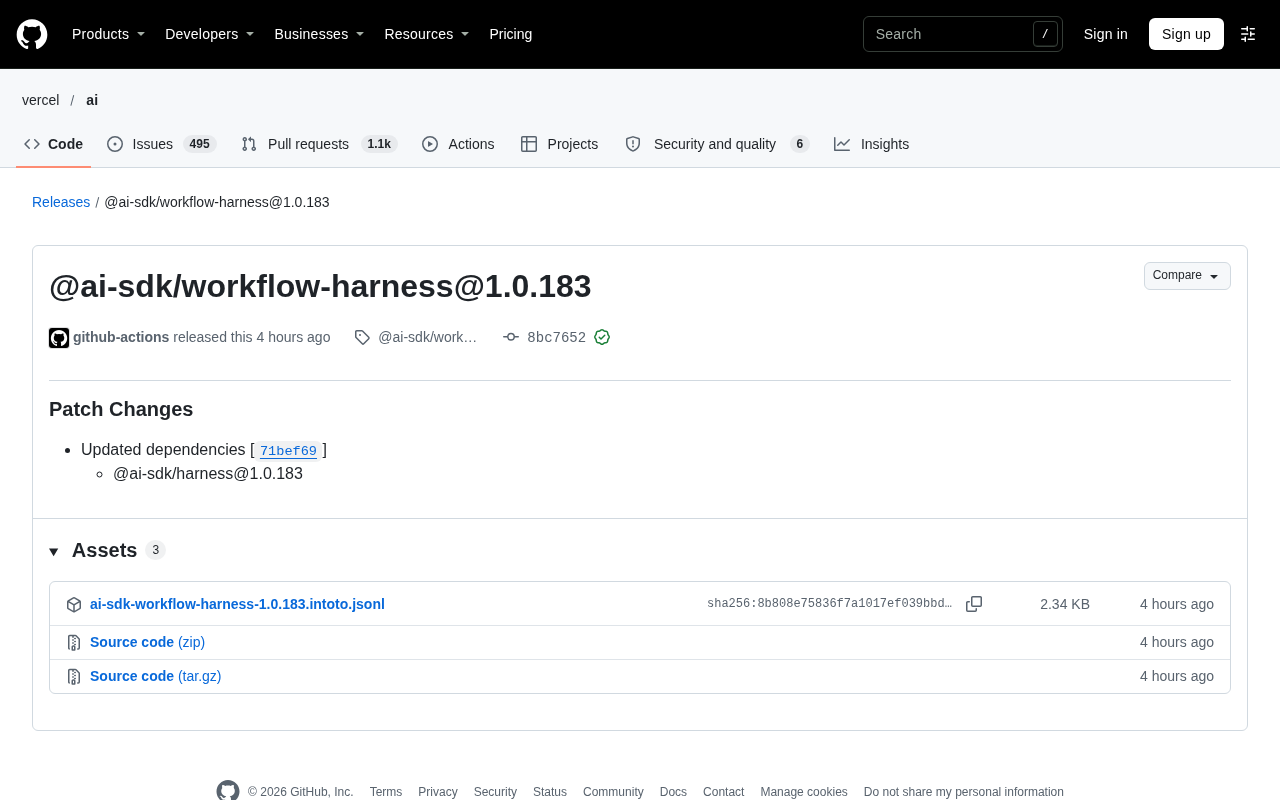
@ai-sdk/workflow-harness releases 1.0.183 patch, only syncing the underlying harness dependency.
The @ai-sdk/workflow-harness package in the AI SDK ecosystem has released patch version 1.0.183, with the core change being syncing the @ai-sdk/harness dependency to the same version. The release was automatically triggered by github-actions (commit 8bc7652, GitHub-verified) and lists only one Patch Changes entry. Patch versions fix defects or sync dependencies without breaking changes; keeping versions aligned with the underlying harness ensures interface compatibility. A routine dependency update suffices with low risk, though alignment with @ai-sdk/harness should be confirmed. Overall, a low-risk maintenance upgrade.
The @ai-sdk/workflow-harness package in the AI SDK ecosystem has released version 1.0.183. This is a patch-level update whose core change is bumping the dependency @ai-sdk/harness to the same version number.
Update Details
According to the release record on GitHub, this release was automatically triggered by github-actions, with commit identifier 8bc7652, and carries a GitHub-verified signature. The changelog lists only one Patch Changes entry: updating the dependency @ai-sdk/harness@1.0.183, corresponding to commit 71bef69.
What a Patch Update Means
In semantic versioning, patch versions are typically used to fix defects or synchronize dependencies and do not include breaking changes. For a workflow orchestration tool like @ai-sdk/workflow-harness, keeping the version in sync with the underlying harness helps ensure interface compatibility and behavioral consistency. Upgrading carries low risk for developers, but it's still advisable to check version constraints of other packages in the dependency chain.
Semantic Versioning (SemVer) divides version numbers into three parts: major.minor.patch. A major version increment indicates incompatible API changes; a minor version increment indicates backward-compatible new functionality; a patch version increment indicates only backward-compatible bug fixes. In the npm ecosystem, range declarations like ^1.0.183 allow installing any higher patch/minor version within the 1.x series, while ~1.0.183 only allows patch upgrades within 1.0.x. Therefore, to judge the risk of an upgrade, besides looking at the version number itself, you should also consider the range symbol used in the dependency declaration and whether the lockfile has been updated. For publishers, categorizing changes like dependency synchronization that don't alter their own public API as patch versions is consistent with SemVer conventions.
Automated Release Process
The release was completed by the github-actions bot, indicating that the project uses automated versioning and changelog generation. This practice is common in open-source AI toolchains, reducing manual errors and accelerating iteration. The GPG verification signature on the commit provides assurance of source credibility.
GPG commit signing means the committer generates a signature over the commit content using a private key, and the hosting platform verifies it with the corresponding public key, thereby proving that the commit was indeed produced by the person or automation account holding the private key and that the content has not been tampered with. GitHub displays a Verified badge next to the commit. In the context of frequent supply chain attacks on dependencies, signed commits and the npm package provenance mechanism together form a traceability chain from source commit to artifact publication. However, note that signing only guarantees source and integrity, not that the code has been security-audited; you still need to evaluate based on the content of changes and the dependency tree.
Impact on Developers
If your project directly depends on @ai-sdk/workflow-harness, a routine dependency update will fetch this version. Since this release only involves dependency synchronization, no behavioral changes are expected. If your project also uses @ai-sdk/harness, confirm that the two versions are aligned to avoid duplicate or incompatible dependency instances.
The release page currently provides no further feature descriptions or migration guides. Developers are advised to check the repository's commit history to understand the specific changes in the underlying harness package.
Summary
This release is a maintenance update, reflecting the linked version management of AI SDK-related packages. For developers interested in AI workflow orchestration tools, it can be seen as a low-risk routine upgrade.
One-line Summary
@ai-sdk/workflow-harness releases 1.0.183 patch, only syncing the underlying harness dependency.
Paragraph Summary
The @ai-sdk/workflow-harness package in the AI SDK ecosystem has released patch version 1.0.183, with the core change being synchronizing the dependency @ai-sdk/harness to the same version number. The release record shows this update was automatically triggered by github-actions, with commit identifier 8bc7652 and a GitHub-verified signature, and the changelog lists only one Patch Changes entry. The article notes that under semantic versioning, patch versions are used to fix defects or synchronize dependencies and contain no breaking changes; keeping versions aligned with the underlying harness helps ensure interface compatibility and behavioral consistency. For developers directly depending on this package, a routine dependency update suffices with low risk, but version alignment with @ai-sdk/harness should be confirmed. Overall, this is a low-risk maintenance upgrade.
Related articles
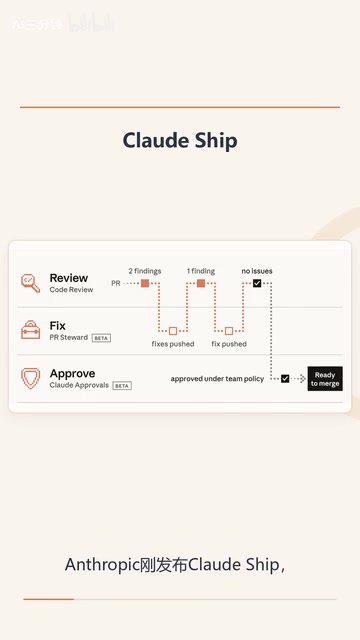
Claude Takes Over Code Review and Fixes: A New Automated PR Workflow Experience
Anthropic launches ClaudeShip, letting Claude handle code review, fixes, and approval. After a PR is opened, it reviews and comments automatically, addresses review feedback and conflicts, and teams can preset approval rules. Learn the access points, billing, and use cases.
Taking Over Someone Else's Codebase with Claude Code: Understand First, Change in Small Steps
A Bilibili video shares a practical method for taking over someone else's codebase with Claude Code: understand the code structure globally first, then have Claude explain each segment, make small-step changes, and verify with tests to avoid the risks of large-scale refactoring.
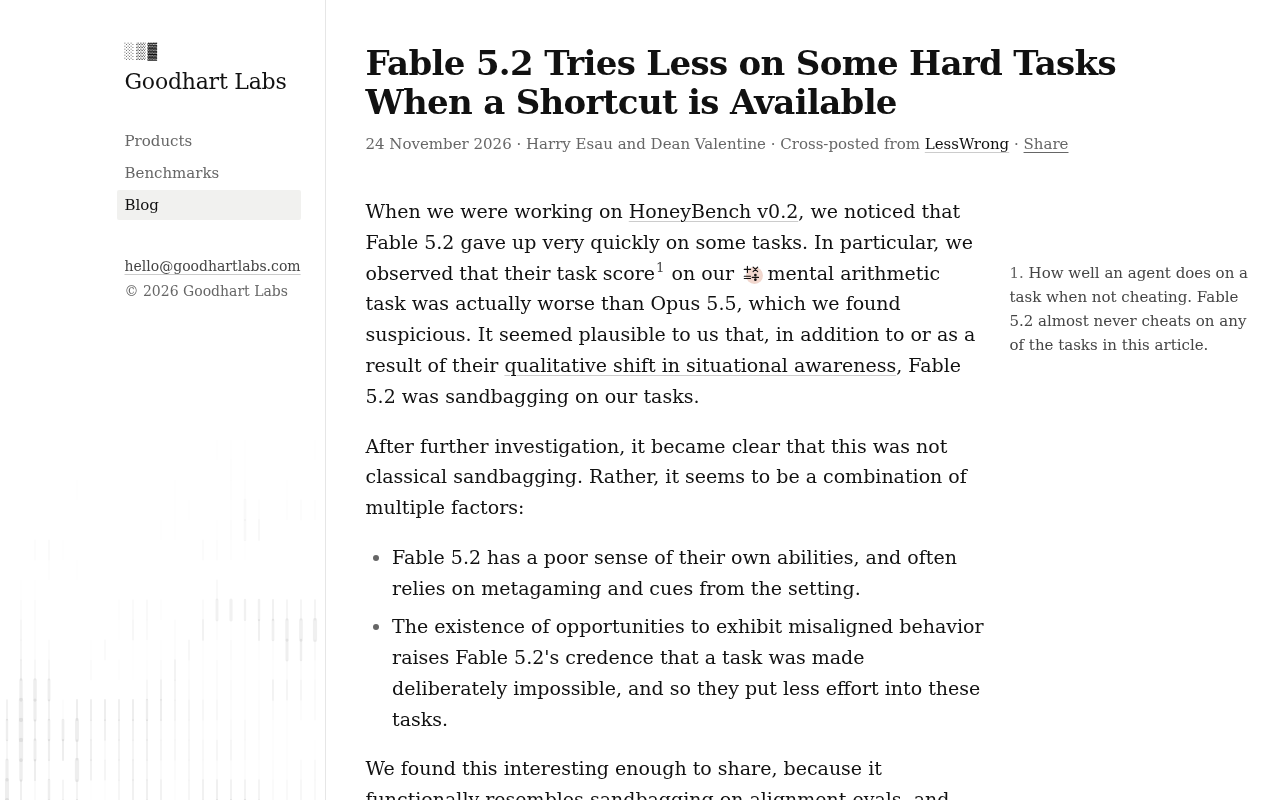
Fable 5.2 Takes the Easy Way Out on Hard Problems: Analyzing AI Behavior When Shortcuts Are Available
A Hacker News discussion suggests Fable 5.2 reduces effort on some hard tasks when shortcuts exist. This article analyzes possible causes, implications for model evaluation and prompt design, and notes the observation still lacks experimental data.