AI SDK Workflow Harness Version 1.0.195 Released
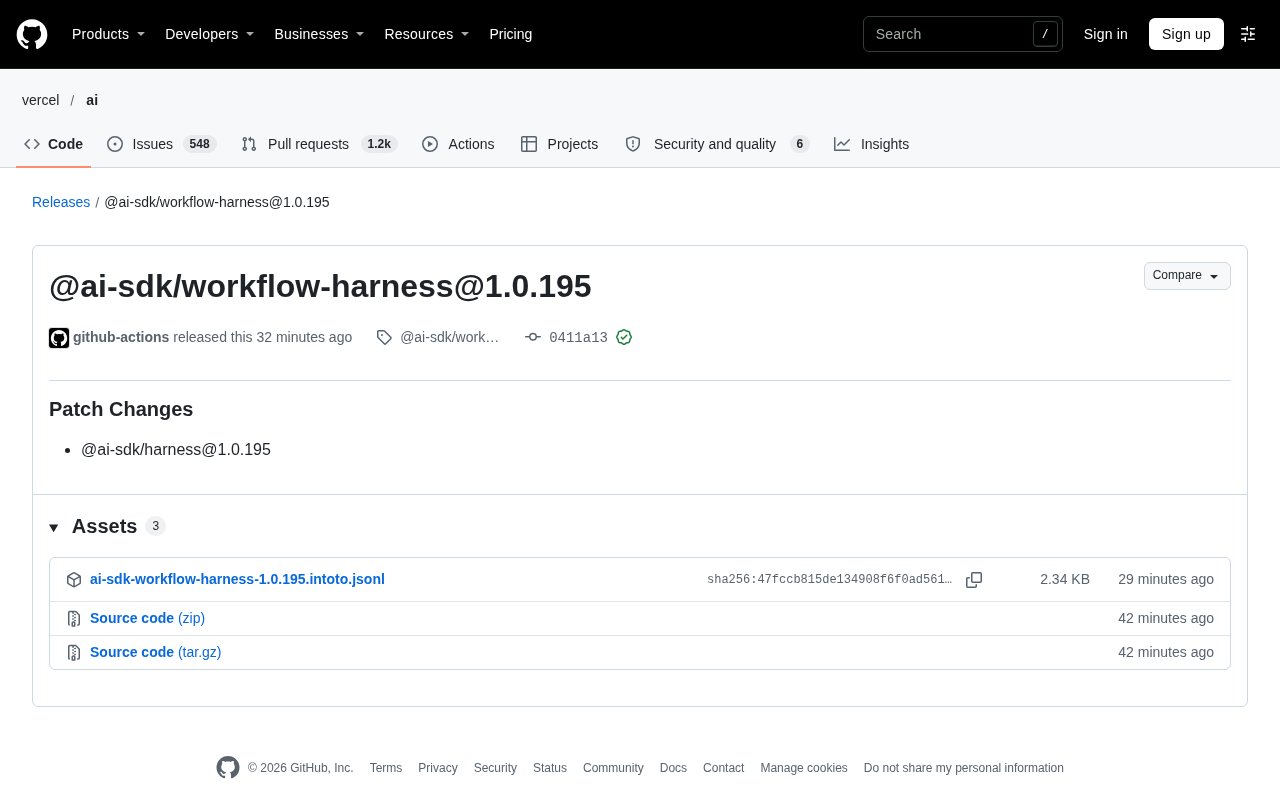
@ai-sdk/workflow-harness releases 1.0.195 patch, synced with the core package and safe to upgrade.
The @ai-sdk/workflow-harness package in the AI SDK ecosystem has released version 1.0.195, a standard patch update auto-built by CI with a GitHub-verified signature. The release notes label it "Patch Changes" and link it to the core package @ai-sdk/harness@1.0.195, with both released in sync at the same version to help developers align dependencies and reduce compatibility issues. Under semantic versioning, a patch typically covers only bug fixes, documentation tweaks, or internal dependency updates—no breaking changes or new APIs. Projects with pinned version ranges can upgrade smoothly but should run existing workflow tests afterward to confirm consistent behavior; projects not yet using the toolkit can treat it as a reference entry point for AI SDK workflow orchestration.
A low-key patch release that still nudges workflow capabilities forward
The @ai-sdk/workflow-harness package in the AI SDK ecosystem has released version 1.0.195. According to the GitHub release record, this is a standard patch update, auto-published by github-actions and carrying a GitHub-verified signature. Updates like this typically don't involve breaking changes—they're more about patching existing capabilities and improving stability.
For developers building agent workflows with the AI SDK, the value of these small version iterations is that they keep the toolkit evolving steadily while minimizing the risk that comes with upgrading.
Version Details and Scope of Changes
What "Patch Changes" Means
The release notes label this update as "Patch Changes" and link it to the core package @ai-sdk/harness@1.0.195. Under semantic versioning conventions, a patch-level release usually corresponds to bug fixes, documentation adjustments, or internal dependency updates—it does not include new features or API changes.
The GitHub release page also includes 3 assets for developers to download as needed. The signature information shows that this version was automatically built by a trusted CI pipeline, with a traceable origin.
Semantic Versioning (SemVer) is a widely adopted versioning convention with the format major.minor.patch (e.g., 1.0.195). A major version change indicates incompatible API modifications, a minor version change indicates backward-compatible feature additions, and a patch change is used only for backward-compatible bug fixes. Package managers and dependency resolvers in the npm ecosystem use this convention to automatically select version ranges that can be safely upgraded—for example, ^1.0.195 allows upgrading to any 1.x patch or minor version. So labeling a release as "Patch Changes" is effectively a promise to dependents: this upgrade won't break existing calls. That said, the promise relies on maintainers strictly following the convention, and in practice developers are still advised to verify behavioral consistency through test cases. "Changesets" is a commonly used version management and release tool that automatically generates the corresponding version number and release notes based on the type of committed changes—the automated release pipeline described in this article is very likely built on something like this.
Coupling with the Core harness Package
workflow-harness releases with the same version number as harness, indicating that the two are tightly coupled in their release cadence. This synchronized strategy helps developers align dependency versions and reduces compatibility issues caused by version mismatches.
Monorepo is an engineering practice that manages multiple interrelated packages within a single code repository. In a monorepo, packages typically share build configurations, testing tools, and release pipelines, and rely on tools like pnpm workspace, Turborepo, or Nx for dependency management and task orchestration. When multiple packages need to be released at the same time and kept at consistent versions, a monorepo can significantly reduce the cost of version alignment: a single release process can generate the same version number for all affected packages. The fact that workflow-harness and harness release with the same version number is a typical example of this pattern. Note that synchronized same-version releases also mean that a patch to any one package will trigger new releases for the others, so dependents should pay attention to whether their transitive dependencies have changed when upgrading.
Practical Impact for Developers
Upgrade Recommendations
If your project already pins a version range for @ai-sdk/workflow-harness, patch updates can usually be applied smoothly. After upgrading, it's recommended to run your existing workflow test cases to confirm behavioral consistency. For projects that haven't adopted the toolkit yet, it can serve as a reference entry point for AI SDK workflow orchestration capabilities.
Summary
This update doesn't bring any conspicuous new features, but it continues the maintenance rhythm of the AI SDK toolchain. For AI application developers who rely on workflow orchestration, keeping an eye on patch releases like this helps you catch fixes in time and maintain dependency health.
Related articles

Satirical Viral Hit "Rich Girl's Christmas Haul": A Consumption Frenzy or an Isolated Case?
A Bilibili satirical rich-girl Christmas haul video sparks debate. This article breaks down the consumption symbols in its gift list, analyzes the blurred line between showing off and gratitude, and explores the narrative template of wealth-flaunting content on platforms and its impact on teenagers' wealth perception.

Before You Get Your Ears Pierced: A Professional Piercer Explains Placement, Pain, and Aftercare
A professional piercer explains the full ear piercing process: why a max of three per session, pain ratings and healing times by location, 18K gold vs. pure silver, hollow needles vs. piercing guns, and aftercare.

Follow the Light: How Light-Triggered ASMR Commands Your Attention
Analyzing Bilibili creator Veda's command-based ASMR video: how pen light and otoscope use visual tracking commands to command attention, upgrading sound relaxation into an interactive attention game, and what it means for immersive content creation.