AI SDK Workflow Testing Tool Releases 1.0.159 Patch Update

AI SDK's workflow-harness releases 1.0.159 patch, only synchronously upgrading the underlying harness package.
@ai-sdk/workflow-harness in Vercel's AI SDK ecosystem has released patch version 1.0.159, with the core change being only the synchronous upgrade of the underlying @ai-sdk/harness dependency to the same version number, introducing no new APIs or features. This version was automatically generated by GitHub Actions and carries a GPG signature, representing routine coordinated maintenance under the monorepo's shared version cadence. workflow-harness is used to locally simulate and validate multi-step AI workflows, and the harness update may involve corrections to test runtime behavior. Since the release notes do not detail the fixes, review commit e6230e4's diff before upgrading; projects with high stability requirements can lock the current version and batch-upgrade later.
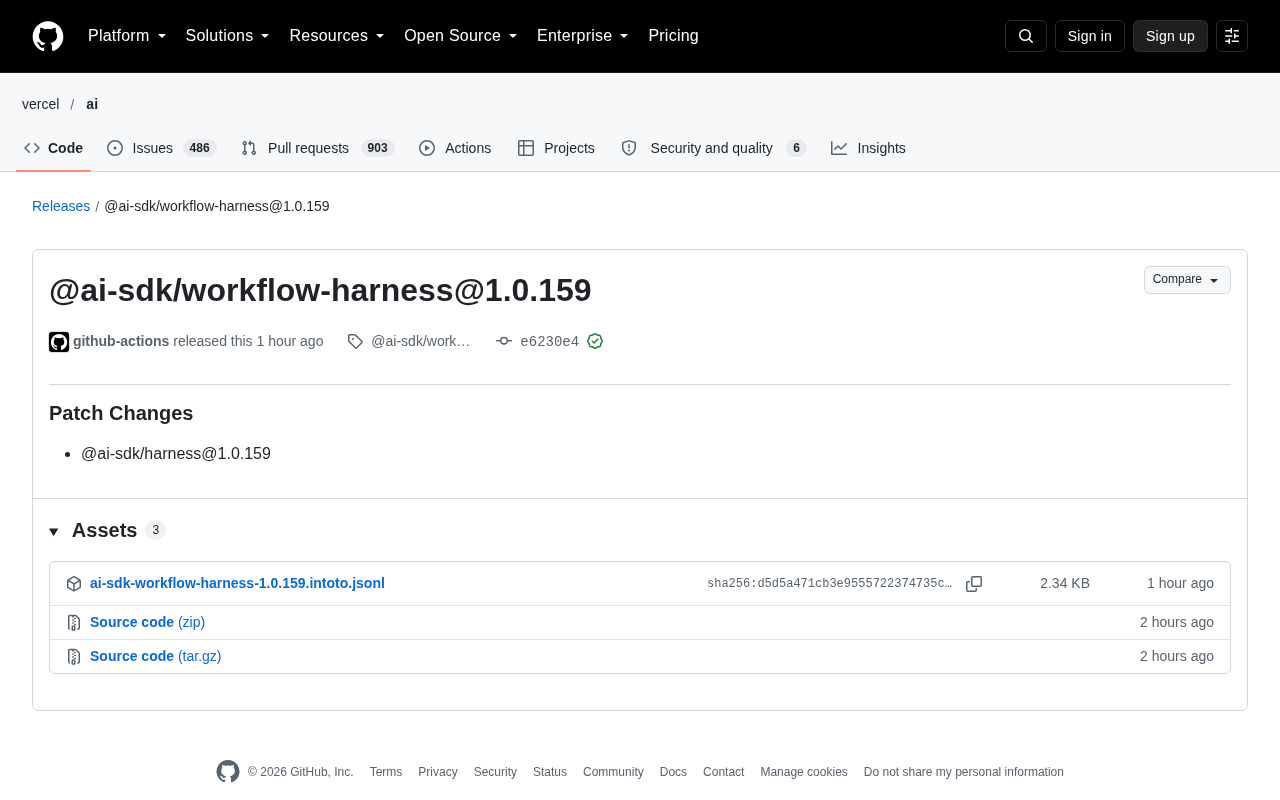
Vercel's AI SDK ecosystem sees a minor version iteration. @ai-sdk/workflow-harness has released version 1.0.159, a patch update whose core change centers on @ai-sdk/harness being synchronously upgraded to the same version number.
What the Patch Update Changed
According to the GitHub Releases page, the commit for this release was automatically generated by github-actions and carries a GitHub verified signature (GPG key ID: B5690EEEBB952194). The release notes are marked as "Patch Changes," and the only listed change is @ai-sdk/harness@1.0.159.
This means workflow-harness itself does not introduce new APIs or features; rather, it aligns the underlying harness package dependency to the latest patch version. AI SDK uses monorepo management, where multiple packages share a version cadence, so this kind of coordinated upgrade is a routine maintenance action.
GPG Signatures and Source Verification
The GPG key ID: B5690EEEBB952194 appearing in the release notes is the signing key identifier GitHub generates for automated commits. When the GitHub Actions bot creates commits on tags or releases, it signs them with a GitHub-hosted private key, and anyone can use the corresponding public key to verify that the commit really came from the GitHub pipeline and that its contents have not been tampered with. For enterprise users, this can be part of supply chain security: verifying signatures in CI prevents packages with forged origins from entering the dependency tree. However, a signature only proves "who produced it," not that "the code is safe," so it still needs to be paired with lockfile verification and dependency auditing.
Practical Impact on Developers
For developers building workflows with AI SDK, this kind of patch update usually means bug fixes or minor adjustments to internal interfaces. Since the release notes do not detail the specific fixes, it is advisable to review the diff of the corresponding commit before upgrading—the commit hash is e6230e4.
A detail worth noting: workflow-harness is the toolkit in AI SDK used for testing and validating multi-step AI workflows. It lets developers simulate a workflow's execution path locally and verify that each step's inputs and outputs match expectations. The synchronous update of the harness package may involve corrections to test runtime behavior.
Observations on Version Maintenance Cadence
Judging by release frequency, AI SDK's harness-related packages maintain a fairly high iteration speed, with the 1.0.x series being mostly patches. This cadence suits a strategy of pinning to a specific minor version plus periodic upgrades in production environments. If a project has high stability requirements, you can lock the current version and upgrade in a batch after several patches have accumulated.
The Assets section of this release shows 3 attachments, typically the source package and build artifacts. Full change details can be viewed through GitHub's compare view to see the differences between the two versions.
Semantic Versioning (SemVer) and Patch Numbers
SemVer specifies version numbers in the form MAJOR.MINOR.PATCH: a major version change represents incompatible API changes, a minor version represents backward-compatible feature additions, and a patch number represents only backward-compatible bug fixes. The 1.0.159 in this article is a patch-position increment, which by convention should not introduce breaking changes—this is also the premise that makes the "pin minor version, upgrade periodically" strategy viable. Note that when multiple packages in a monorepo share a version cadence, the patch number often reflects only the release pipeline's counter rather than the number of fixes, so the version number alone cannot tell you the scale of changes; you still need to assess them alongside the commit diff.
Monorepo and Fixed Version Coupling
A monorepo means managing multiple interdependent packages in a single code repository, with typical tools including pnpm workspaces, Turborepo, and Nx. Its advantage is that cross-package changes can be committed atomically in a single PR, with unified testing and releases; the cost is that packages often adopt a "fixed versioning" strategy, where a release of any package bumps the version numbers of all the others in sync, even if their own code hasn't changed. In this article, workflow-harness only upgrades a dependency without changing code, which is a direct manifestation of this mechanism, so such version jumps usually carry no substantive change information.
One-line Summary
AI SDK's workflow-harness releases 1.0.159 patch, only synchronously upgrading the underlying harness package.
Paragraph Summary
@ai-sdk/workflow-harness in Vercel's AI SDK ecosystem has released patch version 1.0.159, with the core change being only the synchronous upgrade of the underlying @ai-sdk/harness dependency to the same version number, introducing no new APIs or features. This version was automatically generated by GitHub Actions and carries a GPG signature, representing routine coordinated maintenance under the monorepo's shared version cadence. workflow-harness is used to locally simulate and validate the execution paths of multi-step AI workflows, and the synchronous harness update may involve corrections to test runtime behavior. Since the release notes do not detail the specific fixes, it is advisable to review the diff of commit e6230e4 before upgrading; projects with high stability requirements can lock the current version and upgrade in a batch after several patches have accumulated.
Related articles

Chain of Thought Isn't Just for AI: How Humans Can Use CoT to Improve Thinking Quality
Chain of Thought isn't just a prompt trick for large models. Starting from a Hacker News discussion, this article analyzes why CoT works for human thinking too, breaks down actionable ways to transfer it, and highlights the key differences between human CoT and machine CoT.
Cloudflare Teams Up with OpenAI: Closi…
Cloudflare Teams Up with OpenAI: Closing the Loop from Vulnerability Discovery to Defense with AI
Cloudflare uses OpenAI Daybreak to investigate security vulnerabilities and generate reviewable remediation plans, while developers use Codex to boost coding efficiency and quality.

Orca Multi-Agent Orchestration in Practice: A Guide to Parallel Collaboration with Claude and Codex
Orca is Stable AI's free open-source agent workbench supporting 34 agents like Claude Code and Codex in parallel. Learn its Git worktree isolation, multi-model orchestration, and mobile management.