AI SDK Workflow Toolkit 1.0.167 Patch Update Analysis

workflow-harness 1.0.167 is an automated patch release; the core signal is version alignment and signature trustworthiness.
@ai-sdk/workflow-harness in Vercel's AI SDK ecosystem released patch version 1.0.167, automatically built and signed by the github-actions bot, corresponding to commit a5db0af with 5 commits merged. The core dependency @ai-sdk/harness was updated to the same version number. The article notes that patch-level releases typically involve only bug fixes, dependency upgrades, or build adjustments without breaking changes, but this changelog doesn't list specific fixes. The commit carries a GitHub verified signature, serving as a basis for release source trustworthiness. Recommendations for users: upgrade both packages together to avoid version mismatch, verify workflow orchestration in a test environment, and rely on lockfile management and automated regression testing to handle frequent iterations rather than tracking every version's change details.
A Small but Critical Patch: workflow-harness 1.0.167
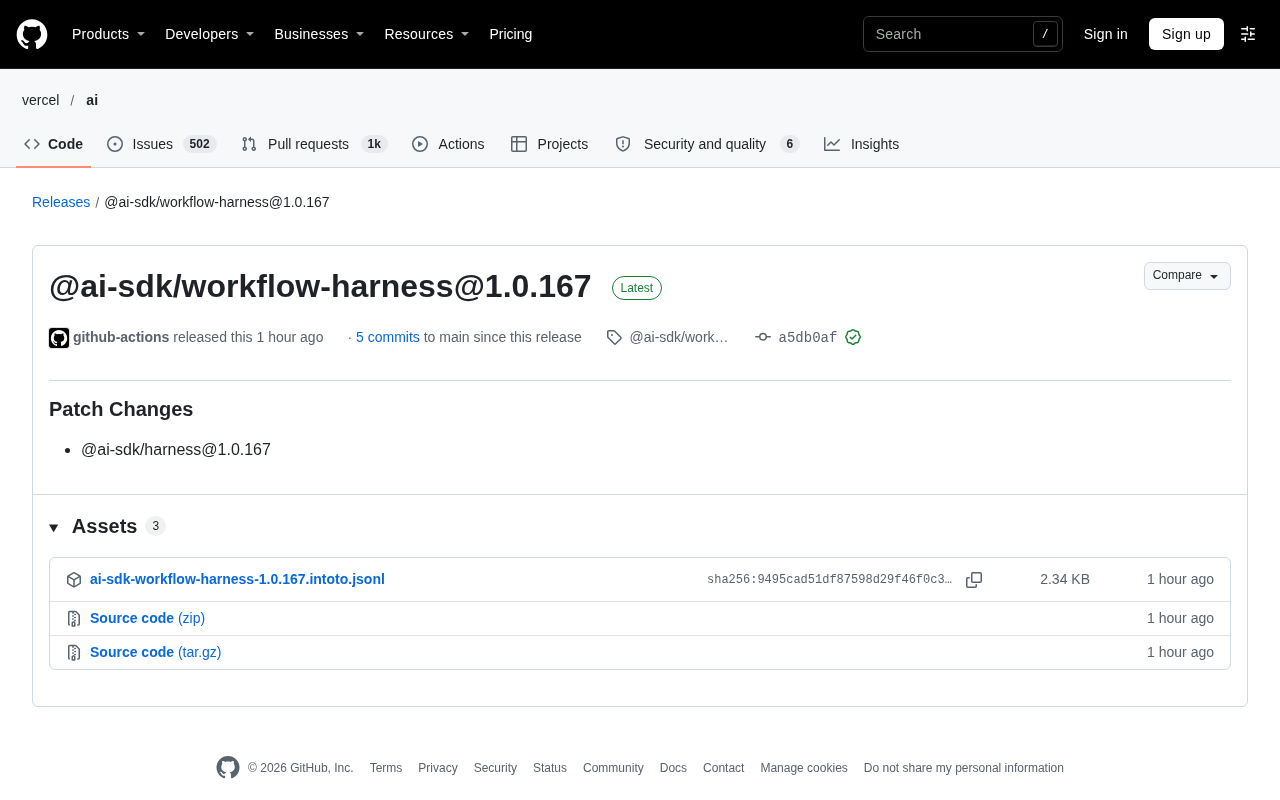
@ai-sdk/workflow-harness, part of Vercel's AI SDK ecosystem, has released version 1.0.167. According to the GitHub Releases page, this is a typical patch-level release (Patch Changes), automatically built and signed by the github-actions bot, corresponding to commit a5db0af, with 5 commits merged into the main branch.
For readers unfamiliar with this product line, it's worth clarifying one relationship first: @ai-sdk/workflow-harness is one of the packages carrying AI SDK workflow capabilities, and this release simultaneously updated its core dependency @ai-sdk/harness to 1.0.167. The aligned version numbers for both packages indicate this is a routine maintenance release coordinated across packages.
Behind the Version Number: What a Patch Release Means
An increment in the patch position of semantic versioning typically points to bug fixes, internal dependency upgrades, or build artifact adjustments—not new APIs or breaking changes. This release note is explicitly labeled "Patch Changes," and the change entry only references @ai-sdk/harness@1.0.167 without detailing specific feature descriptions.
This "version reference only, no detailed changelog" release pattern is quite common in highly automated monorepos: CI pipelines determine version numbers based on commit types, bots handle packaging, signing, and publishing, and manually written changelogs often lag behind or are omitted. Developers who want to confirm the actual changes need to directly compare the diff of commit a5db0af.
Automatic Signing and Supply Chain Trustworthiness
Worth noting is the GPG verification badge on the commit: GitHub shows that this commit was created by GitHub.com with a verified signature, with key ID B5690EEEBB952194. For teams building production applications on the AI SDK, this kind of signature information is a direct basis for judging the trustworthiness of the release source—especially in automated release processes, it confirms that artifacts genuinely come from the official pipeline rather than third-party tampering.
Semantic Versioning (SemVer) splits version numbers into three segments: MAJOR.MINOR.PATCH. A major version increment indicates incompatible API changes, a minor version increment indicates backward-compatible feature additions, and a patch increment indicates only backward-compatible bug fixes. In the npm ecosystem, range notations like ^1.0.167 allow automatic acceptance of patch and minor upgrades, while ~1.0.167 only accepts patch upgrades. Understanding this helps assess the risk boundary of this release—patch-level changes by convention won't break existing callers, but in practice they can still affect downstream code that depends on implementation details due to internal adjustments, so regression testing remains necessary.
GPG (GNU Privacy Guard) signing is a content-origin verification mechanism provided by Git. Committers can sign commit objects with a private key, and verifiers use the corresponding public key to validate, confirming that the commit content hasn't been tampered with and was indeed created by the key holder. GitHub marks automated commits using its hosted keys as "Verified" and displays the key ID. Against the backdrop of frequent software supply chain attacks, signature verification has become an important basis for determining whether dependency packages come from official release pipelines. The npm ecosystem also has a provenance mechanism that binds published artifacts to their source repositories and build pipelines, generating publicly verifiable attestations—together with Git signatures, forming a trust chain from source code to artifacts.
What This Means for Developers Using the AI SDK
If you're importing @ai-sdk/workflow-harness via npm in your project, this update falls into the "recommended to follow but low risk" category. There are two things to note when actually upgrading:
- Version alignment: workflow-harness and harness are both at 1.0.167. If your project explicitly pins an older version of harness, dependency resolution issues could arise from version mismatch—upgrade both together.
- Limited change scope: patch-level updates don't involve breaking changes and typically require no business code modifications. However, if your build depends on internal implementation details, it's still advisable to verify workflow orchestration in a test environment.
From a broader perspective, the AI SDK workflow toolchain is still in a period of rapid iteration, where dense release cadences and frequently jumping version numbers are the norm. Teams should establish fixed dependency upgrade and regression testing mechanisms rather than tracking every patch version by version—focusing energy on lockfile management and automated testing is more efficient than reading changelogs one by one.
Information Gaps and Consultation Advice
The information density of this release note is low—it doesn't list specific fixes or reference related issues. To understand what actually changed in 1.0.167, the most reliable path is to examine the full diff of commit a5db0af on GitHub along with the contents of the 5 associated commits. For most users, simply upgrading and observing behavioral changes in testing may be the lower-cost approach.
A lockfile (such as package-lock.json, pnpm-lock.yaml, yarn.lock) records the exact versions and integrity hashes of the dependency tree, and is key to ensuring reproducible builds. When two packages need version alignment, directly modifying version ranges in package.json doesn't always update transitive dependencies—you need to run npm update or reinstall to refresh the lockfile. If your project has entries explicitly pinning an older version of @ai-sdk/harness, multiple copies of the same package may be installed simultaneously, causing type mismatches or inconsistent runtime behavior. Enabling npm ci in CI ensures strict installation according to the lockfile, avoiding implicit drift.
Summary
@ai-sdk/workflow-harness@1.0.167 is a patch release driven by an automated pipeline, where the core signal is version alignment and signature trustworthiness rather than feature evolution. It reminds us that in an era of rapid AI toolchain iteration, understanding the release mechanism itself is sometimes more important than chasing individual version numbers.
Related articles

WorkBuddy Beginner's Guide: Three Modes and Automation in Practice
A beginner's guide to WorkBuddy: its three work modes for office, coding, and design; core features including projects, experts, skills, connectors, and automation; plus a real deployment case study and workspace pitfalls.

AI Automated Vulnerability Discovery in Practice: From Hermes Agent to Building a Workbench
Based on a Bilibili AI vulnerability discovery tutorial: from AI Agent concepts, Hermes installation and configuration, security knowledge base and Kali Linux workbench setup, to information gathering, vulnerability verification, and report generation—a complete loop, plus host security, custom Skills, and SRC practice platforms.

How to Build an Effective AI Code Review Agent: Prompt and Model Inversion in Practice
A practical breakdown of optimizing AI code review agents: from sandbox and PR webhooks to targeted prompts, historical PR calibration, model inversion, code knowledge bases, end-to-end QA, and cost tiering.