AI SDK Workflow Toolkit Releases 1.0.184 Patch Update

AI SDK workflow toolkit releases 1.0.184 patch with changes concentrated in the harness package, signaling continued high-frequency iteration.
The AI SDK workflow toolkit @ai-sdk/workflow-harness released patch 1.0.184, with core changes in @ai-sdk/harness. The version remains at 1.0.x, indicating rapid patching; patches usually don't change the public API but may include internal behavior fixes or stability improvements. The release was automated via github-actions with GPG signing, showing a mature CI/CD pipeline. Since the release page lacks detailed change notes, developers should review the actual diff and validate tool call ordering and error handling in a test environment before upgrading, while locking versions and building regression tests to control risk.
A Low-Key Patch Release Reveals the Iteration Pace of the AI SDK Ecosystem
The AI SDK workflow toolkit @ai-sdk/workflow-harness has released version 1.0.184. According to the GitHub Releases page, this update is explicitly marked as "Patch Changes," with the core changes landing in the @ai-sdk/harness package.
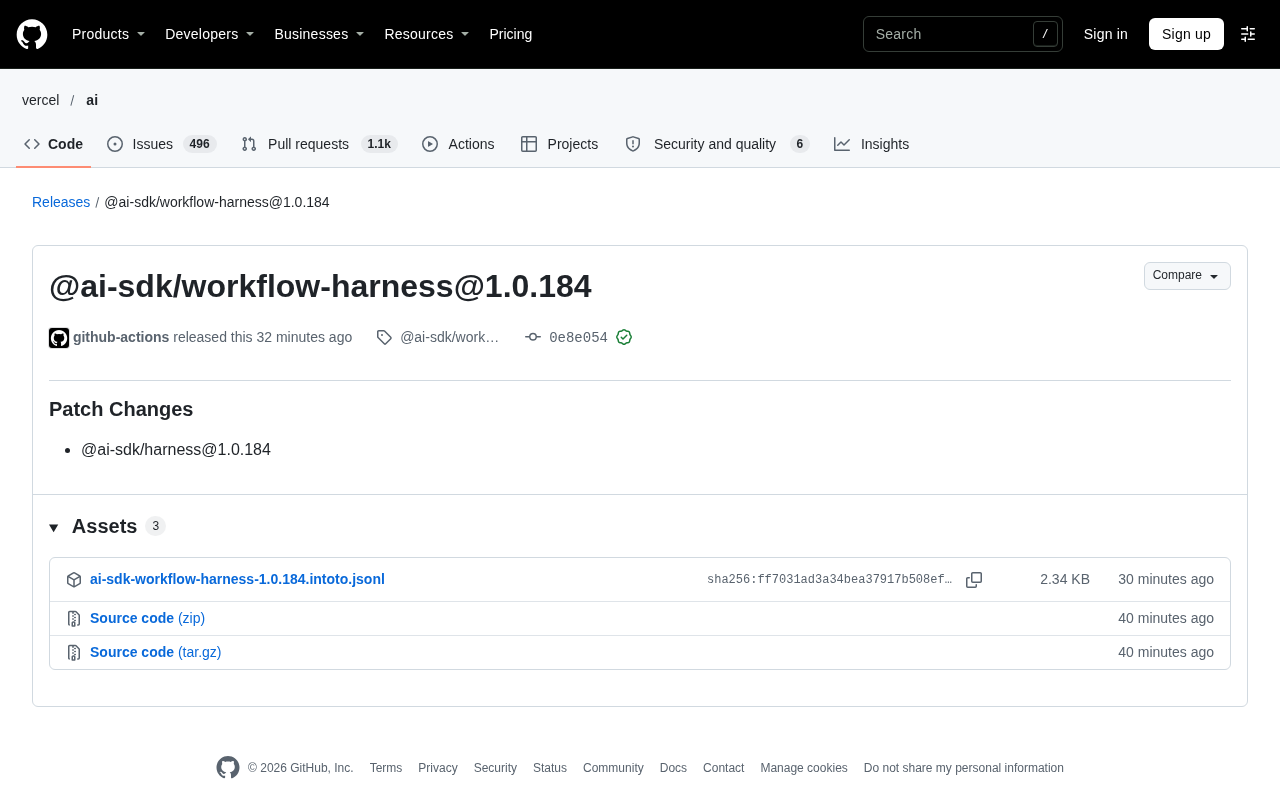
The version number remains in the 1.0.x range, indicating the team is still in a rapid patching phase rather than a feature leap. For developers relying on AI SDK to build Agent or workflow applications, such patch releases typically do not change the public API, but may involve internal behavior fixes, dependency alignment, or stability improvements for edge cases.
Why a Patch Release Is Worth Paying Attention To
In the AI application development stack, the workflow toolkit plays the "orchestration layer" role—it determines how multiple model calls, tool usage, and state transitions are composed and executed. Once the orchestration layer develops subtle deviations, the output quality of upper-layer applications is affected in a cascading manner.
The GitHub release record shows that this commit was automatically published by github-actions and carries a GitHub-verified signature (GPG key ID: B5690EEEBB952194). The maturity of the automated release process indicates that the project has established a relatively standardized CI/CD pipeline, allowing patches to be delivered at a higher frequency.
Under Semantic Versioning (SemVer) conventions, patch versions are intended for backward-compatible bug fixes and should not introduce new features or breaking changes. However, in rapidly iterating AI toolchains, maintainers sometimes classify behavior adjustments as patches as well, especially when the change is deemed to "fix incorrect behavior." This means the version number alone is not sufficient to guarantee zero risk—when locking dependencies, you should also consult the changelog or diff rather than judging compatibility solely by the patch number.
GitHub Actions is a CI/CD automation platform provided by GitHub that allows defining build, test, and release steps through workflow files. Automatically publishing releases under the github-actions identity with a GPG signature means release artifacts can be traced and verified, reducing supply chain tampering risk and indicating that maintainers have standardized the release process so that high-frequency patches can be delivered with low friction.
What Can Be Read from the Release Page
The original page contains limited information—beyond the version number and patch marker, there are no detailed change descriptions or migration guidance. Loading failure prompts appear multiple times on the page, and some resources fail to render properly, which may be due to information loss caused by RSS scraping or dynamic page loading.
For developers, the safest approach is to directly examine the actual diff of @ai-sdk/harness in the repository to confirm whether this patch touches the feature paths you are currently using. Teams that lock version numbers in production environments should pay attention to whether there are implicit behavior changes before upgrading.
Practical Impact on Developers and Recommendations
The value of such patch releases lies not in "new features" but in making workflow orchestration more predictable. If your project manages multi-step Agent workflows through @ai-sdk/workflow-harness, it is recommended to validate this update in a test environment first, focusing on whether tool call ordering and error handling paths meet expectations.
At the same time, the version cadence of this package also reminds us: the AI SDK ecosystem is still in a high-frequency evolution period, and locking versions and establishing regression tests are essential means of controlling upgrade risk.
One-line Summary
AI SDK workflow toolkit releases 1.0.184 patch with changes concentrated in the harness package, indicating the ecosystem is still iterating at high frequency.
Paragraph Summary
The AI SDK workflow toolkit @ai-sdk/workflow-harness has released patch version 1.0.184, with core changes landing in the @ai-sdk/harness package. The version remains at 1.0.x, indicating the project is in a rapid patching phase; patches typically do not change the public API but may involve internal behavior fixes or stability improvements. The release was automatically completed by github-actions with a GPG signature, indicating a relatively mature CI/CD pipeline. Since the release page lacks detailed change descriptions, developers should review the actual diff and validate tool call ordering and error handling paths in a test environment before upgrading, while locking versions and establishing regression tests to control risk.
Related articles

RePlan-VLA: Progress-Aware Replanning Breakthrough for Long-Horizon Robotic Manipulation
The RePlan-VLA framework converts VLA models' short-horizon capabilities into reliable long-horizon execution through progress-aware adaptive replanning, improving success rates by 21.9% and 10.4% on RoboCasa365 and CALVIN, and validating real-world deployment on a Franka Research 3 robot.

Geometric Bridge Flow Matching: A New Breakthrough in Blind Rigid Motion Correction
Geometric bridge flow matching enables blind rigid motion correction in head CBCT, achieving 37.1 dB PSNR and 0.27 mm RPE on simulated data in ~9.1 minutes, outperforming existing methods.

Google Releases Gemini 4 Hydrogen: 2.5x Faster Without Sacrificing Intelligence
Google releases the lightweight Gemini 4 Hydrogen: 2.5x faster task completion, AA Intelligence Index of 54 beating its flagship sibling, 7.3s single-step on Agent Arena faster than Claude and GPT rivals, four thinking levels with pay-as-you-need pricing, now available across AI Studio and more.