@ai-sdk/xai 3.0.153 Patch Release: A Dependency Upgrade Breakdown

@ai-sdk/xai 3.0.153 is a pure dependency-sync patch with no new features; validate in CI before upgrading.
This article breaks down the @ai-sdk/xai 3.0.153 patch release: it introduces no new features and only syncs upstream dependencies @ai-sdk/provider-utils to 4.0.67 and @ai-sdk/openai-compatible to 2.0.94, auto-published via github-actions with signed verification. Such pure dependency updates are common in monorepo-managed SDKs; risk is low, but underlying behavior may shift subtly—especially since provider-utils handles request construction and stream parsing. The article also reads the independent evolution cadence of each package from the unsynchronized 3.x, 2.x, and 4.x versions, and advises developers to check version constraints, follow upstream changelogs, and run integration tests in CI before merging dependency updates.
The AI SDK ecosystem is known for its high-frequency, small-step version iterations, and the latest patch for @ai-sdk/xai, 3.0.153, is a typical example. This release introduces no new features—it's a pure maintenance release focused on dependency updates.
Patch Contents: A Pure Dependency Chain Sync
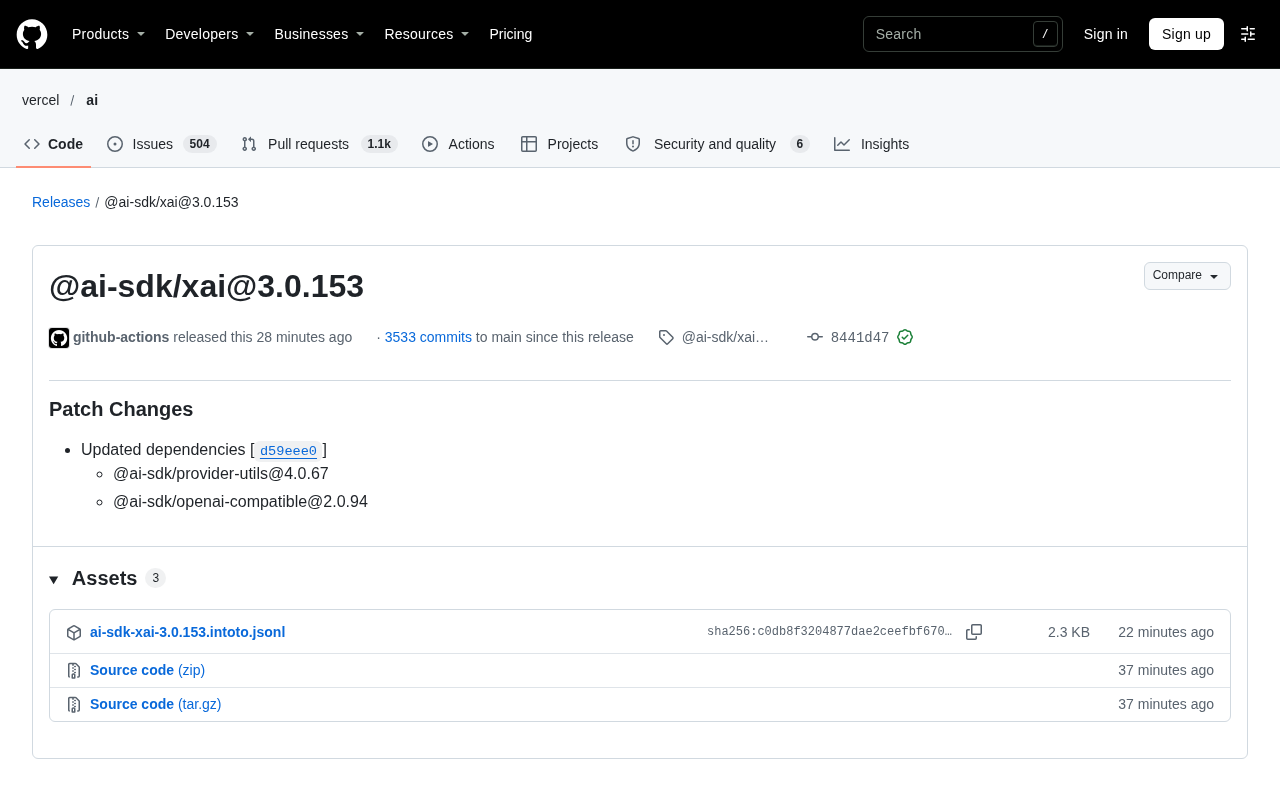
According to the GitHub release records, @ai-sdk/xai@3.0.153 is classified as a Patch Change, with the core change being a sync of upstream dependency versions: @ai-sdk/provider-utils bumped to 4.0.67, and @ai-sdk/openai-compatible bumped to 2.0.94. The release was automated by github-actions, and the commit carries a GitHub-verified signature.
Such patches are very common in SDK projects managed as monorepos. When upstream utility packages fix certain low-level issues or adjust interface details, downstream packages inherit these changes by realigning their dependencies.
Why Patch Versions Are Worth Attention
For most developers, patch versions typically don't involve breaking changes, so upgrade risk is low. However, syncing the dependency chain means underlying behavior may shift subtly—provider-utils handles foundational capabilities like request construction and streaming response parsing, so its version changes can affect the stability and compatibility of xAI model calls.
If your project pins a lockfile, this patch won't take effect automatically; if you use range versioning, it will be pulled in on the next install. It's recommended to run integration tests in CI before merging dependency updates.
Monorepos and Dependency Chain Sync: A monorepo is a structure where multiple interrelated software packages are managed together in a single code repository—the Vercel AI SDK ecosystem uses this approach. Sub-packages (such as @ai-sdk/xai and @ai-sdk/provider-utils) reference each other via the workspace protocol, and the toolchain computes versions uniformly at release time. When an upstream package releases a new version, downstream packages need to publish a "dependency sync" patch to align their references—this is what's meant by dependency chain sync. Its purpose is to ensure that installations resolve to a known-compatible version combination, avoiding runtime inconsistencies caused by dependency tree drift. Such patches usually don't modify business code, but they do change the actual installed dependency versions, so they can still affect behavior.
The Role of @ai-sdk/provider-utils: This is the shared low-level utility library for all provider adapter layers in the AI SDK, handling foundational capabilities such as request parameter construction, HTTP call wrapping, streaming response (e.g., SSE) parsing, and error normalization. Model APIs from different vendors differ in field naming and streaming chunk formats; provider-utils provides a unified abstraction so that each adapter package only needs to focus on vendor-specific logic. Therefore, even patch-level fixes in this package can change request headers, timeouts, retries, or stream parsing details, thereby affecting call stability. Following its changelog is key to assessing the real impact of downstream patches.
Project Cadence as Read from Version Numbers
@ai-sdk/xai, as the adapter layer connecting xAI models to the Vercel AI SDK, has reached version 3.x, indicating it has already undergone a major-version refactor. The companion openai-compatible package is at 2.x, and provider-utils is at 4.x—the three version numbers are not synchronized, which is consistent with the convention of independent evolution for each package in a monorepo.
Release records show the repository has accumulated 3,533 commits, indicating a high level of maintenance activity. The automated release process is driven by github-actions, combined with signature verification, providing a degree of supply chain security.
Trade-offs from the Maintainer's Perspective
Releasing a pure dependency update as a standalone patch rather than batching it with feature updates has the benefit of letting downstream consumers get fixes as quickly as possible; the drawback is faster version number growth and a more fragmented changelog. For a developer-facing SDK, timeliness is the more important trade-off.
How SemVer Interacts with Lockfiles: Semantic Versioning (SemVer) specifies that major version changes represent incompatible changes, minor versions represent backward-compatible new features, and patch versions represent backward-compatible fixes. When you write range constraints like ^3.0.0 in package.json, the installation tool will pull the latest 3.x patch, so 3.0.153 may be introduced automatically; a lockfile, however, pins exact versions and integrity hashes, and won't change unless you actively update it. This is why the article says "if you pin a lockfile, it won't take effect automatically." Dependency update PRs usually only modify the lockfile, so during review you should focus on the transitive dependencies being bumped and their changelogs.
Practical Advice for Users
- Check the version constraint for @ai-sdk/xai in package.json to confirm whether this patch might be pulled in unexpectedly
- Follow the provider-utils changelog to confirm whether underlying changes affect behavior you depend on
- Keep build and integration test results in dependency update PRs to avoid blind merges
This kind of release carries limited information in itself, but it reflects the maintenance cadence of the AI SDK ecosystem: small steps, fast iteration, dependencies first. For applications built on xAI models, keeping the dependency chain healthy matters more than chasing version numbers.
Related articles

Prompt Engineering for Beginners: From Writing Prompts to Engineering Thinking
Starting from the essence and four functions of prompts, this article systematically explains the six-step process, four success criteria, learning value, and practical limitations of prompt engineering to help you build a complete understanding.

Anthropic Launches Nasdaq IPO: AI Giant's Listing and Risk Disclosures
Anthropic officially launches its Nasdaq IPO under ticker ANT, with market valuation expected to potentially exceed SpaceX's record. The prospectus devotes nearly 100 pages to AI risks, while first-half revenue grew over 14x but net losses widened sharply, reigniting the AI bubble debate.

Rust cURL Clone Uses 4,832 unsafe Blocks—Is the Memory Safety Myth Broken?
A Rust cURL clone uses 4,832 unsafe keywords, challenging Rust's memory safety narrative. We analyze what unsafe really means, compare Fil-C, and examine rewrite motives.