AI SDK xAI 5.0.16 Update: New `max` Reasoning Level and Cross-Provider Compatibility

xAI SDK 5.0.16 adds portable `max` reasoning level with cross-provider fallback mappings.
@ai-sdk/xai 5.0.16 introduces a portable `max` reasoning level, letting developers request maximum reasoning intensity with a unified config while the SDK handles translation per provider. Amazon Bedrock Nova 2 and Fireworks both downgrade `max` to `high` with compatibility warnings. The new level widens the `ReasoningLevel` union type — exhaustive `switch` statements or `Record<ReasoningLevel, ...>` usages must be updated before upgrading. The release also upgrades the toolchain to TypeScript 6 and fixes speaker diarization state reporting.
Vercel AI SDK's xAI provider package @ai-sdk/xai has released version 5.0.16, a patch update that carries meaningful changes for all developers leveraging reasoning capabilities. This release introduces a portable max reasoning level and adds compatibility mapping for multiple underlying model providers.
Core Change: Portable max Reasoning Level
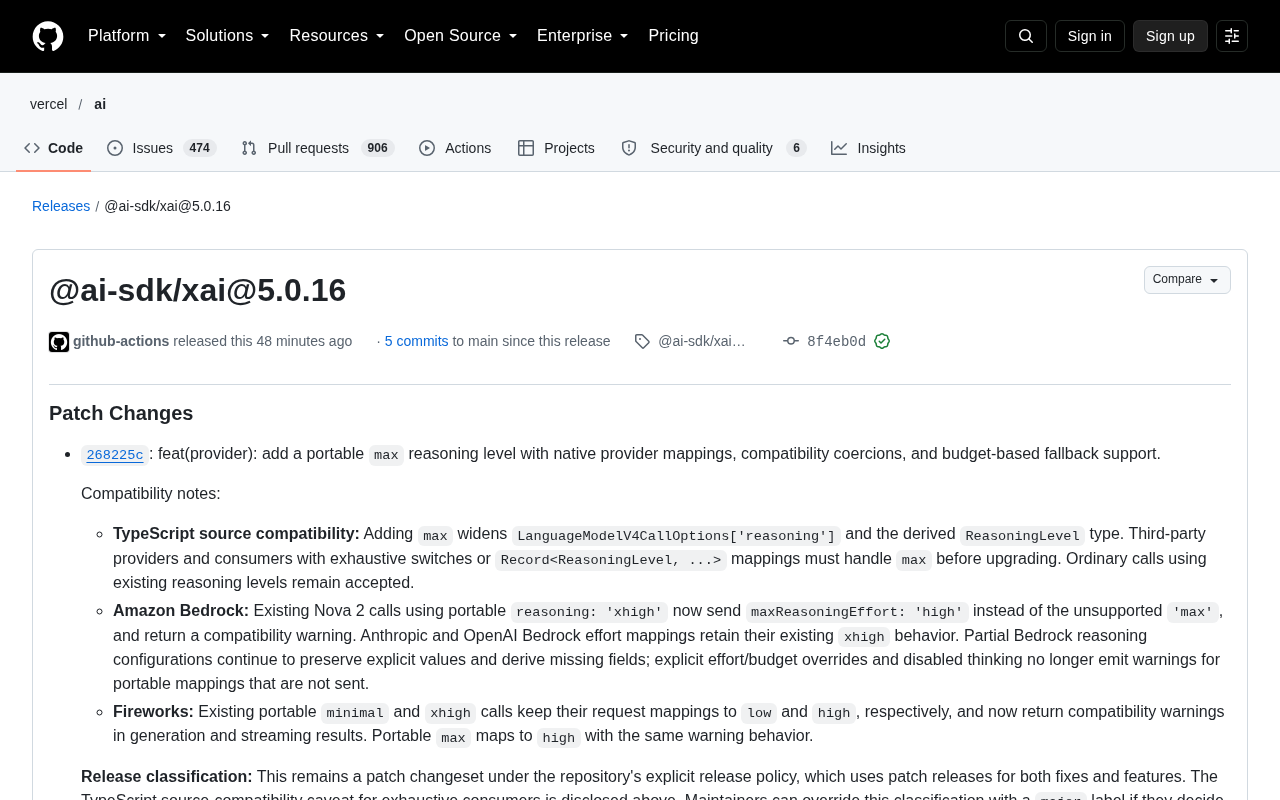
The most significant change in this update is the addition of a portable max reasoning level at the provider layer, complete with native provider mappings, compatibility coercion, and budget-based fallback support.
This means developers can use a unified reasoning: 'max' configuration to request maximum reasoning intensity from a model, without worrying about each provider's specific parameter naming. The SDK internally translates this abstract level into the actual parameters each model supports. This reflects AI SDK's core design philosophy: use a unified abstraction layer to shield developers from differences between model vendors, keeping higher-level code portable.
That said, this seemingly simple addition carries downstream effects at the type system level that developers should be aware of.
What is a reasoning level? Reasoning levels are AI SDK's abstraction for a model's "thinking intensity." Different vendors have their own parameter systems: Anthropic uses
budget_tokensto cap thinking tokens, OpenAI usesreasoning_effort(low/medium/high), and Amazon Bedrock's Nova series usesmaxReasoningEffort. AI SDK introduces a unified portable level enum at the provider layer —minimal,low,medium,high,xhigh, and nowmax— so developers only need to declare abstract intent while the SDK handles translation to each vendor's actual parameters. Budget-based fallback means that when a target provider doesn't natively support a given abstract level, the SDK converts it to a token budget value that provider understands, rather than throwing an error or silently ignoring it.
TypeScript Type Compatibility: What to Watch
Adding max widens both LanguageModelV4CallOptions['reasoning'] and the derived ReasoningLevel type. For typical usage, code that uses existing reasoning levels continues to compile without any changes.
However, one category of code will be affected: if your third-party provider implementations or consumer-side code use exhaustive switch statements, or rely on mapping types like Record<ReasoningLevel, ...>, you must handle the new max member before upgrading — otherwise TypeScript will throw compilation errors. This is a classic breaking effect of union type widening, and deserves careful review during the upgrade.
Union type widening in TypeScript is a common source of breaking changes. When
ReasoningLevelwas originally defined as'minimal' | 'low' | 'medium' | 'high' | 'xhigh', an exhaustiveswitchstatement'sdefaultbranch was guaranteed to have typenever, meaning the compiler confirmed all cases were covered. Once'max'is added to the union, thedefaultbranch is no longernever, and TypeScript will report an error. Similarly,Record<ReasoningLevel, SomeValue>requires a key for every union member — adding a new member means old object literal definitions are missing themaxkey, triggering compilation failures. To audit your codebase, search globally forReasoningLeveland forswitch/Recordusages near the literal'xhigh', then addmaxhandling wherever needed.
Provider-Level Compatibility Mapping
A notable detail of this update is its differentiated fallback and mapping strategies for different underlying providers, communicated to developers via compatibility warnings that explicitly describe which parameters are actually sent.
Amazon Bedrock
Existing calls using the portable reasoning: 'xhigh' on Nova 2 will now send maxReasoningEffort: 'high' instead of the unsupported 'max', along with a compatibility warning. Anthropic and OpenAI models on Bedrock retain their existing xhigh behavior.
Additionally, some Bedrock reasoning configurations will continue to preserve explicit values and auto-infer missing fields. Explicit effort/budget overrides and disabled thinking configurations no longer emit warnings for portable mappings that aren't actually sent — reducing unnecessary warning noise.
Fireworks
On the Fireworks platform, portable minimal and xhigh calls continue to map to low and high respectively, but now return compatibility warnings in both generated and streaming results. The new portable max maps to high with the same warning behavior.
The intent here is clear: preserve existing code behavior while using the warning mechanism to inform developers that the abstract level they specified isn't a precise match on this provider — it has been downgraded.
Why This Is a Patch Release
Conventionally, extending public types or adding new fields would be classified as a minor or even major version bump. However, the official release notes explicitly explain the versioning rationale:
Per this repository's explicit release strategy, patch versions are used for both fixes and feature releases. The TypeScript source compatibility notes disclosed above have been provided as transparent documentation. The maintainers reserve the right to re-align this provider-spec addition under a major tag in a future AI SDK major release.
In other words, this is a deliberate decision consistent with the repository's release policy — not an oversight. Developers should still treat it as a change that may affect type checking during upgrades.
A note on Semantic Versioning (SemVer): The SemVer spec reserves patch versions for backward-compatible bug fixes, minor versions for new public API additions or type extensions, and major versions for breaking changes. However, SemVer also allows projects to declare custom interpretations in their README or release policy documentation. Vercel AI SDK uses a "patch-also-ships-features" strategy, which is not uncommon in fast-moving infrastructure libraries — the rationale is typically that maintainers consider the actual impact surface small enough, or have shifted the risk to consumers through thorough type documentation. Regardless of how the version is labeled, users should always review the CHANGELOG when upgrading and run full type checks in CI, rather than assuming a patch tag means it's safe.
Other Changes and Dependency Updates
Beyond the core reasoning level changes, this release includes two additional noteworthy items:
- Upgrade to TypeScript 6: A toolchain update at the engineering level, laying the groundwork for future feature development.
- Fix for speaker diarization handling: When this capability is unavailable, the SDK now correctly preserves or reports the state instead of silently handling it.
This release also updates several dependency packages, including @ai-sdk/provider-utils@5.0.55 and @ai-sdk/provider@4.0.23.
Summary
For teams building reasoning-focused applications with AI SDK, the max reasoning level in 5.0.16 provides a stronger, more unified entry point for controlling reasoning intensity. The accompanying compatibility mappings and warning mechanisms reflect the project's continued investment in cross-provider consistency. The upgrade itself carries low risk, but any codebases using exhaustive type matching should review their ReasoningLevel handling logic before upgrading.
Related articles

Python 3.15 New Feature: Is the sentinel Type Better Than None?
Python 3.15 adds the sentinel type, using named unique sentinel objects to replace None and bare object(), resolving confusion among missing values, explicit emptiness, and invalid input while avoiding type hint failures.

Deep Learning's Three Architectures and the Universal Approximation Theorem: A Complete Guide to MLPs, CNNs, and Transformers
Explaining the inductive bias differences among MLP, CNN, and Transformer, the existence meaning of the Universal Approximation Theorem (UAT), and the role of Taylor expansion in approximation analysis, while clearing up common misconceptions.

GitLab Emergency Patch Release: Analysis of Critical Security Fixes
GitLab releases critical patch 19.5.1, sparking 355 points of discussion on Hacker News. This article analyzes the background, upgrade steps for self-hosted instances, and verification points to help DevOps teams respond quickly to security updates.