@ai-sdk/xai 5.0.20 Released: A Breakdown of This Dependency-Sync Patch

@ai-sdk/xai 5.0.20 patch release syncs upstream provider dependencies with no breaking changes.
`@ai-sdk/xai@5.0.20` is a patch update to the Vercel AI SDK's provider adapter for xAI (Grok) models. It introduces no new features or API changes, only syncing two upstream packages: `@ai-sdk/provider@4.0.26` and `@ai-sdk/provider-utils@5.0.58`. This dependency-sync pattern is standard practice in the AI SDK's monorepo architecture. Following SemVer, patch releases carry no breaking changes, making this a low-risk upgrade — though running your existing tests afterward and checking for version compatibility between packages is still recommended.
Version Overview
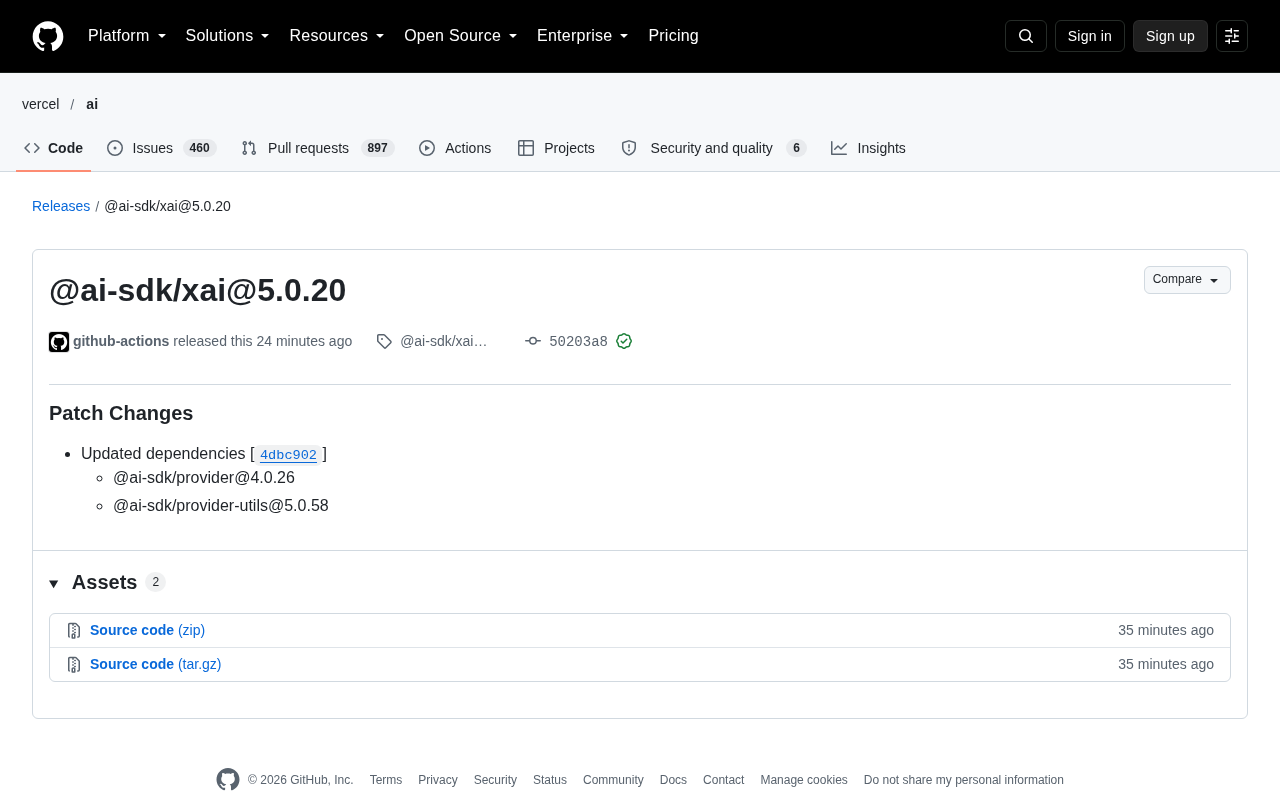
The xAI provider package @ai-sdk/xai in Vercel's AI SDK has released version 5.0.20. According to the GitHub Releases page, this is a patch update (Patch Changes) published via an automated pipeline (github-actions) and verified with a GitHub signature.
The core change in this release is straightforward: it synchronizes upstream dependencies. For developers building applications with the AI SDK day-to-day, patch releases like this rarely introduce breaking changes — but understanding the underlying dependency chain helps you better manage your project's update cadence.
What Changed in This Release
From the Release Notes, version 5.0.20 is a Patch Changes update with one primary action — updating dependencies:
@ai-sdk/provider@4.0.26@ai-sdk/provider-utils@5.0.58
In other words, the functional code within @ai-sdk/xai itself hasn't changed significantly. Instead, it's keeping pace with upgrades to the two foundational packages beneath it: provider and provider-utils. This pattern is very common in Vercel AI SDK's monorepo architecture — provider adapter packages (for xAI, OpenAI, Anthropic, etc.) all depend on a shared provider abstraction layer, and when that layer is updated, each adapter follows with a patch release.
What Is @ai-sdk/xai?
For those less familiar with this ecosystem, a brief introduction is in order. @ai-sdk/xai is the provider package within Vercel's AI SDK that enables integration with xAI (the Grok family of models). It lets developers call xAI's large language models through a unified API, without worrying about the underlying HTTP requests, streaming, or other low-level details.
The entire AI SDK is built in layers:
The Provider Abstraction Layer
@ai-sdk/provider defines the interface specifications that model providers must follow — it's the "contract" for the entire ecosystem. Changes to its version often signal adjustments to interface definitions or type-level concerns.
Semantic Versioning (SemVer) is essential context for understanding these updates. The version format is
MAJOR.MINOR.PATCH. Patch updates only fix bugs or sync internal dependencies without changing the public API; minor updates add backward-compatible features; major updates may include breaking changes.@ai-sdk/provideris currently at4.0.26, meaning a future upgrade to 5.x could require significant changes in adapter packages like@ai-sdk/xai. Understanding SemVer helps developers assess upgrade risk when locking dependency versions.
The Provider Utils Layer
@ai-sdk/provider-utils provides shared utility functions used across all providers — things like request handling, response parsing, and error management. It has been bumped to 5.0.58 in this release.
The Provider Adapter Layer
Packages like @ai-sdk/xai sit at the top of this stack, translating a specific vendor's API into the AI SDK's unified interface. Tracking patch updates from the layers below is routine maintenance that keeps the entire ecosystem version-consistent.
How Should Developers Respond?
For patch-level releases like this, here's the recommended approach:
Since this follows Semantic Versioning as a patch update, it theoretically contains no breaking changes and is safe to upgrade. If your project uses a version range like ^5.0.0, your package manager will typically pull in 5.0.20 automatically when you run an install or update.
That said, the cautious move is to run your existing test suite after upgrading to confirm that any logic involving xAI model calls is unaffected. This is especially important if your project also pins specific versions of @ai-sdk/provider or @ai-sdk/provider-utils — pay attention to version compatibility between packages to avoid dependency conflicts.
The monorepo architecture is the foundation of how Vercel AI SDK manages multi-package dependencies. In a monorepo, multiple related packages live in the same repository and are managed together using tools like Turborepo and pnpm workspaces. This structure allows
@ai-sdk/provider,@ai-sdk/provider-utils, and the various provider adapter packages to advance their versions in sync — a single commit can trigger release pipelines for multiple packages simultaneously. For external consumers, this means that when a fix lands in a foundational package, dependent adapters tend to follow with a patch release shortly after. Staying on top of package update cadence is more efficient than manually reviewing each changelog.
Summary
@ai-sdk/xai@5.0.20 is a classic dependency-sync patch release. It introduces no new features or API changes — its sole purpose is to track the upgrades to @ai-sdk/provider@4.0.26 and @ai-sdk/provider-utils@5.0.58. For developers using the AI SDK to integrate with Grok models, this is a low-risk maintenance update. Keeping your dependencies current lets you benefit from any fixes delivered upstream.
Note: This article is based solely on the information available on the GitHub Release page. For details on the underlying changes, consult the relevant commits and the changelogs of the dependency packages directly.
Related articles

Chain of Thought Isn't Just for AI: How Humans Can Use CoT to Improve Thinking Quality
Chain of Thought isn't just a prompt trick for large models. Starting from a Hacker News discussion, this article analyzes why CoT works for human thinking too, breaks down actionable ways to transfer it, and highlights the key differences between human CoT and machine CoT.
Cloudflare Teams Up with OpenAI: Closi…
Cloudflare Teams Up with OpenAI: Closing the Loop from Vulnerability Discovery to Defense with AI
Cloudflare uses OpenAI Daybreak to investigate security vulnerabilities and generate reviewable remediation plans, while developers use Codex to boost coding efficiency and quality.

Orca Multi-Agent Orchestration in Practice: A Guide to Parallel Collaboration with Claude and Codex
Orca is Stable AI's free open-source agent workbench supporting 34 agents like Claude Code and Codex in parallel. Learn its Git worktree isolation, multi-model orchestration, and mobile management.