AI SDK xAI 5.0.22 Update Analysis: Dependency Patches and Ecosystem Maintenance

@ai-sdk/xai@5.0.22 is a patch-level maintenance update that only upgrades a shared dependency and does not affect existing behavior.
Vercel's AI SDK ecosystem has released @ai-sdk/xai@5.0.22, a patch update automatically completed via GitHub Actions. The only change is upgrading the dependency @ai-sdk/provider-utils to 5.0.60. Since provider-utils is the shared low-level toolkit for all Providers—handling request processing, streaming response parsing, and error wrapping—its updates cascade synchronized upgrades across xAI, OpenAI, Anthropic, and other packages to maintain ecosystem version alignment. This release introduces no new APIs and fixes no functional bugs, so production projects can expect unchanged behavior after upgrading. The version number 5.0.22 also indicates the project is in a stable maintenance phase: major and minor versions remain unchanged while the patch number increments frequently, reflecting a dependency-driven automated release cadence. Developers can safely upgrade directly, while teams with strict audit requirements can further consult provider-utils' own changelog.
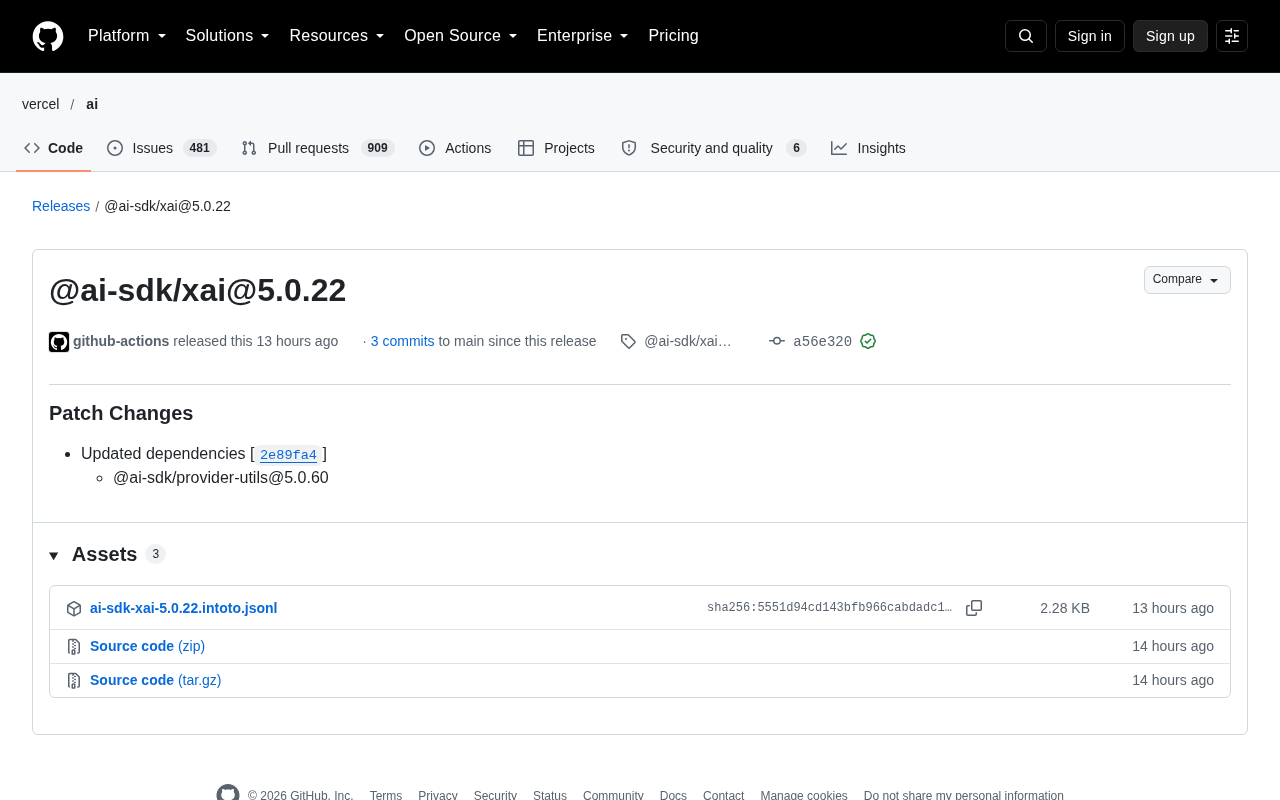
Vercel's AI SDK ecosystem has rolled out another minor version iteration. @ai-sdk/xai@5.0.22 has been automatically published via GitHub Actions—a typical patch update whose core change centers on dependency maintenance.
What Changed in This Update
According to the GitHub Release page, @ai-sdk/xai@5.0.22 falls under the Patch Changes level, and its sole content is an update of the dependency @ai-sdk/provider-utils to version 5.0.60.
This means the release introduced no new API capabilities, fixed no functional bugs, and did not adjust the xAI model invocation logic. For developers already using @ai-sdk/xai in production, behavior after upgrading is expected to remain unchanged.
Why Patch Updates Are Still Worth Noticing
@ai-sdk/provider-utils is the shared low-level toolkit for all Providers in the AI SDK, handling request processing, streaming response parsing, error wrapping, and other foundational capabilities. When this package releases a new version, all Provider packages that depend on it—including xAI, OpenAI, Anthropic, and others—are synchronized via automated workflows.
This chained dependency update mechanism ensures consistency across the entire AI SDK ecosystem. Changes to provider-utils may involve edge-case handling, type definition corrections, or internal refactoring. While transparent to upper-layer users, keeping versions aligned helps avoid potential compatibility issues.
Semantic Versioning (SemVer) is key background for understanding this release level. SemVer splits a version number into three segments: major.minor.patch. A major version increment means incompatible API changes, a minor version increment represents backward-compatible new features, and a patch increment only indicates backward-compatible bug fixes or internal adjustments. Based on this, @ai-sdk/xai going from 5.0.21 to 5.0.22 only bumped the patch digit—the lowest-risk update type.
Lockfile is another concept worth explaining. Lock files such as package-lock.json, pnpm-lock.yaml, and yarn.lock precisely record the resolved version and integrity hash of every dependency and its transitive dependencies, ensuring the dependency tree is identical across different machines and times. This means that even if @ai-sdk/xai's version declaration allows upward compatibility, as long as the lockfile isn't updated, the actually installed @ai-sdk/provider-utils may still be an older version. Only commands like npm update will truly rewrite the lockfile and pull the new version.
The Release Cadence Behind the Version Number
From the version number 5.0.22, we can see that the AI SDK's xAI Provider has entered a relatively stable maintenance phase. The major version 5 remains unchanged, indicating a stable API contract; the minor version 0 shows no new features recently; and the patch number 22 reflects a high-frequency maintenance release cadence.
This release pattern aligns with Vercel's overall strategy for the AI SDK: automated releases via GitHub Actions, with each dependency update producing an independent patch version that makes it easy for developers to trace the source of changes.
GitHub Actions is GitHub's continuous integration and continuous delivery (CI/CD) platform, where developers can define tasks in YAML files that automatically execute when specific events (such as code merges or tag creation) are triggered. In multi-package repositories (monorepos) like the AI SDK, a common practice is to use tools like Changesets to automatically determine the change level, increment version numbers, generate CHANGELOGs, and publish to npm when a PR is merged. This explains why the Release page for this update has no manual description and only lists dependency changes: the patch release was completed by a bot, with information sourced from commit records rather than hand-written notes.
Monorepo refers to managing multiple interrelated packages in a single code repository. The AI SDK ecosystem is exactly this structure: the core package, provider-utils, and various Provider packages coexist in one place, sharing build and release pipelines. The benefit is that cross-package changes can be committed atomically and versions can be uniformly aligned, but the cost is that any update to a low-level package may trigger a cascade of releases across many upper-layer packages—which also explains why patch version numbers accumulate quickly.
What Developers Should Do
For most projects, upgrading directly to 5.0.22 is safe. If you manage dependencies with a lockfile, you can get the update via npm update @ai-sdk/xai or by manually changing the version number.
If your project has strict dependency version audit requirements, you can look into the specific changes in @ai-sdk/provider-utils@5.0.60—although this Release provided no detailed notes, that package's own changelog will contain more technical details.
Overall, this is a routine ecosystem maintenance update that reflects the AI SDK project's standardized approach to dependency management.
One-line Summary
@ai-sdk/xai@5.0.22 is a patch-level maintenance update that only upgrades a shared dependency and does not affect existing behavior.
Paragraph Summary
Vercel's AI SDK ecosystem has released @ai-sdk/xai@5.0.22, a patch update automatically completed via GitHub Actions whose only change is upgrading the dependency @ai-sdk/provider-utils to 5.0.60. Since provider-utils is the shared low-level toolkit for all Providers, handling request processing, streaming response parsing, and error wrapping, its updates cascade synchronized upgrades across xAI, OpenAI, Anthropic, and other packages to maintain ecosystem version alignment. This release introduces no new APIs and fixes no functional bugs, so production projects can expect unchanged behavior after upgrading. The version number 5.0.22 also indicates the project is in a stable maintenance phase: major and minor versions remain unchanged while the patch number increments frequently, reflecting a dependency-driven automated release cadence. Developers can safely upgrade directly, while teams with strict audit requirements can further consult provider-utils' own changelog.
Related articles

JobRunner MCP Server: AI Agents Can Now Fix Failed Java Jobs
JobRunner launches an open-source MCP server enabling AI agents to view cluster status, diagnose failures, and recover Java jobs—incident response from any cloud coding environment or existing agent.

MLAI Digital Launches 9 Security Agents: MCP Server Safeguards the Full Lifecycle of Agentic AI
MLAI Digital launches Security MCP Server with nine built-in specialized security agents covering vulnerability discovery, attack simulation, prompt injection detection, API and infrastructure assessment, and accelerated remediation—embedding security validation across the full Agentic AI lifecycle from development to production.

Running Isaac Lab on H100 GPUs: Exploring Better Approaches
Exploring optimization methods for running Isaac Lab on NVIDIA H100 GPUs, including MIG configuration, mixed precision, TensorRT acceleration, and community experience to improve robotics simulation and reinforcement learning efficiency.