AI SDK xAI 5.0.27 Patch Analysis: Path Encoding and Lazy Loading Optimization

ai-sdk/xai 5.0.27 patch unifies path segment encoding and defers validation schema construction.
@ai-sdk/xai released patch version 5.0.27, updating dependency @ai-sdk/provider-utils to 5.0.65. Two substantive changes: a new shared encodePathSegment helper encodes identifiers returned by xAI in credentialed subsequent request paths, preventing special characters from breaking path structure or causing path traversal, thereby narrowing the attack surface of credentialed requests; and deferring construction of the provider validation schema until first use, avoiding unnecessary object assembly costs during module import, which is friendlier for serverless cold starts and test startup. The update has no breaking changes, upgrade risk is low, and projects using the xAI provider are recommended to upgrade directly.
A Quiet but Critical Patch Update
Vercel's AI SDK ecosystem has another minor iteration. @ai-sdk/xai@5.0.27 has been released as a patch version for the xAI provider. On the surface, it's just a version number change, but two changes are worth noting: unified handling of path segment encoding and lazy construction of the validation schema. These changes don't alter the API surface, but deliver real optimizations in security and load performance.
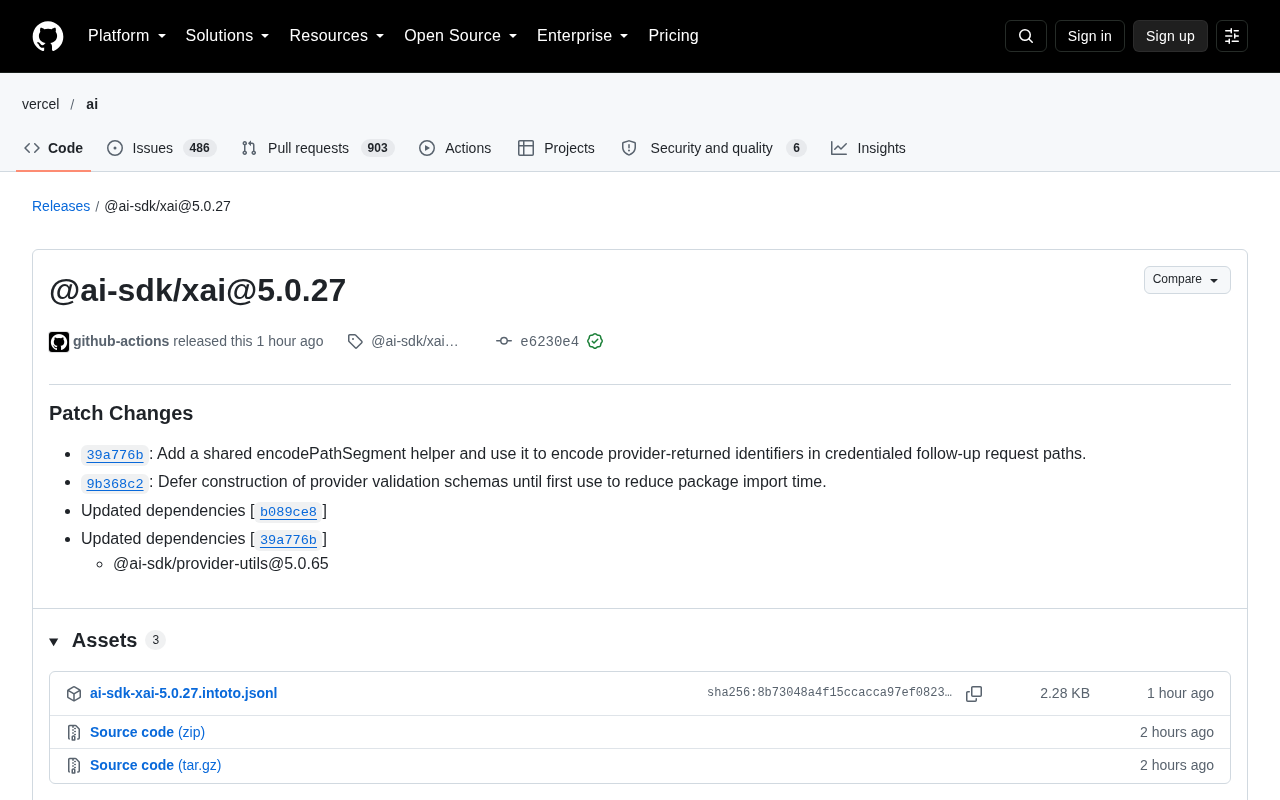
According to the changelog, this is a patch-level release that also updates the dependency @ai-sdk/provider-utils@5.0.65. For developers using xAI models, this is a recommended upgrade.
Path Segment Encoding: Consolidating the Security Boundary in One Place
The Value of a Shared Helper
The most substantive change is the addition of a shared encodePathSegment helper function, used to encode identifiers returned by the provider in "credentialed subsequent request paths."
That sentence carries a lot of meaning. The "identifiers returned by the provider" refer to ID-type fields that xAI's server sends back in responses, which may be concatenated into the URL paths of subsequent requests. If these identifiers contain special characters—slashes, spaces, question marks, hash signs, etc.—direct concatenation can break the path structure, causing request failures at best and path traversal risks at worst.
Extracting the encoding logic into a shared helper means the entire package no longer handles things independently, but instead uses the same rules for path segments. This kind of refactoring typically appears after duplicated code has been identified across multiple places—a classic case of "pain point first, abstraction later."
Why Credentialed Requests Are More Sensitive
The qualifier "credentialed" deserves special mention. Credentialed requests carry API Keys or similar authentication information. If the path is constructed in an unexpected way, credentials could be sent to unintended endpoints. Strictly encoding such request paths is essentially about reducing the attack surface.
For developers who routinely call xAI APIs, this change is likely transparent—you don't need to change any code, but your requests will become more robust.
Path traversal is a common security vulnerability: when untrusted data is directly concatenated into URL paths, attackers can use ../ or encoded equivalent sequences (such as %2e%2e%2f) to escape the expected directory hierarchy and access or trigger endpoints that should not be reachable. In server-side API scenarios, an unencoded / in a path segment will also split a single path segment into multiple segments, changing route matching results. Using encodeURIComponent-style functions on path segments escapes slashes, question marks, hash signs, and other characters into percent-encoding, ensuring that identifiers semantically always occupy exactly one path segment. Note that encodeURIComponent does not over-escape characters like !'()*; some implementations add stricter handling on top of it, which is another benefit of consolidating the logic into a shared helper—there is only one set of rules and behavior is predictable.
Lazy-Loading the Validation Schema: Making Way for Import Speed
The Lazy Construction Approach
The second change is "deferring the construction of the provider validation schema until first use." In other words, the schema object is no longer built immediately when the module is imported, but only when validation is actually needed.
This is a pragmatic performance trade-off. Building a validation schema often involves relatively heavy object assembly. If executed at the module top level, any import of the package would bear that cost—even if this run never needs the validation feature at all. Deferring to first use shifts the cost to the call paths that actually need it.
JavaScript modules execute top-level code on import; object construction and function calls at the module top level happen synchronously during import. There are two common implementations of lazy initialization: one is a closure plus cache, using a variable to track whether construction has occurred, constructing and saving it on first call; the other is ES modules' top-level await import(). The "defer until first use" described here belongs to the former, typically paired with a singleton cache to ensure construction happens only once. For validation schemas, lazy construction not only saves import time but also avoids bearing the side effects of object assembly on paths that don't need validation. The cost is a one-time construction delay on the first validation call, so the benefit is limited in high-frequency validation scenarios and more noticeable in low-frequency or cold-start-sensitive scenarios.
Practical Impact on Developer Experience
This kind of optimization is more noticeable in large projects or serverless cold-start scenarios. Shorter import times mean faster cold starts and quicker test startup. However, the benefit depends on usage patterns: if your application triggers validation frequently, the first call will see a slight delay, after which it returns to normal.
From an engineering perspective, this embodies the "pay-as-you-go" principle—don't pay for features you don't use.
Dependency Synchronization and Release Cadence
This release also updates @ai-sdk/provider-utils to 5.0.65, which is related to the path encoding changes. AI SDK provider packages generally depend on the low-level utilities provided by provider-utils; version alignment avoids inconsistencies in helper behavior.
Looking at the release cadence, the xAI provider package maintains fairly frequent patch iterations. This shows both that the upstream model API is continuously evolving and that the maintainers are actively closing edge cases. For users, keeping up with patch versions is a low-cost stability investment.
Upgrade Recommendation
This update has no breaking changes, so upgrade risk is very low. It's recommended to upgrade directly to 5.0.27 in projects using @ai-sdk/xai, especially those that handle identifiers returned by xAI and concatenate them into subsequent requests—the path encoding fix is most valuable for such usage.
If you care about cold-start performance, the lazy-loaded schema change is a nice bonus, but don't expect order-of-magnitude improvements. It's more like steady, incremental engineering polish.
One-line Summary
ai-sdk/xai 5.0.27 patches unify path segment encoding and defer validation schema construction.
Paragraph Summary
@ai-sdk/xai has released patch version 5.0.27, updating the dependency @ai-sdk/provider-utils to 5.0.65. Two substantive changes: a new shared encodePathSegment helper encodes identifiers returned by xAI in credentialed subsequent request paths, preventing special characters from breaking path structure or even causing path traversal, thereby narrowing the attack surface of credentialed requests; and deferring the construction of the provider validation schema until first use, avoiding unnecessary object assembly costs during module import, which is friendlier for serverless cold starts and test startup. The update has no breaking changes, upgrade risk is low, and projects using the xAI provider are recommended to upgrade directly.
Related articles

FastAPI: A High-Performance Python Framework and a Production-Ready API Development Powerhouse
FastAPI is a high-performance web framework based on Python type hints, supporting async and automatic OpenAPI docs. With over 100k GitHub stars, this article analyzes its core strengths, production readiness, and selection advice.

Tesla Optimus Begins Mass Production: Can the Goal of 20,000 Units Per Week Be Achieved?
Tesla Optimus officially begins mass production as Musk sets a target of 20,000 units per week. This article analyzes the supply chain challenges behind mass production, the real gap in capacity ramp-up, and the competitive landscape for humanoid robots.

PCL: A Minecraft Launcher with 8.5k Stars — Why Was It Written in VB.NET?
An in-depth analysis of PCL, the GitHub Minecraft launcher with 8,500+ stars: why it chose VB.NET, its features and China network advantages, and the limits of Windows-only.