@ai-sdk/xai 5.0.37 Patch Release: The Ecosystem Signals Behind a Dependency Update

@ai-sdk/xai releases 5.0.37 patch, only syncing the provider-utils dependency—a low-risk update.
@ai-sdk/xai 5.0.37 is a patch release centered on dependency synchronization, locking the underlying provider-utils to 5.0.73, with release notes almost entirely consisting of Updated dependencies. The release was completed automatically by GitHub Actions with a verified signature, and all three commits revolve around dependency alignment. The article explains AI SDK's layered architecture: provider-utils carries common logic such as streaming parsing, retries, and AbortSignal, and adapter packages must stay version-aligned with it. For developers using Grok models, this upgrade is a low-risk operation; it's recommended to verify streaming conversation and tool-calling use cases after upgrading. Projects that haven't encountered related issues can also hold off. The article also notes that the xAI adapter has iterated to 5.x, on par with mature adapters, and the patch-dominated cadence reflects that the integration is stabilizing.
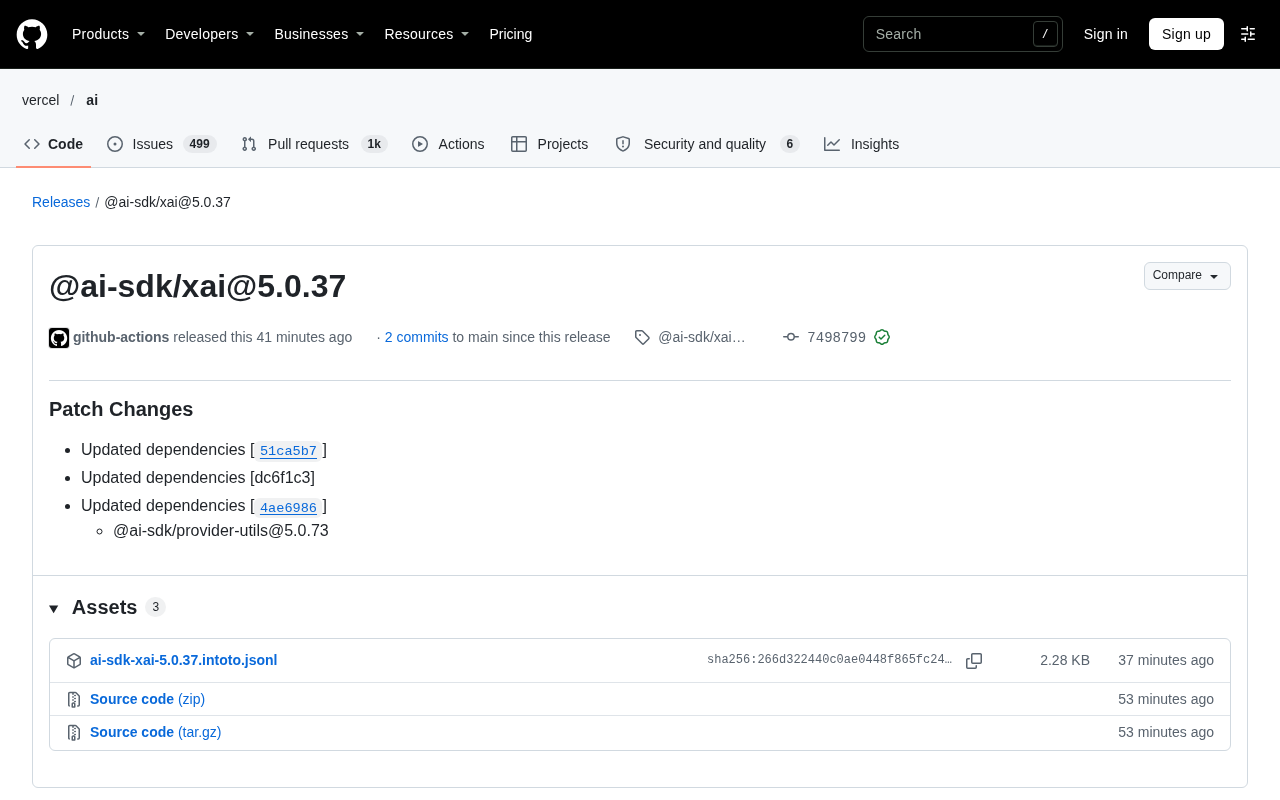
Vercel's AI SDK xAI adapter package @ai-sdk/xai has released version 5.0.37. Judging from the GitHub Release page, this is a typical patch update (Patch Changes), with the core content centered on synchronized dependency upgrades, involving @ai-sdk/provider-utils@5.0.73 and several other related commits.
A "Quiet" Patch Release
This version introduces no new features and no breaking changes—the release notes are almost entirely occupied by "Updated dependencies." All three commits (51ca5b7, dc6f1c3, 4ae6986) point to dependency updates, ultimately locking the provider-utils version at 5.0.73. The release was completed automatically by GitHub Actions, and the commit carries a GitHub-verified signature (GPG key ID: B5690EEEBB952194), consistent with Vercel team's long-standing automated release workflow.
For readers unfamiliar with this toolchain, it's worth first understanding the relationship between the packages: AI SDK uses a layered architecture. provider-utils is the underlying shared utility library, handling request construction, streaming parsing, error handling, and other common logic across model providers. @ai-sdk/xai, meanwhile, is the adapter layer for xAI (the Grok family of models), translating the unified SDK interface into request formats that the xAI API can understand. The two version numbers evolve independently, but the adapter layer must stay aligned with the underlying utility library.
GitHub Actions is GitHub's continuous integration and continuous deployment (CI/CD) platform, allowing repository maintainers to define automated workflows via YAML configuration files. In Vercel's release process, GitHub Actions typically listens for version tag pushes or merge events, automatically executing steps such as testing, building, version bumping, changelog generation, and npm publishing. The GitHub-verified signature on the commit (GPG key ID: B5690EEEBB952194) indicates that the commit was generated by an automated account holding the corresponding private key rather than by manual operation, providing cryptographic assurance of release integrity and traceability. This fully automated release approach reduces the risk of human error and explains why patch versions can be output frequently and stably.
Why Dependency Updates Deserve Attention
Looking at the version number alone, upgrading from some provider-utils version to 5.0.73 seems merely routine. But in AI SDK's release cadence, patch versions of provider-utils often carry detailed fixes for streaming response parsing, retry strategies, AbortSignal handling, and more. When the adapter package follows suit with an upgrade, it means developers using @ai-sdk/xai indirectly gain these underlying improvements without having to manually pin or override dependencies.
This kind of "follow-along" release is also a sign of a healthy multi-provider SDK ecosystem. AI SDK simultaneously maintains multiple adapters including OpenAI, Anthropic, Google, and xAI, and any change to an underlying package requires synchronized verification across adapters—otherwise runtime exceptions caused by version drift can easily occur. The fact that all three commits in this release center on dependency synchronization shows the team is actively converging version differences.
AbortSignal is a signal mechanism in the Web standard used to cancel asynchronous operations. In the context of AI SDK, it allows developers to terminate an in-progress streaming conversation request midway—for example, when a user switches to another topic or closes the page. Handling of AbortSignal in provider-utils involves correctly passing the cancellation signal down to the underlying fetch request, cleaning up the streaming reader after cancellation, and distinguishing active cancellation from network errors. If these details are handled improperly, they can lead to memory leaks, uncaught Promise rejections, or connections not being released promptly. Therefore, although patch updates to provider-utils are small, they can directly affect resource management and user experience in production environments.
Practical Impact on Developers
If you use @ai-sdk/xai in your project to call Grok models, upgrading to 5.0.37 is a low-risk operation—patch versions don't involve API signature changes and usually only require updating the lockfile. It's recommended to run your existing streaming conversation and tool-calling tests after upgrading to confirm that behavior changes in provider-utils don't affect your use cases.
For projects pinned to older versions, there's no need to rush to follow along. The benefits of patch-level dependency updates are mainly the accumulation of bug fixes; if you haven't encountered related issues, staying put is equally reasonable. What's really worth watching is the next minor version, which may bring integration of new xAI-side capabilities.
A lockfile is a dependency-locking file generated by a package manager (such as npm's package-lock.json, pnpm's pnpm-lock.yaml, or Yarn's yarn.lock), recording the exact version number and integrity hash of every dependency package in the project. When @ai-sdk/xai is upgraded, the version number change of the direct dependency triggers an update to the corresponding entry in the lockfile, and may also cause its transitive dependencies (such as provider-utils) to be refreshed along with it. For projects using semantic version ranges (such as ^5.0.0), running npm update or reinstalling will fetch the patch update; if the project uses exact version pinning, you'll need to manually change the version number in package.json. Understanding the lockfile update mechanism helps determine whether an upgrade has introduced unexpected transitive dependency changes.
Judging xAI Adapter Maturity from Release Cadence
As a provider that entered AI SDK's support list relatively late, xAI's adapter package has already iterated to the 5.x series, with version numbers on the same order of magnitude as mature adapters like OpenAI and Anthropic—which in itself indicates that the integration has become relatively stable. Frequent patch releases rather than major version jumps also fit the phase characteristic of "stable interfaces, polished details."
What's worth continuing to watch is the degree to which xAI model capabilities (especially tool calling and structured output) are covered in the adapter layer. Dependency synchronization is only surface-level; whether the adapter can keep up with new features of the xAI API in a timely manner is the key metric for measuring the quality of this integration. This release doesn't reveal information in this regard—the release notes of subsequent minor versions will be a better observation window.
Related articles

AI Coding Enters the Team Collaboration Era: Interpreting Three Major Moves from Meta, GitHub, and Mistral
Meta acquires Conductor, GitHub Copilot Fusion becomes available, Mistral opens Large 4 weights—three moves show AI coding shifting from code generation to organizing development workflows. This article explains task orchestration, model collaboration, and cost control for developers.

Building a RAG Assistant with Dify: A Practical Guide to Knowledge Bases, Workflows, and Agent Nodes
How should knowledge bases, workflows, and Agent nodes connect in a Dify RAG assistant? We break down the division of labor and wiring logic for a shippable app.
 Tech Frontiers
The AI Industry Doesn't Lack Marketing—It Lacks Good Products
AI faces market selloffs and public skepticism—is marketing really the problem? This analysis of market signals and product experience argues the core困境 is incomplete products and a gap between promises and experience; the only way to change perceptions is to ship better products.