@ai-sdk/xai 5.0.38 Patch Release: The Ecosystem Signals Behind a Dependency Update

@ai-sdk/xai releases 5.0.38 patch, upgrading the shared utility package to 5.0.74.
Vercel's @ai-sdk/xai package released patch 5.0.38, with the only substantive change being an upgrade of the foundational @ai-sdk/provider-utils dependency to 5.0.74, with no new features or public API changes. It was auto-published by github-actions with a GitHub-verified signed commit, reflecting a standardized CI process. The article notes that provider-utils carries cross-provider shared logic like request construction, streaming parsing, and error mapping, and its version sync prevents hidden behavioral divergence between adapters — key for multi-model routing or fallback apps. The upgrade is nearly transparent for most developers, but checking utility package version consistency across providers and watching for version drift is still advised.
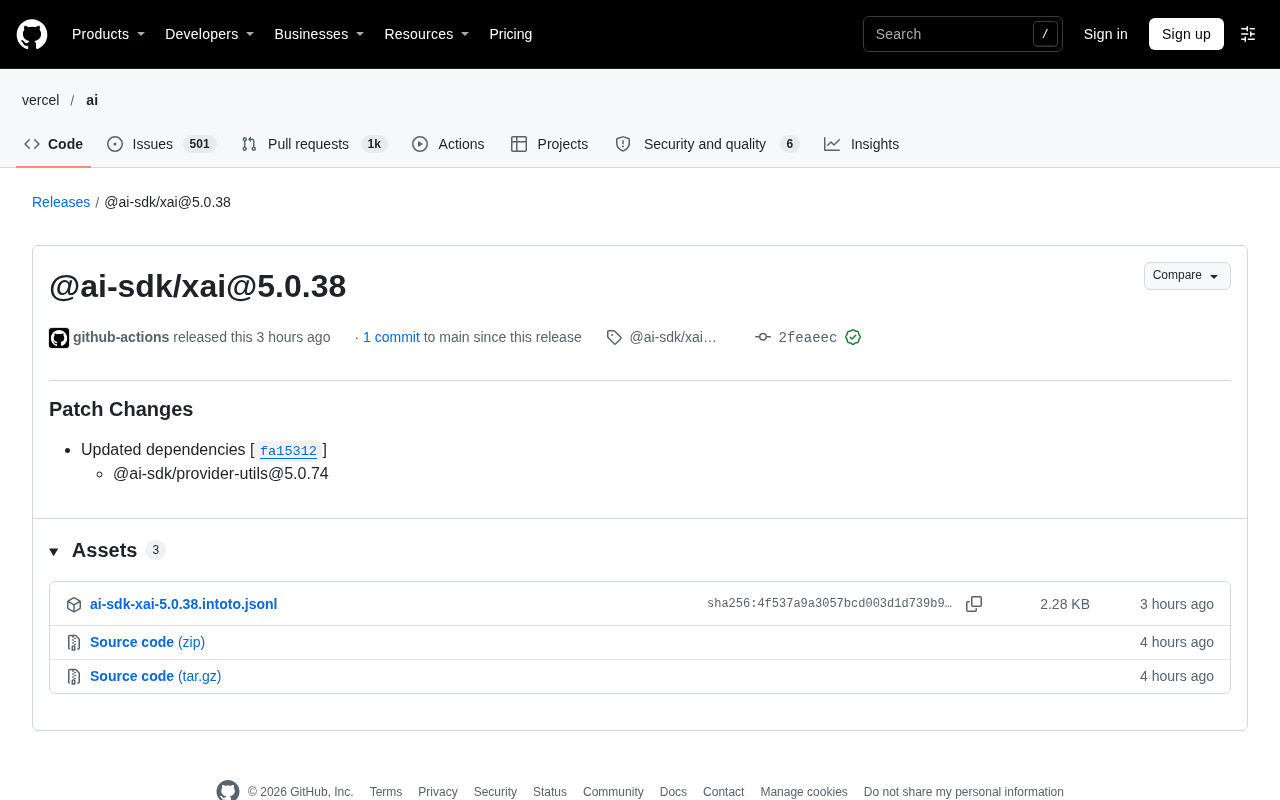
The AI SDK ecosystem has another small iteration. Vercel's @ai-sdk/xai package released version 5.0.38, marked as Patch Changes, with just one core change: upgrading its dependency on @ai-sdk/provider-utils to 5.0.74. For everyday developers, this looks like a routine version bump, but within the overall AI SDK architecture, it reveals a toolchain that is steadily evolving toward more refined governance.
A Full Picture of a Patch Update
According to the release record on GitHub, @ai-sdk/xai@5.0.38 was auto-published by github-actions, with commit hash 2feaeec. The commit carries a GitHub-verified signature (GPG key ID: B5690EEEBB952194), indicating the release process went through the official CI pipeline's standardized handling. The changelog explicitly labels "Patch Changes" and references the dependency update commit fa15312.
This update introduces no new features and has no public API changes, making it a maintenance release. For developers using @ai-sdk/xai, upgrading mainly brings cumulative fixes and improvements from the upstream provider-utils package.
Why Dependency Updates Matter
@ai-sdk/provider-utils is a shared foundation package used by multiple providers in the AI SDK, handling request construction, streaming response parsing, error mapping, and other low-level logic. Its version changes simultaneously affect the consistency of multiple provider implementations, including xAI, OpenAI, and Anthropic.
Upgrading provider-utils to 5.0.74 means the xAI adapter layer can align with the latest utility function behavior. This seemingly trivial synchronization is precisely what prevents "hidden behavioral divergence" between providers. In scenarios where an AI application needs to connect to multiple models at once, consistency in the shared utility layer directly affects debugging costs and runtime stability.
Judging by the release cadence, the AI SDK team uses an automated release process where every dependency update triggers a separate patch version. This approach makes version history traceable and allows developers to pin versions as needed.
The AI SDK's layered architecture: Vercel's AI SDK uses a layered design of "core abstractions + provider adapters + shared utility packages." The ai core package defines unified interfaces such as LanguageModelV1, @ai-sdk/provider-utils provides cross-provider infrastructure for request construction, streaming parsing (such as SSE's EventSourceParserStream), error mapping, and retries, while adapters like @ai-sdk/xai and @ai-sdk/openai only handle the differences in each vendor's API. The significance of this layering: when the utility package fixes a boundary bug in streaming chunks, all providers benefit simultaneously without having to patch it individually. Conversely, if an adapter pins an older version of the utility package, it may produce different outputs from other providers given the same input — this is the technical root of the "hidden behavioral divergence" mentioned in the article.
Practical Impact on Developers
If your project directly depends on @ai-sdk/xai, this patch upgrade is essentially transparent and won't break existing code. But if you strictly pin dependency versions, it's worth taking this opportunity to check whether the provider-utils version is consistent with other provider packages.
For applications building multi-model routing or fallback mechanisms, keeping the underlying utility package versions in sync across providers can reduce boundary issues caused by differences in streaming response formats. Although patch-level updates typically don't involve breaking changes, cross-package version drift remains a maintenance risk worth watching.
The automated publishing plus signature verification process also reflects the AI SDK's emphasis on supply chain security. In AI application development where open-source dependencies are frequently introduced, a verifiable release source is one of the basic lines of defense.
What SemVer and "patch level" mean: In the npm ecosystem's semantic versioning convention, an increment in the patch number (third digit) indicates a backward-compatible bug fix and should not introduce new public APIs or breaking changes. Therefore, releases like 5.0.38 are theoretically safe upgrades, and the ^5.0.38 range will automatically accept subsequent patches. However, note that AI SDK packages release frequently in a "small steps, fast pace" manner, and multiple interdependent packages may each advance several patch versions in a short time. If a project uses --save-exact for precise pinning, it's easy for the utility package version depended on by @ai-sdk/xai to diverge from the version depended on by @ai-sdk/anthropic. In practice, you can use npm ls @ai-sdk/provider-utils or pnpm why to check for duplicate installed copies (multi-version duplication), and if necessary, force unification with the overrides/resolutions field.
Ecosystem Maturity Through Version Numbers
@ai-sdk/xai has reached the 5.x series, and provider-utils is also iterating rapidly in the 5.x range. Version numbers alone don't say much, but release frequency and dependency governance reflect a project's maturity: small change granularity, high automation, and clear records for every release.
Such patch updates won't make headlines, but they are a true reflection of the day-to-day operation of the AI development toolchain. For developers, paying attention to these subtle version signals helps more than chasing major version announcements to understand the actual direction of ecosystem evolution.
This article is based on version information published in the RSS source; the screenshot shows the original interface of the release page.
GPG signature verification and supply chain security: GitHub automatically attaches signatures to commits made through the web interface or official CI using GitHub-hosted keys, and the commit page displays a "Verified" badge along with the corresponding GPG key ID. Compared with public keys generated and uploaded locally by developers, GitHub-hosted keys are managed by the platform, lowering the verification threshold — but it also means it verifies that "the commit was produced through GitHub's identity authentication channel," not that the committer holds the private key on their local machine. Against the backdrop of frequent dependency chain security incidents, signature verification combined with integrity hashes in lockfiles forms two basic integrity defenses in the npm ecosystem: the former confirms source identity, the latter confirms package contents haven't been tampered with.
One-line Summary
@ai-sdk/xai releases 5.0.38 patch, primarily upgrading the shared utility package to 5.0.74.
Paragraph Summary
Vercel's @ai-sdk/xai package released patch version 5.0.38, with the only substantive change being an upgrade of the foundational utility package @ai-sdk/provider-utils dependency to 5.0.74, introducing no new features or public API changes. This version was auto-published by github-actions, with the commit carrying a GitHub-verified signature, reflecting a standardized CI process. The article notes that provider-utils carries cross-provider shared logic such as request construction, streaming parsing, and error mapping, and its version synchronization prevents hidden behavioral divergence between multiple adapters — especially critical for applications building multi-model routing or fallback. For everyday developers, the upgrade is nearly transparent, but it's still advisable to check whether utility package versions are consistent across provider packages and to watch for maintenance risks from version drift.
Related articles

VERS: Editing Activation Explanations to Halve Reasoning Model Tokens
VERS guides reasoning models by editing activation explanations, cutting 45.8% of tokens on GSM8K with only a 0.82 pp accuracy drop and transferring to larger models, but losing accuracy on competition problems.

Finding Errors Is Not Enough: Selective Model Escalation for Entity-Targeted Sentiment Analysis
This study explores selective model escalation for entity-targeted sentiment analysis, comparing data collection ordering, uncertainty-driven re-examination, and model routing—finding that minority-class priority only helps at very small data volumes, the oracle upper bound far exceeds actual gains, and escalation must be tailored to each dataset.

WAS-PO: Using Whitened Advantages to Solve the Correlation Trap in Multi-Reward Reinforcement Learning
WAS-PO paper proposes whitening advantages to correct correlation bias in multi-reward RL: when rewards are correlated, naive weighted summation effectively applies Σ^{1/2}w instead of w. Experiments show training reward improves steadily, but held-out accuracy does not improve in sync, and under two rewards it actually falls behind.