@ai-sdk/xai 5.0.43 Patch Release: What a Dependency Update Signals About the Ecosystem

@ai-sdk/xai 5.0.43 only syncs provider-utils to 5.0.79, reflecting the AI SDK's modular maintenance approach.
@ai-sdk/xai has released patch version 5.0.43, whose sole substantive change is upgrading the shared underlying dependency @ai-sdk/provider-utils to 5.0.79. It was auto-published by github-actions with signature verification, and 8 commits were merged since the prior version. Provider packages handle each model's API, while provider-utils consolidates request construction, error handling, and stream parsing, so dependency syncing gives all providers uniform fixes without changing business code. The author advises following such patches in production but checking dependency-tree deduplication and reviewing the utility layer's changelog. The high-frequency small-version maintenance signals that AI SDK's abstraction layer has stabilized, with focus shifting to reliability and consistency.
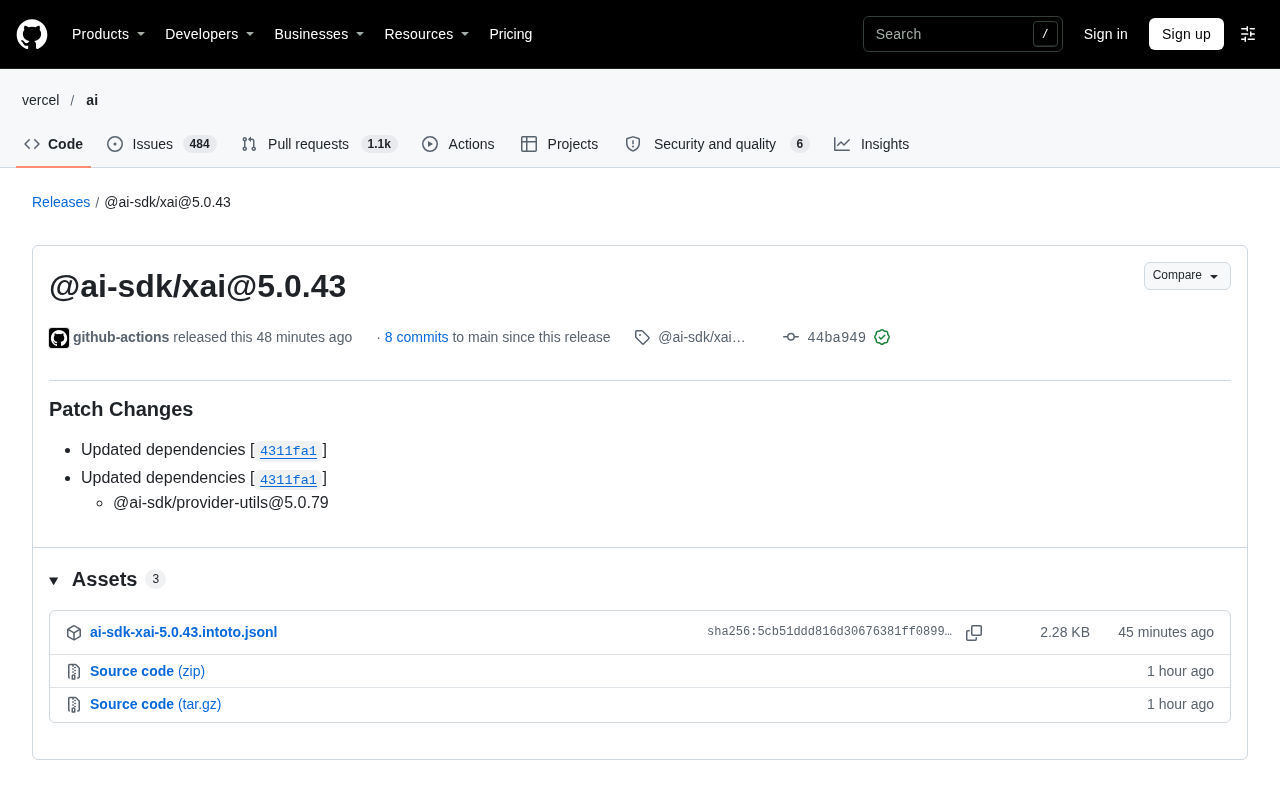
Vercel's AI SDK ecosystem has seen another small iteration. @ai-sdk/xai has released version 5.0.43, with a changelog just a few lines long—a patch update whose core change is syncing @ai-sdk/provider-utils to 5.0.79. For developers who don't track SDK release cadences, this information is almost lost in the flood of GitHub Releases; but when placed back into the modular architecture of the AI SDK, these "unremarkable" patches are precisely the underlying guarantee of ecosystem stability.
What a patch that's "only a dependency update" means
From the release notes, 5.0.43's Patch Changes contain only one substantive item: updating the dependency @ai-sdk/provider-utils to version 5.0.79. The commit (44ba949) carries a verified signature on GitHub, was auto-published by github-actions, and has had a cumulative 8 commits merged into the main branch since the previous version.
The keyword here is provider-utils. In the AI SDK's design, provider packages (such as @ai-sdk/xai, @ai-sdk/openai, etc.) are responsible for interfacing with the APIs of various model service providers, while provider-utils is the shared underlying utility layer for these packages—common logic such as request construction, error handling, and streaming response parsing all lives here. When the utility layer ships a fix, all provider packages can uniformly receive it through dependency upgrades, without each one reinventing the wheel.
This is exactly the value of a modular SDK: upper-layer packages stay lightweight, and shared capabilities are pushed down for reuse. For developers using xAI models, upgrading to 5.0.43 usually requires no changes to business code, but indirectly gains stability improvements from the utility layer.
Where the xAI provider sits in the AI SDK landscape
@ai-sdk/xai is the officially maintained xAI integration package for the AI SDK, allowing developers to call xAI's models through unified interfaces like generateText and streamText, without writing a separate adapter for each service provider. This "one set of interfaces, multiple backends" model is why the AI SDK is widely adopted for application-layer development.
For this reason, provider package version numbers often move in lockstep with the underlying toolchain. In a three-part version number like 5.0.43, a small increment in the patch position usually corresponds to dependency syncing or minor bug fixes, while the minor position carries new capabilities. Watching version number changes can help you judge whether an upgrade is "routine maintenance" or a "feature iteration."
What the AI SDK's provider abstraction layer is
The AI SDK's core design abstracts "model invocation" into a unified interface: methods like generateText, streamText, and embed are defined in the core package, while the specifics of how to assemble HTTP requests, how to parse SSE streams, and how to handle each provider's different error codes are left to the individual provider packages to implement. Each provider package exports a factory function (such as createXai) that returns an object conforming to specifications like LanguageModelV1. The core package depends only on these specifications, not on any specific vendor, so adding or replacing a model service requires almost no changes to business code.
The division of labor between provider-utils and the spec package
@ai-sdk/provider holds pure type and interface definitions (model capabilities, message formats, tool-call structures, etc.) and contains no runtime logic; @ai-sdk/provider-utils provides executable shared implementations, such as request retries, JSON stream parsing, and common request functions like postJsonToApi. The two usually upgrade in pairs: the spec package defines "what it looks like," and the utility package provides "how to do it." Understanding this division of labor makes it clear why a provider package patch often amounts to nothing more than a change in the utility package's version number.
How developers should treat these patches
If you have pinned a minor version of @ai-sdk/xai in production, these patch updates can generally be followed with confidence. The automated publishing process (triggered by github-actions) and signature verification mean the release pipeline itself is protected and the source is trustworthy.
What deserves more attention is actually the dependency chain. If the provider-utils version upgrade is referenced by multiple provider packages at the same time, duplicate dependencies may appear in your project. After upgrading, it's recommended to use your package manager's deduplication capability to check the dependency tree. For projects with strict dependency locking, you can review the specific changes in provider-utils@5.0.79 to confirm whether they involve the streaming response or error handling paths you are using.
"Small versions" from an ecosystem perspective
The value of a single patch is limited, but continuous observation reveals a pattern: the AI SDK's provider ecosystem is in a period of high-frequency maintenance, with dependency syncing and utility-layer fixes occurring far more often than major feature updates. This indicates that the abstraction layer has stabilized, and the maintenance focus has shifted toward reliability and consistency. For developers, this means the cost of integrating new model service providers continues to decrease, and the friction of migrating across providers also diminishes.
Placed within this trend, 5.0.43 is not just a version number, but a snapshot of the AI SDK's modular architecture continuously operating.
What semantic versioning actually means in provider packages
The AI SDK's provider packages follow Semantic Versioning (SemVer), but this must be understood in conjunction with the release strategy: the patch position is used for dependency syncing and bug fixes, ensuring no change to the public API; the minor position introduces new models, new parameters, or new capabilities; and the major position may adjust interface signatures or remove deprecated fields. Because provider packages are version-linked with provider-utils, a patch upgrade can also indirectly bring behavioral changes (for example, boundary fixes in streaming parsing). Therefore, "patch means risk-free" is not absolute; applications sensitive to error handling and streaming output should still consult the changelog for the corresponding provider-utils version.
One-line Summary
@ai-sdk/xai 5.0.43 merely syncs provider-utils to 5.0.79, reflecting the AI SDK's modular maintenance approach.
Paragraph Summary
@ai-sdk/xai has released patch version 5.0.43, whose only substantive change is upgrading the shared underlying dependency @ai-sdk/provider-utils to 5.0.79. It was auto-published by github-actions with signature verification, and 8 commits have been merged since the previous version. The article notes that provider packages handle integration with each model's API, while provider-utils consolidates common logic such as request construction, error handling, and stream parsing; dependency syncing lets all providers receive fixes uniformly without changing business code. The author suggests that production environments can safely follow such patches, but should check dependency tree deduplication and review the utility layer's changelog. From an ecosystem perspective, the high-frequency small-version maintenance of provider packages shows that the AI SDK abstraction layer has stabilized, with the maintenance focus shifting toward reliability and consistency.
Related articles

From 0 to 1: Vibe Coding an AI Knowledge Base — A Practical Retrospective and Tech Stack Breakdown
A retrospective on building the AI knowledge base OilBook from scratch with Vibe Coding: Next.js+Neon stack, Oil Dev Skill workflow, Stripe paywall security, interview-style writing, AI-flavor control, and Vercel deployment.

GLM-5.4 Hands-On: Native Vision Meets a New Vibe Coding Workflow
Hands-on with Zhipu GLM-5.4: native vision tested across a 3D product demo, pure-code video generation, and remote-control Vibe Coding, compared with GPT-6.2 and Gemini Neon.

AI and Humans Claim to Prove the Riemann Hypothesis: Machine-Verified, Yet Nobody Can Understand It
Anthropic mathematician and AI Claude claim to prove the Riemann Hypothesis with 17 million lines of Lean code, machine-verified but unreadable by humans. This article analyzes the event, the zero proportion record from 41.6% to 67.2%, and the gap between machine verification and human understanding.