AI SDK xAI 5.0.45 Patch Released: The Maintenance Logic Behind Dependency Updates

@ai-sdk/xai releases patch 5.0.45, only syncing provider-utils to 5.0.81—a low-risk dependency update.
@ai-sdk/xai@5.0.45 is a typical patch update whose only change is syncing the underlying shared dependency @ai-sdk/provider-utils to version 5.0.81. This version was automatically published by github-actions with a GPG verified signature through a standardized CI process, introducing no new APIs and not changing external behavior. The article explains AI SDK's layered architecture: a unified upper interface, provider-specific adapter packages below, and provider-utils in the middle handling common logic such as request construction and streaming processing, so version synchronization of the shared library directly affects call chain consistency. For developers, such patches are low-risk updates, best upgraded along with routine dependency maintenance and followed by a round of integration tests to confirm no behavior changes; more important is the version trajectory of provider-utils itself, since its impact is broader.
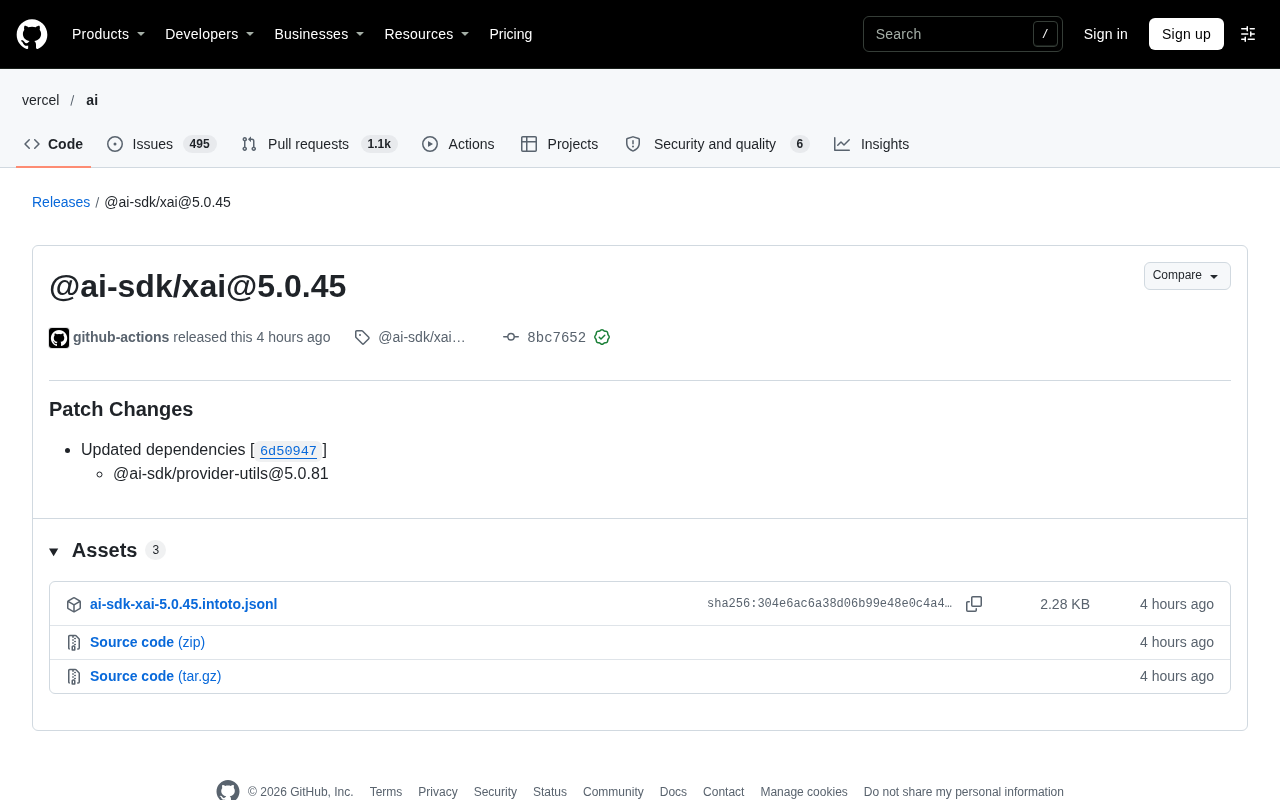
The xAI adapter package in the AI SDK ecosystem, @ai-sdk/xai, has released version 5.0.45. Judging from the release record, this is a typical patch update, with the core action being to sync the underlying dependency @ai-sdk/provider-utils to version 5.0.81. For developers using Vercel AI SDK to connect to xAI models, such updates may seem unremarkable, but they directly affect the stability of the call chain.
The Substance of a Patch Update
The release notes on GitHub show that the change type for @ai-sdk/xai@5.0.45 is marked as Patch Changes, with the only modification being an update to the dependency @ai-sdk/provider-utils@5.0.81. The commit was automatically published by github-actions and carries a GitHub verified signature, indicating that the entire process runs through a standardized CI pipeline.
Such patches do not introduce new APIs or change external behavior. Their value lies in aligning the provider layer's shared utility functions to the latest state. provider-utils handles foundational capabilities such as request construction, response parsing, and streaming processing, and the xAI adapter package relies on it to interface with the xAI API. An outdated dependency version may lead to protocol inconsistencies or error-handling differences in specific scenarios.
The Role of provider-utils in the AI SDK Architecture
In the layered structure of Vercel AI SDK, @ai-sdk/provider defines the unified interface specification that all model provider adapter packages must implement, while @ai-sdk/provider-utils is the collection of shared utility functions used by these adapter packages. It encapsulates the infrastructure related to HTTP communication: serialization of request bodies, parsing of Server-Sent Events (SSE) streams, normalization of error responses, and retry and timeout logic. Adapter packages (such as @ai-sdk/xai and @ai-sdk/openai) themselves are only responsible for mapping provider-specific API parameters to the unified interface; the actual low-level communication details are delegated to provider-utils. Therefore, when provider-utils fixes edge cases in stream parsing or adjusts the structure of error objects, all downstream adapter packages need to inherit these fixes through version synchronization; otherwise, "version drift" may occur, where the same utility library behaves inconsistently across different adapter packages.
Why Dependency Synchronization Deserves Attention
AI SDK adopts a layered design: the upper layer is the unified interface for developers, the lower layer consists of adapter packages for various model providers, and the middle is bridged by shared libraries like provider-utils that handle common logic. When a shared library fixes edge cases or adjusts internal conventions, adapter packages need to follow up and sync; otherwise, version drift occurs.
For projects in production environments, such patches are generally recommended to be upgraded along with routine dependency updates. They bring no migration cost but can prevent occasional issues caused by inconsistent versions of underlying utilities. The release record does not list the specific change entries in provider-utils 5.0.81, so the actual impact scope needs to be judged by developers based on the features they use.
Signals from the Automated Release Process
This version was published by the github-actions bot, and the commit carries a GPG verified signature. This pattern means the AI SDK team has fully delegated version releases to automated pipelines, with human intervention limited to merging changes. For users, this improves the predictability of the release cadence and reduces the probability of human error.
Consistent with AI SDK's long-standing multi-package management strategy, the version numbers of the xAI adapter package and provider-utils evolve independently, and an increment in the patch number reflects a change in the dependency relationship rather than a feature iteration. Paying attention to such release records can help developers determine when to refresh their lock files.
Changesets and Multi-Package Version Management
The AI SDK repository uses Changesets as its multi-package version management tool. Developers include a changeset file in a PR describing the change type (major/minor/patch); after merging, the CI pipeline automatically calculates the version increment for each package, generates the CHANGELOG, and publishes to npm. This is exactly why patch numbers evolve independently: the version number of @ai-sdk/xai only reflects changes to that package itself, while the version number of its dependency provider-utils advances along its own changeset trajectory. When a patch of provider-utils is released, the adapter packages that depend on it are automatically triggered to publish a "dependency update" type patch release, with only the dependency version change recorded in their CHANGELOG. Understanding this mechanism explains why a version number like 5.0.45 does not itself carry functional semantics—the real change information should be found in the release notes of provider-utils.
How Developers Should Handle Such Updates
If your project calls xAI models through AI SDK, 5.0.45 is a low-risk update and can be upgraded at the usual pace. After upgrading, it is recommended to run your existing integration tests to confirm that request and streaming response behavior has not changed. For projects that pin dependency versions, this can be handled together with the next scheduled maintenance.
What is more worth watching is actually the version trajectory of provider-utils itself. It is the common foundation for multiple adapter packages, and its changes often have a broader impact. Focusing on the release notes at this layer is more efficient than tracking the patch numbers of each adapter package one by one.
Conclusion
@ai-sdk/xai@5.0.45 is a routine dependency synchronization patch with no functional changes. It reminds us that much of the maintenance work for multi-package architectures like AI SDK happens between the adapter layer and the shared utility layer. Understanding this relationship helps manage dependency upgrades more calmly.
One-line Summary
@ai-sdk/xai releases patch 5.0.45, only syncing provider-utils to 5.0.81—a low-risk dependency update.
Paragraph Summary
@ai-sdk/xai@5.0.45 is a typical patch update whose only change is syncing the underlying shared dependency @ai-sdk/provider-utils to version 5.0.81. This version was automatically published by github-actions with a GPG verified signature through a standardized CI process, introducing no new APIs and not changing external behavior. The article explains AI SDK's layered architecture: a unified upper interface, provider-specific adapter packages below, and provider-utils in the middle handling common logic such as request construction and streaming processing, so version synchronization of the shared library directly affects call chain consistency. For developers, such patches are low-risk updates, best upgraded along with routine dependency maintenance and followed by a round of integration tests to confirm no behavior changes; more important is the version trajectory of provider-utils itself, since its impact is broader.
Related articles

Prompt Engineering for Beginners: From Writing Prompts to Engineering Thinking
Starting from the essence and four functions of prompts, this article systematically explains the six-step process, four success criteria, learning value, and practical limitations of prompt engineering to help you build a complete understanding.

Anthropic Launches Nasdaq IPO: AI Giant's Listing and Risk Disclosures
Anthropic officially launches its Nasdaq IPO under ticker ANT, with market valuation expected to potentially exceed SpaceX's record. The prospectus devotes nearly 100 pages to AI risks, while first-half revenue grew over 14x but net losses widened sharply, reigniting the AI bubble debate.

Rust cURL Clone Uses 4,832 unsafe Blocks—Is the Memory Safety Myth Broken?
A Rust cURL clone uses 4,832 unsafe keywords, challenging Rust's memory safety narrative. We analyze what unsafe really means, compare Fil-C, and examine rewrite motives.