@ai-sdk/zai 1.0.6 Released: Patch Version with Dependency Updates

@ai-sdk/zai 1.0.6 patches dependency versions with no breaking changes — safe to upgrade.
`@ai-sdk/zai` 1.0.6 is a pure dependency-sync patch update, bumping `@ai-sdk/provider-utils` to 3.0.40 and `@ai-sdk/openai-compatible` to 1.0.57, with no new features or breaking changes. As a model provider package in the Vercel AI SDK ecosystem, it uses a unified abstraction layer to let developers call different model vendors through a consistent API built on the OpenAI-compatible interface standard. This cascading release pattern is typical in monorepos — when a shared base package updates, upstream providers follow suit. Existing users can safely upgrade via their package manager and run their test suite to confirm compatibility.
The @ai-sdk/zai provider in the Vercel AI SDK ecosystem has released version 1.0.6. This is a patch-level update focused on syncing dependency upgrades, with no new features or breaking changes introduced.
What's in This Update
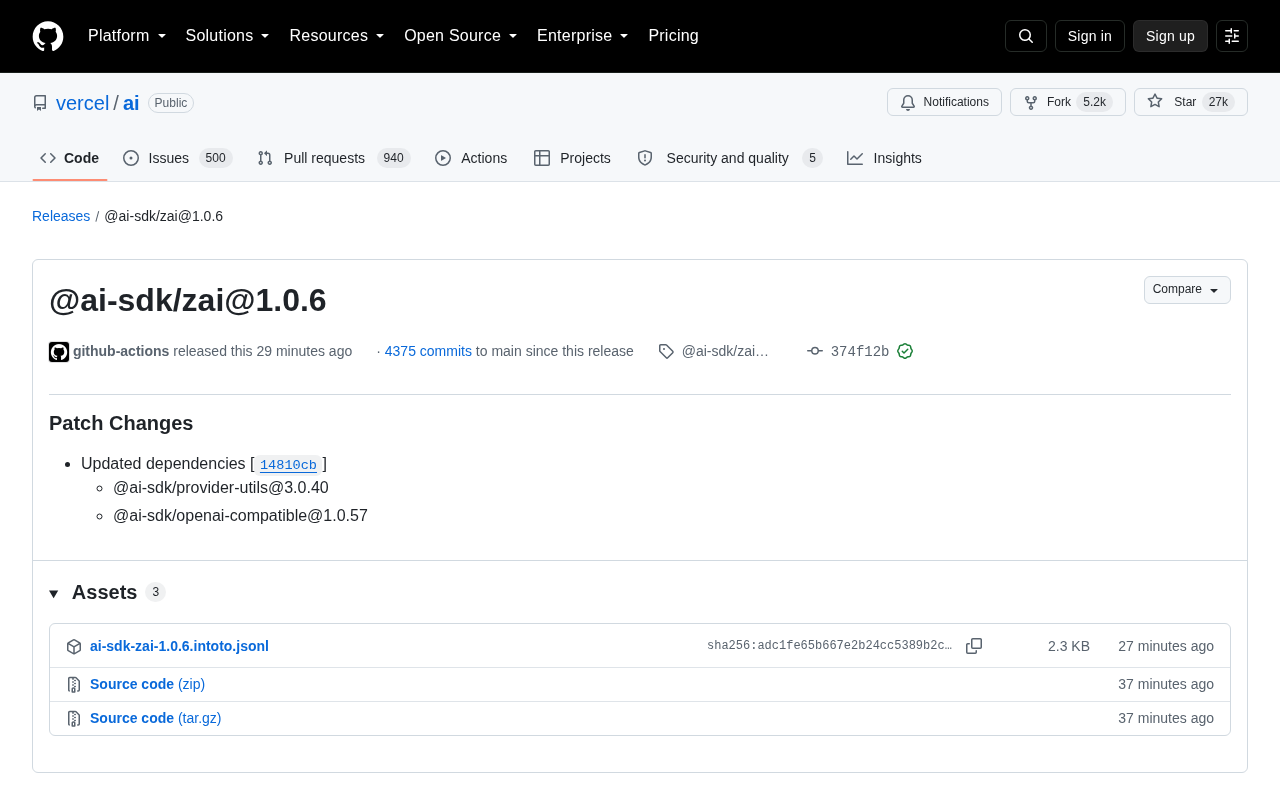
According to the GitHub Release page, @ai-sdk/[email protected] falls under Patch Changes, with the core updates being dependency bumps:
- Updated dependency
@ai-sdk/[email protected] - Updated dependency
@ai-sdk/[email protected]
This version was automatically published via GitHub Actions at commit hash 374f12b, and has been verified with an official GitHub GPG signature (key ID: B5690EEEBB952194), ensuring the trustworthiness of the release source.
What Is @ai-sdk/zai
@ai-sdk/zai is a model provider package within the Vercel AI SDK family. The Vercel AI SDK (repository: vercel/ai) is one of the most widely adopted toolkits for frontend and full-stack developers building AI-powered applications, having earned approximately 27k stars and 5.2k forks on GitHub with a highly active community.
Provider packages like this one serve to offer a standardized interface for connecting to specific model services. Through a unified SDK abstraction layer, developers can call models from different vendors using a consistent API, without having to rewrite integration logic for each provider. The fact that this version depends on @ai-sdk/openai-compatible indicates that the provider is implemented on top of the OpenAI-compatible interface.
@ai-sdk/openai-compatible is the foundational package within the Vercel AI SDK designed to interface with "OpenAI-compatible APIs." OpenAI-compatible APIs refer to the practice by many third-party model service providers — such as Together AI, Groq, Mistral, and locally deployed Ollama — of directly replicating OpenAI's REST API specification to reduce migration costs for developers. This allows code originally written to call GPT-series models to switch to these services with little to no modification. @ai-sdk/zai relies on this package to communicate with its target model service, which means the underlying model service also follows this compatibility protocol rather than a proprietary interface.
What a Patch Update Means
Following Semantic Versioning (SemVer), 1.0.6 is simply a PATCH increment over 1.0.5, meaning this update is fully backward compatible and will not break any existing code. For projects currently using this provider, upgrading is generally safe and recommended — it pulls in the latest fixes from the underlying provider-utils and compatibility layer.
This kind of cascading version release triggered by dependency updates is very common in large monorepo projects. The Vercel AI SDK uses a unified version management strategy: when a low-level shared package (such as provider-utils) is updated, the higher-level provider packages automatically follow with their own releases, ensuring consistency across the entire ecosystem.
Semantic Versioning (SemVer) defines version numbers in a three-part structure: MAJOR.MINOR.PATCH. A PATCH increment specifically refers to backward-compatible bug fixes; a MINOR increment indicates new backward-compatible functionality; and a MAJOR increment signals breaking, incompatible changes. Understanding this convention helps developers quickly assess upgrade risk: patch versions are safe to upgrade without concern, minor versions warrant a look at whether new features conflict with your usage patterns, and major versions require careful review of migration guides. In a monorepo setup (such as Vercel AI SDK's use of Turborepo or Changesets), a single patch update to a shared low-level package often triggers synchronized patch releases across multiple dependent sub-packages — a "version waterfall" effect. This is precisely the scenario behind the 1.0.6 release.
Recommendations for Developers
If your project depends on @ai-sdk/zai, you can upgrade directly to 1.0.6 via your package manager to pick up the latest dependency fixes. Since this is a pure dependency-sync patch release, no changes to your business logic should be necessary.
It's worth noting that the release notes for this version do not detail the specific fixes made in provider-utils or openai-compatible. If you need to understand the underlying changes, refer to the changelogs of those respective packages.
Related articles

Felix Rieseberg Personal Homepage
Felix Rieseberg's personal homepage sparks attention on Hacker News. This article covers the Slack engineer's technical background, the rise and fall of nativefier, and the value of a developer homepage as a tech calling card.

@ai-sdk/vue 3.0.306 Patch Release Syncs with [email protected] Update
@ai-sdk/vue 3.0.306 released, synced with [email protected]. A routine patch release for the Vercel AI SDK ecosystem with no public API changes; the Vue adapter layer stays version-aligned with the core package.

Gemini 4 Argon API Launches: The Era of Million-Token Output Begins
Google launches Gemini 4 Argon with sparse MoE architecture, up to 1M output tokens, and a 68.90% Vals Index score, available across API, AI Studio, and the Gemini app.