@ai-sdk/zai 2.0.24 Released: The Ecosystem Signals Behind a Dependency Chain Update

@ai-sdk/zai 2.0.24 is a patch release whose core is synchronizing two upstream dependencies, with no new features.
Vercel's AI SDK ecosystem has released @ai-sdk/zai 2.0.24, a patch version that includes no new APIs or models—its substance is synchronizing two upstream dependencies: @ai-sdk/provider-utils to 4.0.69 and @ai-sdk/openai-compatible to 2.0.96. provider-utils is the common utility layer handling provider abstraction, request construction, and response parsing, and its changes may involve underlying behaviors such as error handling and streaming parsing; openai-compatible is the adapter layer for Z.ai's integration via the OpenAI-compatible protocol. The two versions must stay in sync, or type or runtime behavior mismatches may occur. The article recommends that projects using exact versions check whether the lockfile is synchronized, and that projects using caret ranges run integration tests in CI, focusing on streaming output and function calling scenarios. It also notes that the high-frequency patch cadence reflects the ongoing maintenance and decoupled architecture of the AI SDK provider matrix.
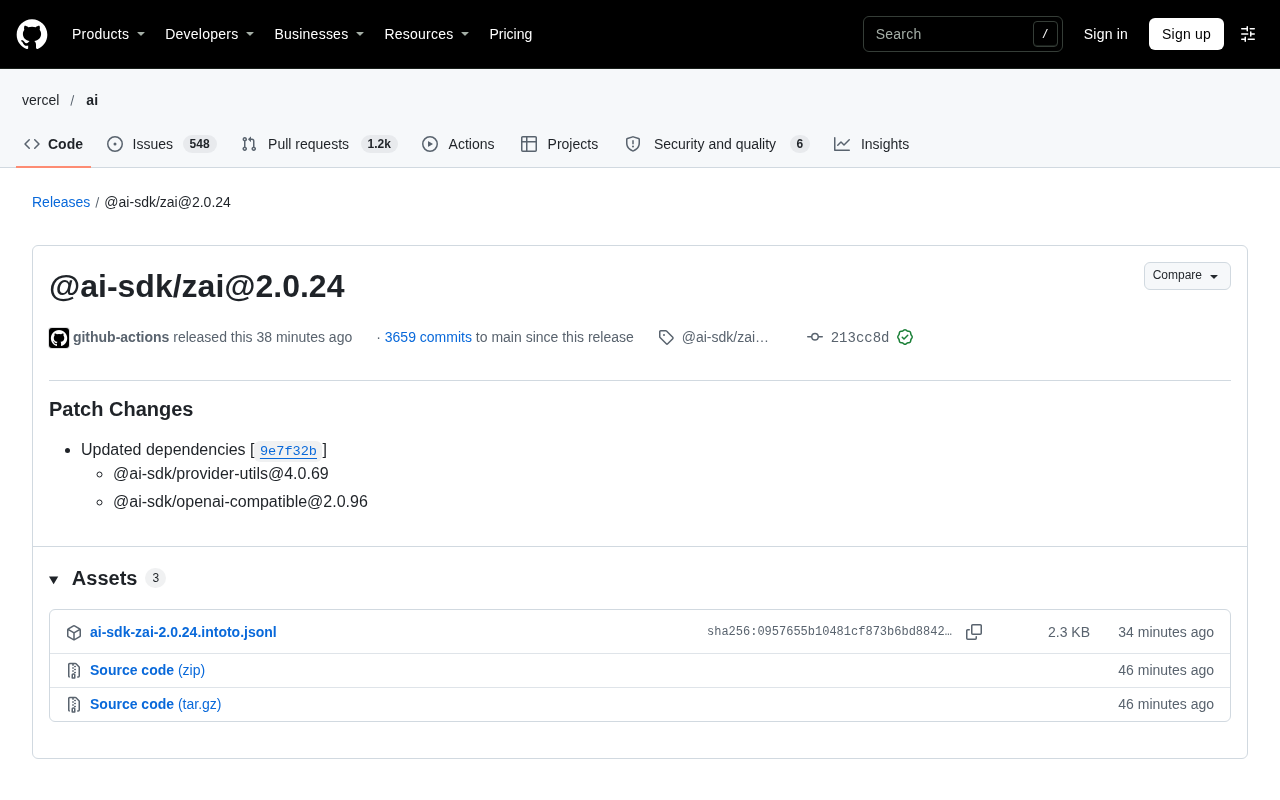
Vercel's AI SDK ecosystem has another minor version iteration. @ai-sdk/zai has released patch version 2.0.24, and judging from the changes, the core of this update isn't new features but a synchronized upgrade of the dependency chain. For developers using Z.ai model integration capabilities, this is a "silent but necessary" maintenance release.
What Exactly Changed in This Update
According to the GitHub Release page, @ai-sdk/zai@2.0.24 is a Patch Changes release, and the actual change is updating two upstream dependencies: @ai-sdk/provider-utils bumped to 4.0.69 and @ai-sdk/openai-compatible bumped to 2.0.96. The commit history shows this release is based on 3659 commits on the main branch, with build and signing completed automatically by github-actions.
In other words, this isn't a version that brings new APIs or new models, but one that aligns the underlying toolkit to the latest state. For projects relying on semantic versioning, such patches can usually be upgraded painlessly, but it's still worth paying attention to the two-level dependency changes it triggers.
Semantic Versioning (SemVer) is a widely adopted versioning convention in the npm ecosystem, formatted as major.minor.patch. A major version change indicates incompatible API modifications, a minor version indicates backward-compatible feature additions, and a patch version indicates backward-compatible bug fixes. @ai-sdk/zai moving from some 2.0.x version to 2.0.24 only changes the patch position, which by convention should not contain breaking changes—hence the article's claim that it "can be upgraded painlessly." However, SemVer is a promise, not an enforcement, and transitive dependencies in the dependency chain may still introduce behavioral differences, which is exactly why running tests after a patch upgrade is still recommended.
The lockfile (such as package-lock.json, pnpm-lock.yaml, yarn.lock) records the exact resolution results of the dependency tree, ensuring identical version combinations are installed across different environments. When a project uses caret (^) ranges in package.json, npm may automatically pull new patch versions, but whether the lockfile is synchronized depends on the install command and configuration. CI typically uses npm ci or pnpm install --frozen-lockfile, installing strictly according to the lockfile, so after upgrading you need to proactively confirm that the versions of provider-utils and openai-compatible in the lockfile have been synchronized—otherwise local and CI behavior may diverge.
Why provider-utils' Version Is Worth Noting
@ai-sdk/provider-utils is the common utility layer in AI SDK that handles provider abstraction, request construction, and response parsing. Its version changes often imply consistency adjustments to underlying behavior—possibly internal optimizations to error handling paths, streaming response parsing, or request parameter serialization.
The official Release doesn't list specific change details, only noting the dependency update. This "scarce information" is a typical characteristic of automated release processes: changes are driven by upstream dependencies, and release notes are generated by tools rather than written by humans. For developers, the safer approach is to look directly at commit 9e7f32b or cross-reference the changelog for provider-utils 4.0.69 to confirm whether any interfaces you're using are affected.
In the AI SDK architecture, a "provider" refers to the integration implementation for a particular model service vendor (such as OpenAI, Anthropic, Z.ai). AI SDK defines a unified calling interface, and each provider package is responsible for translating that unified interface into the specific vendor's HTTP request and response formats. provider-utils is precisely the common toolbox for this translation work, encapsulating general logic such as request construction, auth header handling, streaming response (SSE) parsing, and error mapping. Since multiple provider packages share the same utility layer, its internal adjustments affect all downstream providers simultaneously—which is why its version changes deserve separate attention.
Streaming response parsing is one of the more error-prone areas: different vendors return different SSE data chunk formats, end markers, and error events, and once the utility layer's parsing logic is adjusted, it may affect the chunk-by-chunk output order of tokens or the timing of error throwing. Function calling's incremental parameter concatenation also depends on this layer. Therefore, cross-referencing the changelog to confirm whether these paths are touched is more meaningful than simply looking at the version number.
The Role of openai-compatible
@ai-sdk/openai-compatible is the adapter layer in AI SDK that lets third-party model services integrate via the OpenAI-compatible protocol. Z.ai's integration is built precisely on top of this compatibility abstraction, so its version upgrade directly affects the compatibility behavior of requests. 2.0.96 is likewise patch-level, theoretically introducing no breaking changes, but its version combination with provider-utils needs to stay consistent—otherwise type definitions or runtime behavior mismatches may occur.
This also explains why @ai-sdk/zai's patch releases always appear in groups: it's more of a lightweight wrapper layer itself, with the real logic residing in the two upstream packages.
Practical Impact on Users
If your project pins exact versions, after upgrading to 2.0.24 you need to confirm that provider-utils and openai-compatible in the lockfile are synchronized. If you use caret ranges, this change will most likely be included automatically, but it's still advisable to run integration tests in CI, especially for scenarios involving streaming output and function calling.
From an ecosystem perspective, this release sends a clear signal: the AI SDK's provider matrix is still under high-frequency maintenance, and the decoupling of the compatibility layer from the utility layer allows each provider package to keep up with low coordination cost. For teams focused on AI application development infrastructure, this kind of patch cadence is itself a reference indicator for judging ecosystem activity.
Summary
@ai-sdk/zai@2.0.24 is a standard dependency synchronization release with no new features, but it ensures consistency between the Z.ai integration path and the AI SDK mainline. Its value isn't in "what's been added" but in "not falling behind."
Related articles

Prospero: A Lightweight Native AI Coding Tool Built with ImGui
Prospero is a bloat-free native AI coding tool built with ImGui, emphasizing lightweight design, high performance, and low dependencies. This article analyzes its design philosophy, technical choices, and the divergence between platformization and toolization in AI coding tools.

WebRTC Abused: New Variant of Credit Card Skimming Scripts on Shopping Sites
Security researchers found skimming scripts on popular shopping sites using WebRTC data channels to exfiltrate credit card data. This article analyzes the technical原理, differences from traditional Magecart attacks, and defense strategies for e-commerce platforms in third-party script governance and CSP policies.

Single GB10 Card Hits 101 tok/s: Inkling 2 Mini Performance Tested on vLLM
A developer shared on Hacker News running Inkling 2 Mini with vLLM on a single GB10 at 101 tok/s. This article analyzes the technical context, the significance of vLLM with small models on single cards, and caveats for interpreting tok/s metrics.