@ai-sdk/zai@3.0.17 Released: A Deep Dive into This Vercel AI SDK Patch Update

Vercel AI SDK releases @ai-sdk/zai@3.0.17, a maintenance patch syncing two core internal dependencies.
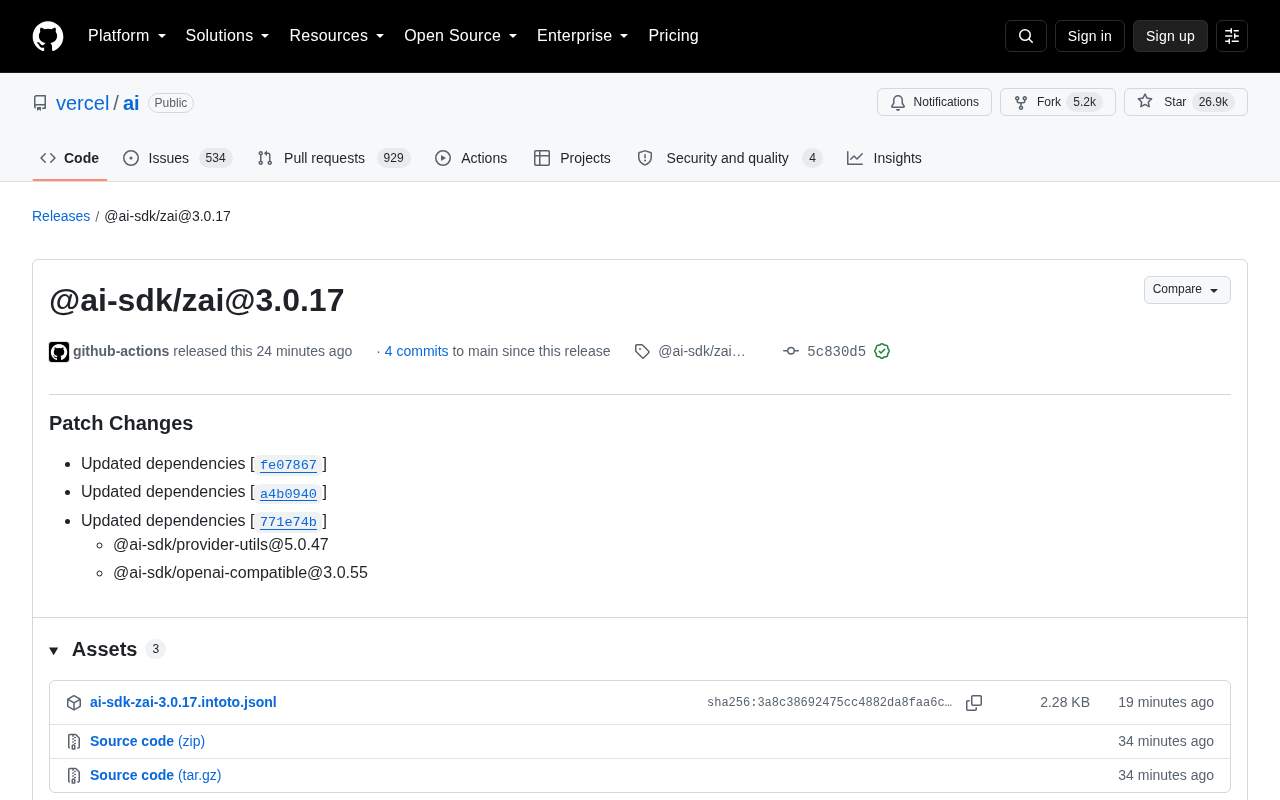
`@ai-sdk/zai@3.0.17` is a maintenance patch release for the Vercel AI SDK's Zhipu AI (Z.AI) adapter. Following SemVer conventions, this backward-compatible update syncs internal dependencies `@ai-sdk/provider-utils` and `@ai-sdk/openai-compatible` to their latest versions. The `zai` provider reuses the OpenAI compatibility layer, allowing it to benefit from base library fixes with minimal overhead. While patch updates introduce no new features, staying current helps avoid issues with streaming responses and error handling. Upgrade via a single npm or pnpm command, then run your test suite to verify core functionality.
Vercel's AI SDK ecosystem recently released @ai-sdk/zai@3.0.17. This is a patch-level update focused primarily on dependency upgrades and maintenance. For developers using this SDK to integrate Z.AI (Zhipu AI) models, this kind of update may not bring significant feature changes, but it plays a crucial role in maintaining project stability and compatibility.
What's in This Update
According to the GitHub Release page, @ai-sdk/zai@3.0.17 falls under Patch Changes. Following Semantic Versioning (SemVer) conventions, this typically means backward-compatible bug fixes — not new features or breaking changes.
The main changes in this release center on syncing internal dependency updates, specifically for the following two packages:
@ai-sdk/provider-utils@5.0.47@ai-sdk/openai-compatible@3.0.55
The upgrade to the openai-compatible dependency is particularly noteworthy. It indicates that the zai provider reuses the OpenAI compatibility layer under the hood — a pattern consistent with the broader industry trend of domestic and third-party LLM providers offering OpenAI-compatible APIs.
Semantic Versioning (SemVer) defines version numbers in a MAJOR.MINOR.PATCH structure. Incrementing the patch number indicates backward-compatible bug fixes; incrementing the minor version indicates new backward-compatible features; and incrementing the major version signals breaking changes that may cause existing code to break. The bump from @ai-sdk/zai@3.0.16 to 3.0.17 — only the patch number — means developers can upgrade safely without worrying about API signature or behavioral changes. In a monorepo-based SDK ecosystem, patch updates to shared base libraries tend to trigger a domino effect, causing all dependent packages to release new versions in sync. That's precisely what's happening here.
What Is @ai-sdk/zai
@ai-sdk/zai is a Provider (model service adapter) within the Vercel AI SDK family. Vercel AI SDK is a TypeScript toolkit for building AI-powered applications, with over 26.9k stars and 5.2k forks on GitHub, making it one of the go-to choices for frontend and full-stack developers integrating LLM capabilities.
Through its suite of provider packages, developers can call models from different vendors using a unified API interface. The zai provider specifically corresponds to Z.AI (Zhipu AI) model services. The benefit of this modular design is that switching underlying model providers requires virtually no changes to business logic code, significantly reducing the cost of multi-model integration.
@ai-sdk/openai-compatible is a general-purpose adapter layer provided by Vercel AI SDK, designed for third-party model services that implement the OpenAI REST API specification. OpenAI's Chat Completions API — including the SSE format for streaming output — has effectively become the industry-standard interface for LLM services. Domestic providers like Zhipu AI, DeepSeekAd, and Moonshot (Kimi), as well as many overseas inference providers, all offer OpenAI-compatible endpoints. By reusing this compatibility layer, the zai provider inherits built-in support for streaming responses, Function Calling, and Tool Use, while continuously benefiting from protocol-level fixes and optimizations as the openai-compatible package evolves — without needing to maintain low-level communication logic inside the zai package itself.
Why Patch Updates Matter
Many developers tend to overlook patch-level updates, dismissing them as inconsequential. But in the context of a rapidly iterating AI SDK, staying current with dependency updates has real practical value.
Because the zai provider depends on shared base libraries like provider-utils and openai-compatible, when those libraries fix issues related to request handling, error catching, or streaming responses, the upstream provider needs to sync its version to benefit from those fixes. This "dependency cascade" update pattern is the direct cause of this version bump.
For production projects, it's recommended to validate compatibility and then apply patch updates promptly, to avoid instability caused by known issues in underlying libraries.
How to Upgrade
The upgrade process is straightforward — just run the update command with your package manager:
npm install @ai-sdk/zai@3.0.17
# or
pnpm add @ai-sdk/zai@3.0.17
Worth noting: since this update also bumps internal dependencies, it's advisable to run your full test suite after installation to confirm that core functionality — such as model calls and streaming output — continues to work as expected.
Summary
@ai-sdk/zai@3.0.17 is a typical maintenance release, with dependency syncing at its core. It introduces no new features, but reflects the continuous, high-frequency maintenance cadence of the Vercel AI SDK ecosystem. For projects relying on Zhipu AI models, staying in sync with official releases is a sound practice for ensuring long-term stability.
Related articles

Chain of Thought Isn't Just for AI: How Humans Can Use CoT to Improve Thinking Quality
Chain of Thought isn't just a prompt trick for large models. Starting from a Hacker News discussion, this article analyzes why CoT works for human thinking too, breaks down actionable ways to transfer it, and highlights the key differences between human CoT and machine CoT.
Cloudflare Teams Up with OpenAI: Closi…
Cloudflare Teams Up with OpenAI: Closing the Loop from Vulnerability Discovery to Defense with AI
Cloudflare uses OpenAI Daybreak to investigate security vulnerabilities and generate reviewable remediation plans, while developers use Codex to boost coding efficiency and quality.

Orca Multi-Agent Orchestration in Practice: A Guide to Parallel Collaboration with Claude and Codex
Orca is Stable AI's free open-source agent workbench supporting 34 agents like Claude Code and Codex in parallel. Learn its Git worktree isolation, multi-model orchestration, and mobile management.