@ai-sdk/zai 3.0.20 Released: A Guide to Vercel AI SDK Dependency Updates

Vercel AI SDK's Zhipu model provider package zai releases patch 3.0.20, syncing three upstream dependency upgrades.
`@ai-sdk/zai@3.0.20` is a Patch-level update in the Vercel AI SDK ecosystem with no new features or breaking changes. It synchronizes three upstream dependencies: `@ai-sdk/provider-utils@5.0.50`, `@ai-sdk/openai-compatible@3.0.58`, and `@ai-sdk/provider@4.0.19`. The package is Vercel AI SDK's provider adapter for Zhipu (Z.ai / GLM series) models, leveraging an OpenAI compatibility layer for low-cost integration. This cascade-style dependency update is typical of the AI SDK's modular architecture. The upgrade is backward-compatible, but developers should run basic regression tests and ensure version alignment across all `@ai-sdk/*` packages.
Vercel's AI SDK ecosystem has received another minor iteration. @ai-sdk/zai@3.0.20 was recently auto-published on GitHub via github-actions as a Patch-level update. While it's a patch release, understanding the dependency changes behind each update still has practical value for developers building applications on top of the AI SDK.
Release Overview
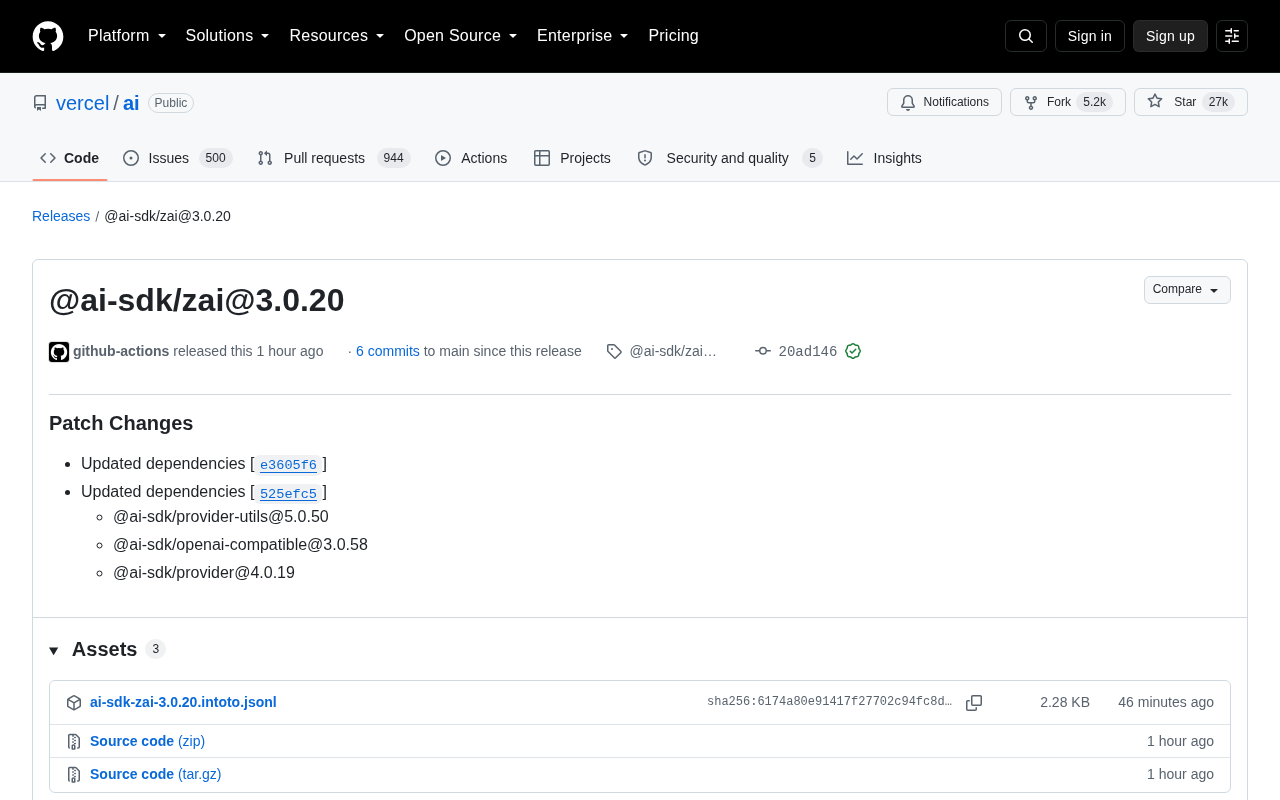
@ai-sdk/zai@3.0.20 is a classic Patch Changes update. The core content isn't new features — it's a synchronized upgrade of internal dependency packages. According to the release notes, the following dependencies were updated:
@ai-sdk/provider-utils@5.0.50@ai-sdk/openai-compatible@3.0.58@ai-sdk/provider@4.0.19
These dependency updates were triggered by two commits (e3605f6, 525efc5), indicating that the behavioral changes in this package stem primarily from upstream dependency chain reactions rather than any logical refactoring within the zai package itself.
The Role of the zai Provider in AI SDK
@ai-sdk/zai is a provider adapter package within the Vercel AI SDK, designed to integrate with Zhipu (Z.ai / GLM series) model capabilities. The AI SDK uses a modular design, splitting different model service providers into independent provider packages that developers can import as needed.
Notably, this update includes the @ai-sdk/openai-compatible dependency. This package provides a unified call layer compatible with the OpenAI interface specification, and many third-party model services (including Zhipu) integrate via OpenAI compatibility mode. As a result, upgrades to openai-compatible often cascade to multiple downstream provider packages — and this patch to zai is a perfect example of that dependency propagation.
Zhipu (Z.ai) is a well-known large model service provider in China. Its GLM series models (such as GLM-4 and ChatGLM) were jointly developed by Tsinghua University and Zhipu AI. Zhipu offers an API specification highly compatible with OpenAI's interface, which allows @ai-sdk/zai to integrate into the Vercel AI SDK ecosystem at low adaptation cost using @ai-sdk/openai-compatible as an intermediary layer. The core idea behind OpenAI compatibility mode is that third-party model service providers align their API request/response structures with OpenAI's Chat Completions format, enabling client code originally written for OpenAI to be reused directly. This pattern has become standard practice for a large number of model service providers both in China and abroad, significantly reducing the cost for developers to migrate or switch between multiple models.
What a Patch Update Means for Developers
Following Semantic Versioning (SemVer) conventions, a Patch version (incrementing the third number) typically represents backward-compatible bug fixes or dependency synchronizations, with no breaking changes. For projects currently using the AI SDK, upgrading from a previous 3.0.x release to 3.0.20 should theoretically be safe.
However, since these changes originate from updates to the core provider-utils and provider utility packages, developers are advised to keep the following in mind after upgrading:
- API call consistency: Adjustments to core provider utilities may subtly alter request/response handling logic — verify that existing calls continue to work as expected.
- Dependency version alignment: Ensure that other
@ai-sdk/*packages in your project are version-compatible to avoid dependency tree conflicts. - Compatibility layer behavior: After the
openai-compatibleupgrade, run basic regression tests on your Zhipu model integrations.
Semantic Versioning (SemVer) is the industry-standard specification for software version number management, using the format MAJOR.MINOR.PATCH. Its core conventions are: a MAJOR change introduces backward-incompatible breaking API modifications; a MINOR change adds backward-compatible new features; a PATCH change contains only backward-compatible bug fixes or internal dependency synchronizations. Based on this specification, package managers (such as npm, yarn, and pnpm) can use version range declarations like ^3.0.0 to automatically install the latest compatible version within the same MAJOR, continuously receiving bug fixes and dependency updates while staying safe. For frequently iterated SDK packages like @ai-sdk/zai, strict adherence to SemVer is an important foundation for maintaining ecosystem stability.
Vercel AI SDK's Iteration Cadence
This release highlights a key characteristic of the Vercel AI SDK ecosystem: high-frequency, fine-grained version iterations. The project has accumulated approximately 27,000 Stars and 5,200 Forks on GitHub, reflecting a highly active community. By automating releases via github-actions and using GPG signature verification (GPG key ID: B5690EEEBB952194), Vercel ensures that every release is traceable and secure.
This modular, automated release strategy allows individual provider packages to evolve independently while maintaining overall consistency through shared core utility packages. For teams building multi-model AI applications, this means the flexibility to select only the model services they need without worrying about an bloated SDK.
Summary
@ai-sdk/zai@3.0.20 is a patch update centered on dependency synchronization, containing no breaking changes. It does, however, reflect the typical dependency propagation pattern within the AI SDK's modular architecture. For developers using Zhipu models or relying on the OpenAI compatibility layer, staying current with such patches and running basic regression tests is a sound practice for maintaining project stability.
Related articles

FastAPI: A High-Performance Python Framework and a Production-Ready API Development Powerhouse
FastAPI is a high-performance web framework based on Python type hints, supporting async and automatic OpenAPI docs. With over 100k GitHub stars, this article analyzes its core strengths, production readiness, and selection advice.

Tesla Optimus Begins Mass Production: Can the Goal of 20,000 Units Per Week Be Achieved?
Tesla Optimus officially begins mass production as Musk sets a target of 20,000 units per week. This article analyzes the supply chain challenges behind mass production, the real gap in capacity ramp-up, and the competitive landscape for humanoid robots.

PCL: A Minecraft Launcher with 8.5k Stars — Why Was It Written in VB.NET?
An in-depth analysis of PCL, the GitHub Minecraft launcher with 8,500+ stars: why it chose VB.NET, its features and China network advantages, and the limits of Windows-only.