@ai-sdk/zai@3.0.28 Released: A Deep Dive into This Dependency-Sync Patch

@ai-sdk/zai 3.0.28 is a dependency-sync patch with no API changes, safe to adopt.
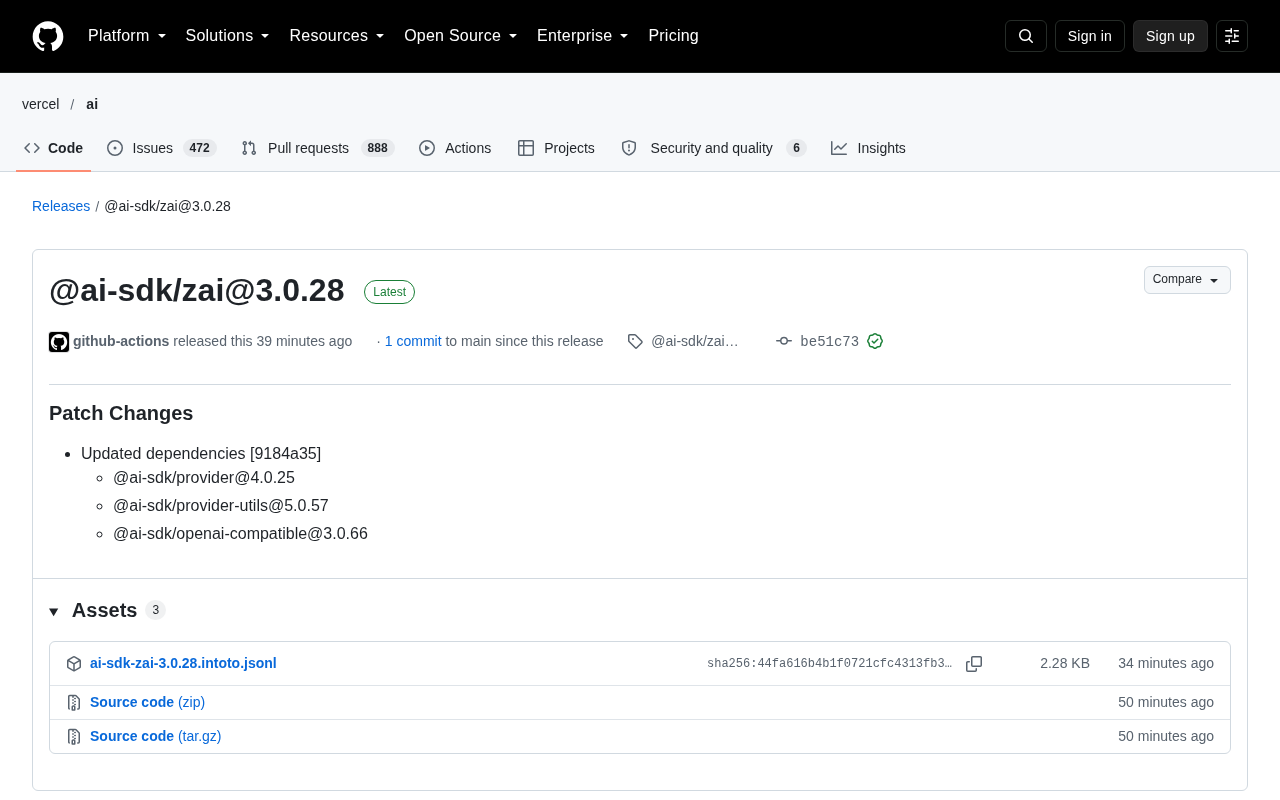
`@ai-sdk/zai@3.0.28` is a patch-level update to the Vercel AI SDK's Provider adapter for Zhipu AI (GLM series), published automatically via GitHub Actions with GPG signature verification. The update introduces no new features or breaking changes — it solely synchronizes upstream dependencies: `@ai-sdk/provider@4.0.25`, `@ai-sdk/provider-utils@5.0.57`, and `@ai-sdk/openai-compatible@3.0.66`. This type of dependency-alignment patch is standard practice in changesets-managed Monorepo projects. For teams already using Zhipu GLM models, this is a low-risk upgrade; to understand the substantive changes, trace the relevant commit in the upstream package changelogs.
Overview
@ai-sdk/zai has released version 3.0.28, a patch-level update. This release was published on October 8 via GitHub Actions automation and verified with a GitHub GPG signature (key ID: B5690EEEBB952194), ensuring the integrity of the release artifacts.
Based on the release record, this update introduces no new features or breaking changes — its core content is a dependency synchronization upgrade. For developers working within the Vercel AI SDK ecosystem, patch releases like this typically signal smooth under-the-hood iteration rather than any interface-level changes.
What's in This Update
According to the release notes, 3.0.28 is a Patch Change, primarily following upstream dependency version bumps (Updated dependencies [9184a35]), affecting the following related packages:
@ai-sdk/provider@4.0.25@ai-sdk/provider-utils@5.0.57@ai-sdk/openai-compatible@3.0.66
@ai-sdk/zai is the AI SDK's Provider adapter package for Zhipu AI (Z.ai / GLM model series). It relies on the OpenAI-compatible layer provided by @ai-sdk/openai-compatible to interface with model endpoints. Therefore, whenever the underlying provider, provider-utils, or compatibility layer is updated, the zai package also publishes a corresponding patch release to maintain consistency across the dependency tree.
@ai-sdk/openai-compatible is a general-purpose compatibility adapter layer provided by Vercel AI SDK, designed specifically for third-party model services that implement the OpenAI API format (i.e., endpoints like /v1/chat/completions). Zhipu AI's GLM model series (such as GLM-4) exposes HTTP interfaces that are highly compatible with OpenAI's, so @ai-sdk/zai doesn't need to implement full network request logic from scratch. Instead, it builds on top of openai-compatible with minimal configuration — such as base URL, authentication method, and model ID mapping — to integrate Zhipu AI's capabilities into the AI SDK's unified abstraction layer. This layered design keeps the zai package's codebase very small, with most of the maintenance burden carried by upstream shared packages. It also explains why zai needs to publish a new release every time an upstream package is updated.
What This Means for Developers
This kind of "dependency alignment" patch release is very common in modern Monorepo projects (the AI SDK uses changesets to manage multi-package versioning). Its value lies in:
Maintaining Ecosystem Consistency
When shared utility libraries like @ai-sdk/provider-utils fix bugs or improve internal implementations, all downstream providers need to follow suit to avoid runtime issues caused by version mismatches.
Changesets is a widely adopted multi-package version management tool for Monorepo projects. The Vercel AI SDK repository contains dozens of interdependent sub-packages, all managed through changesets for a unified release process. When developers merge a PR, they attach a changeset file (describing the change level and scope of impact), and the CI pipeline automatically aggregates these to generate version bumps and changelogs for each package. When a base-level package (such as @ai-sdk/provider-utils) changes, changesets identifies all packages that directly or indirectly depend on it and triggers corresponding patch version releases — this is the automated mechanism behind the current @ai-sdk/zai 3.0.28 update.
Low-Risk Upgrades
Since no public API changes are involved, developers can generally upgrade @ai-sdk/zai to 3.0.28 with confidence, without any additional migration effort. When using semantic version ranges in npm/pnpm (e.g., ^3.0.0), these kinds of patches are typically picked up automatically.
Tracking Upstream Changes
If you want to understand the substantive content of this update, the more valuable approach is to trace commit 9184a35 back to the changelogs of @ai-sdk/provider and @ai-sdk/provider-utils — that's where the actual features or fixes originate.
Summary
@ai-sdk/zai@3.0.28 is a classic dependency-sync patch update with no new features, but it reflects the engineering discipline of multi-package coordination within the AI SDK ecosystem. For teams that have already integrated Zhipu AI's GLM models into their projects, this is a version you can safely adopt.
Note: This article is based on publicly available GitHub Release records. For specific code-level changes, please refer to the official changelog.
Related articles

Chain of Thought Isn't Just for AI: How Humans Can Use CoT to Improve Thinking Quality
Chain of Thought isn't just a prompt trick for large models. Starting from a Hacker News discussion, this article analyzes why CoT works for human thinking too, breaks down actionable ways to transfer it, and highlights the key differences between human CoT and machine CoT.
Cloudflare Teams Up with OpenAI: Closi…
Cloudflare Teams Up with OpenAI: Closing the Loop from Vulnerability Discovery to Defense with AI
Cloudflare uses OpenAI Daybreak to investigate security vulnerabilities and generate reviewable remediation plans, while developers use Codex to boost coding efficiency and quality.

Orca Multi-Agent Orchestration in Practice: A Guide to Parallel Collaboration with Claude and Codex
Orca is Stable AI's free open-source agent workbench supporting 34 agents like Claude Code and Codex in parallel. Learn its Git worktree isolation, multi-model orchestration, and mobile management.