@ai-sdk/zai 3.0.29 Released: Dependency Updates and Patch Maintenance

@ai-sdk/zai 3.0.29 patch syncs core dependencies — low risk, upgrade recommended.
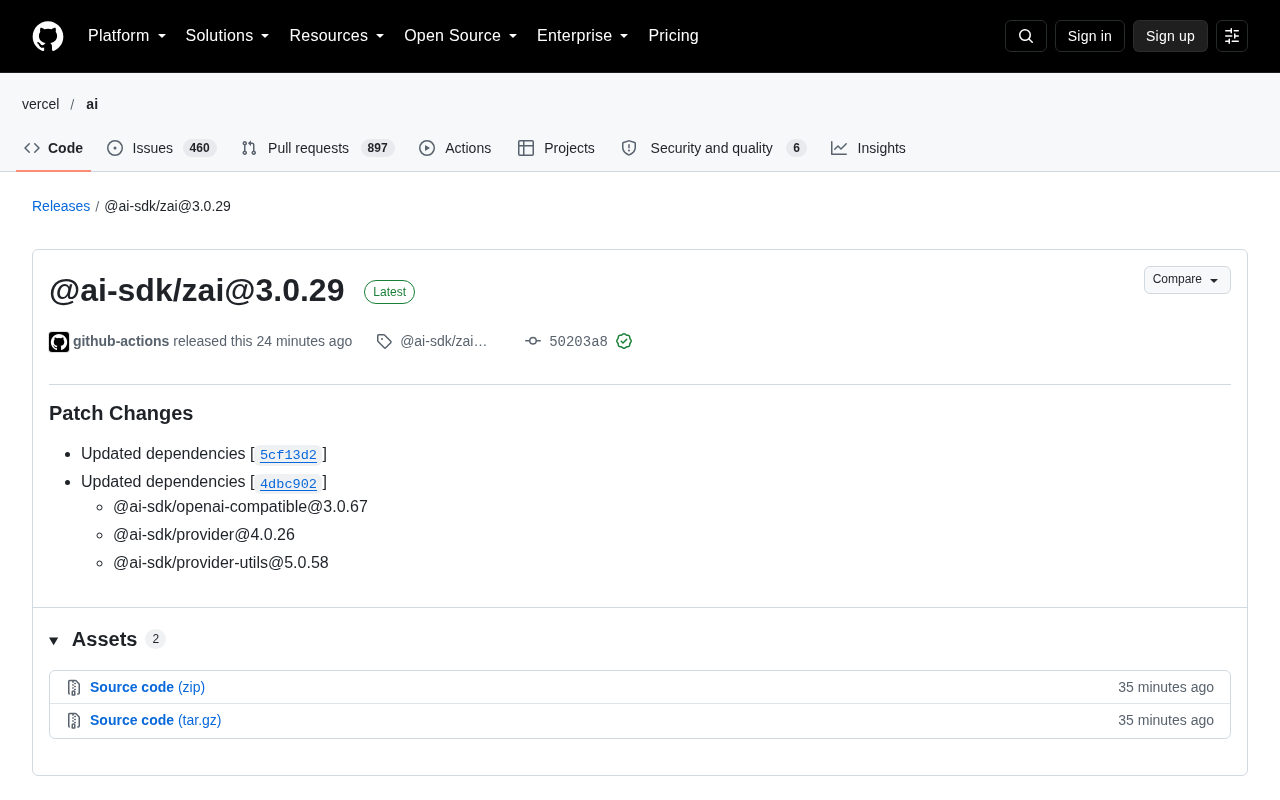
@ai-sdk/zai 3.0.29 is a patch-level release published on October 8, 2024, verified with a GitHub GPG signature. It introduces no new features or breaking changes — the core update is a sync of underlying dependencies to their latest versions: `@ai-sdk/openai-compatible@3.0.67`, `@ai-sdk/provider@4.0.26`, and `@ai-sdk/provider-utils@5.0.58`. AI SDK's modular design means all Provider packages share a common infrastructure layer, so when that layer updates, upstream packages must follow to maintain compatibility. While this "follow-along release" lacks flashy new features, it directly impacts runtime stability. The upgrade risk is minimal, and developers are encouraged to manage AI SDK package versions together using a lockfile.
The AI SDK ecosystem has recently released version 3.0.29 of @ai-sdk/zai as a patch update. This version was automatically published on October 8th via GitHub Actions and verified with a GitHub GPG signature (key ID: B5690EEEBB952194), confirming its authenticity.
According to the release notes, this is a typical patch-level update focused entirely on syncing underlying dependencies rather than introducing new features or breaking changes. For developers integrating Z.ai models, this kind of update generally signals improvements in stability and compatibility.
What Changed in This Update
The changes in 3.0.29 are primarily reflected in dependency upgrades across several core AI SDK packages:
@ai-sdk/openai-compatible@3.0.67@ai-sdk/provider@4.0.26@ai-sdk/provider-utils@5.0.58
The upgrade to the openai-compatible package is particularly noteworthy. Since @ai-sdk/zai serves as the Provider implementation for Z.ai, it likely reuses the OpenAI compatibility layer for communication and protocol handling. When that compatibility layer is upgraded, the zai Provider needs to update in lockstep to ensure consistent interface behavior — which is the primary motivation behind this patch.
@ai-sdk/provider and @ai-sdk/provider-utils form the foundational infrastructure of the entire AI SDK Provider system, defining standard Provider interfaces and shared utility functions respectively. Their version increments signal that the ecosystem is advancing in sync at the protocol specification level.
Why Dependency Updates Still Matter
Developers often overlook patch releases that appear to have "no new features," but in a fast-moving ecosystem like AI SDK, keeping dependency versions aligned is directly tied to runtime stability.
AI SDK uses a modular architecture, splitting different model providers into independent Provider packages (such as openai, anthropic, zai, etc.), all of which share a common provider and provider-utils foundation. Once the foundational layer changes — for example, fixing streaming response parsing or adjusting error handling logic — every upstream Provider package needs to follow with a patch release. Failing to do so can result in type errors or runtime exceptions caused by version mismatches.
@ai-sdk/zai 3.0.29 is exactly this kind of "follow-along release" — the package's own code may have barely changed, but by locking in upgraded dependencies, it ensures users get a mutually compatible set of packages upon installation.
It's also worth noting that AI SDK's versioning follows Semantic Versioning (SemVer). Under this system, version numbers are structured as MAJOR.MINOR.PATCH: a PATCH increment indicates a backward-compatible bug fix, a MINOR increment signals backward-compatible new functionality, and a MAJOR increment denotes a breaking change. The bump from @ai-sdk/zai 3.0.28 to 3.0.29 — a PATCH increment — clearly communicates "no breaking changes, safe to upgrade." For a monorepo ecosystem like AI SDK with dozens of interdependent sub-packages, strict adherence to SemVer is critical. It allows automated tools (such as Renovate and Dependabot) to safely batch-upgrade patch versions, and gives developers a clear basis for assessing upgrade risk.
Recommendations for Users
For teams using Vercel AI SDK to integrate Z.ai models, it's recommended to upgrade @ai-sdk/zai to 3.0.29 and update related dependencies in sync, to avoid potential version conflicts. Since this is a patch update, the upgrade risk is minimal and no changes to business logic should be required.
In practice, you can use pnpm up or npm update alongside a lockfile to uniformly manage versions across the AI SDK package family, ensuring provider, provider-utils, and each Provider package remain compatible.
It's worth noting that the release notes for this version are fairly limited — the official release does not disclose specific issues fixed or behavioral changes introduced. For detailed information about what changed in the underlying dependencies, refer to the respective changelogs for @ai-sdk/openai-compatible and @ai-sdk/provider.
There are some nuances to be aware of when using pnpm up versus npm update in multi-package monorepo-style projects. pnpm natively supports the workspace protocol and can automatically identify and upgrade all @ai-sdk/* packages to their latest compatible versions in one pass. By contrast, npm update in non-workspaces projects only updates direct dependencies by default — transitive dependencies require an additional --depth flag or manual intervention. The core value of using a lockfile (package-lock.json / pnpm-lock.yaml) is ensuring that all team members and CI environments install an identical dependency tree, eliminating the classic "works on my machine" problem. After upgrading AI SDK packages, it's best practice to commit the updated lockfile so that the version state is auditable and can be rolled back if needed.
Related articles

Ollama Local LLM Deployment Tutorial: From Installation to GUI Client
Complete Ollama local LLM deployment tutorial: three-platform installation, importing GGUF and SafeTensors models, connecting GUI clients to OpenCode and WebSearch with hands-on testing, plus key settings like model storage paths and selection advice.

TenetBench: Testing AI Compliance with Russian Professional Ethics Clauses
TenetBench is a benchmark of 3,433 Russian professional ethics clause-conflict requests evaluating whether LLMs comply with professional codes. It finds 11 of 14 model configurations generate violating content, and reasoning mode may reduce refusal rates.

OmniSimulator: How Small Models Achieve High-Fidelity User Simulation
OmniSimulator proposes a structured five-dimensional behavioral reasoning framework, distilling reasoning trajectories from a teacher model to train small models—Qwen3-8B improves 34.33%, competitive with Claude-Sonnet-4.5, and supports self-hosted high-fidelity user simulation.