@ai-sdk/zai 3.0.34 Patch Update: Zhipu AI Adapter Dependency Upgrade

Vercel AI SDK's Zhipu adapter @ai-sdk/zai releases patch 3.0.34, centered on upgrading three underlying dependency packages.
In Vercel's AI SDK ecosystem, the adapter package @ai-sdk/zai for Zhipu AI has released patch version 3.0.34. This update introduces no new features; the core action is synchronously upgrading three dependencies: @ai-sdk/provider to 4.0.30, @ai-sdk/openai-compatible to 3.0.72, and @ai-sdk/provider-utils to 5.0.63. The release was automatically completed by the GitHub Actions bot, containing 6 commits with GPG verified signatures. The article notes that while a single patch has limited impact, these three packages the adapter depends on directly determine the consistency of request construction, error handling, and streaming response parsing. For teams integrating Zhipu models into production environments, following such patches is a routine practice for maintaining stability, and attention should be paid to version constraint conflicts when mixing multiple providers.
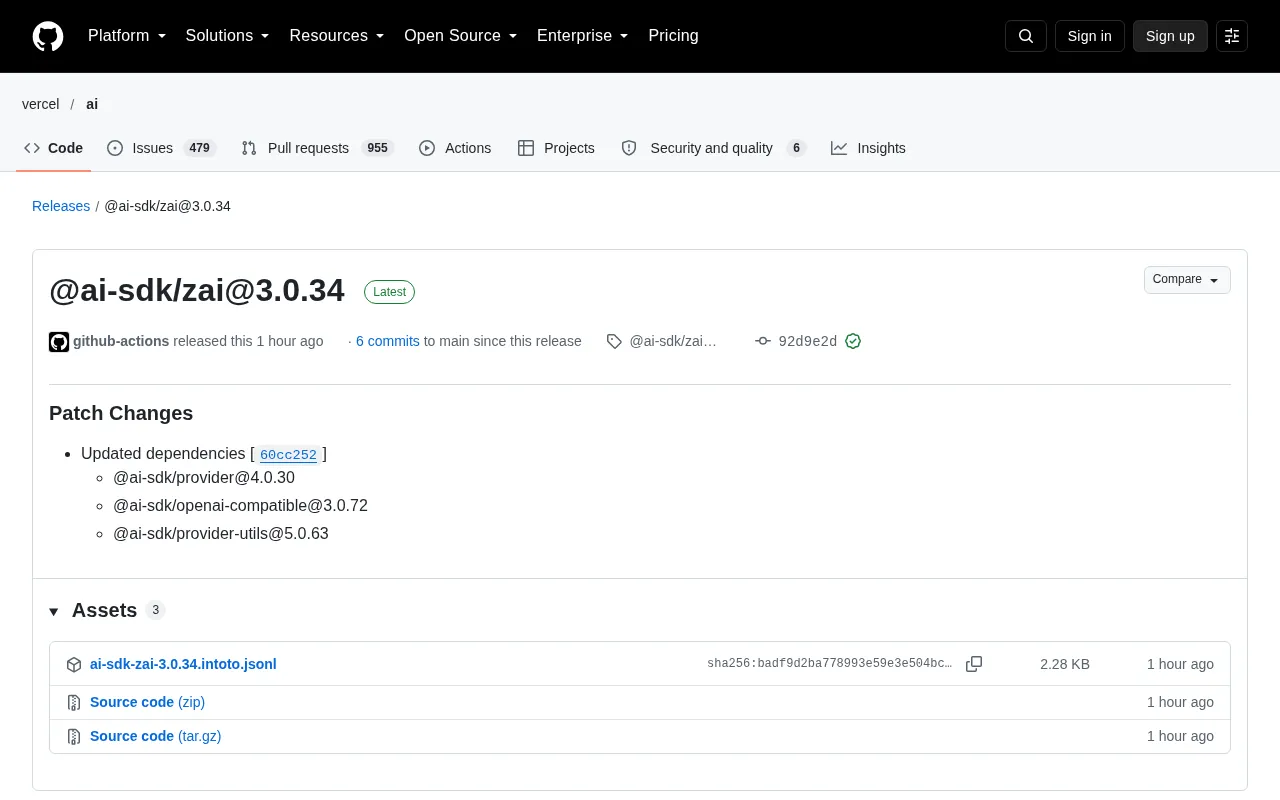
Vercel's AI SDK ecosystem recently saw a routine iteration—the adapter package @ai-sdk/zai for Zhipu AI (Z.ai) released patch version 3.0.34. This update itself introduces no new features, but it triggers a small-scale ripple across the AI SDK core dependency chain.
Update Content: A Typical Dependency Patch
According to the release record on GitHub, @ai-sdk/zai@3.0.34 is classified as Patch Changes, with the core action being dependency updates. Specifically, three packages are involved:
@ai-sdk/providerupgraded to 4.0.30@ai-sdk/openai-compatibleupgraded to 3.0.72@ai-sdk/provider-utilsupgraded to 5.0.63
In semantic versioning, a patch version signifies a backward-compatible fix with no breaking changes. For projects using this adapter, the upgrade path is relatively smooth—typically just syncing the lockfile is enough.
This release was pushed by the github-actions bot on October 19 at 18:00, containing 6 commits merged into the main branch. The commits carry GitHub verified signatures (GPG key ID: B5690EEEBB952194), indicating the release process goes through an automated CI channel.
Semantic Versioning (SemVer) and lockfiles are the two levers for assessing the risk of this upgrade. SemVer stipulates that version numbers take the form major.minor.patch, where an increment in the patch number indicates backward-compatible bug fixes, an increment in the minor number indicates backward-compatible feature additions, and only a major version increment may contain breaking changes. Therefore, moving from 3.0.x to 3.0.34 theoretically does not change the public API signatures. However, note that dependency resolution in the npm ecosystem is not simply taking the latest version: @ai-sdk/zai usually declares its three dependencies with ^ ranges, and the actually installed versions are locked by the lockfile. So simply running npm install may not upgrade to 4.0.30 / 3.0.72 / 5.0.63—you need to explicitly update or delete the lockfile and reinstall. For projects mixing multiple providers, different adapters may impose different version ranges on the same @ai-sdk/provider-utils, and the package manager (especially pnpm's strict dependency isolation) will produce multiple copies or hoisting conflicts accordingly—this is precisely the technical reason emphasized in the article to check lockfile differences.
Why a Patch Package Deserves Attention
Looking at the version number alone, 3.0.34 is just a minor fix. But placed within the AI SDK architecture, its significance goes beyond that.
@ai-sdk/zai is the official adapter layer for Zhipu AI under the AI SDK's unified Provider interface system. When developers call models from different vendors through the AI SDK, it is precisely this type of adapter that actually bridges the API differences of each vendor. The openai-compatible package it depends on handles integration with the OpenAI-compatible protocol, while provider-utils provides general-purpose request/response utility functions.
In other words, the version advancement of these three dependency packages directly affects the adapter's behavioral consistency in request construction, error handling, streaming response parsing, and other stages. Patch updates often fix exactly these kinds of low-level details—while not changing the public API, they may resolve compatibility issues in certain edge cases. For teams integrating Zhipu models into production environments, following such patches is a routine practice for maintaining stability.
The AI SDK's Provider abstraction layer is the key background for understanding the value of such adapters. Vercel's AI SDK defines a unified calling interface (such as generateText, streamText) that converges all differences between model vendors—authentication methods, request body formats, streaming response chunking protocols, error code semantics—into the Provider layer. @ai-sdk/zai is one of the community/officially maintained Provider implementations; internally it does not hand-write HTTP requests directly but reuses the general-purpose protocol client provided by @ai-sdk/openai-compatible. The reason reuse is possible is that some of Zhipu's APIs follow the OpenAI-compatible request and response structure, which means the adapter's work mainly lies in baseURL, model ID mapping, and compatibility handling of specific fields. @ai-sdk/provider defines the interface types that a Provider must implement (such as LanguageModelV1), and @ai-sdk/provider-utils provides utility functions and type guards shared across Providers. The reason the three versions move in tandem is that once an interface definition adds an optional field, both the utility functions and the specific adapter need to be upgraded in sync to stay consistent.
Signals from the Version Iteration Cadence
Judging from the release frequency, the AI SDK's various Provider adapters maintain a fairly high rate of minor version advancement. openai-compatible has reached 3.0.72, and provider-utils 5.0.63. This high-frequency patch release typically reflects two possibilities: first, upstream protocols or dependencies have continuous minor adjustments that need syncing; second, issues reported by the community are being fixed quickly.
For developers, this means two things. First, locking dependency versions and regularly checking changelogs are necessary engineering habits, especially in projects mixing multiple providers, where a dependency upgrade of one adapter may conflict with version constraints of other packages. Second, the automated release process (completed by github-actions this time) lowers maintenance costs, but it also requires users to have some upgrade verification capability—they should not blindly follow the latest tag.
GitHub Actions-driven automated releases explain why patches can be produced at such a high frequency. Such repositories typically configure a changesets workflow: when a developer submits a PR, they attach a changeset file describing the change type; after merging into main, the bot automatically aggregates pending changes, increments the version numbers of the corresponding packages, generates a changelog, and tags and publishes to npm. The release commit carries a GPG signature (B5690EEEBB952194 this time), indicating that the npm package and Git commit can be traced back to their source through the provenance mechanism—this has practical significance for supply chain security: users can verify that the installed package was indeed produced by that repository's CI rather than a tampered third-party build. This also means the version number itself carries limited information: without accompanying release notes, the patch number can only indicate "there are changes and they are backward-compatible," and cannot tell you whether a boundary bug in streaming parsing was fixed or merely upstream type definitions were synced. This is the underlying reason for recommending small-scale verification first.
How to Follow This Update
If your project imports @ai-sdk/zai via pnpm, npm, or yarn, simply run a routine dependency update command and check the lockfile differences. Pay special attention to version changes in @ai-sdk/provider-utils, because changes at the utility function layer can sometimes affect custom middleware or error handling logic.
It should be noted that the release information this time does not include detailed change descriptions or a list of issue fixes—only the dependency version numbers are listed. In the absence of release notes, the prudent approach is to verify in a small-scale environment first before pushing to production.
The AI SDK's Provider ecosystem is still expanding, and the maintenance quality of adapters directly determines how smooth the multi-model switching experience is. Patches like 3.0.34 have limited impact individually, but continuous follow-up is a fundamental action for keeping the tech stack healthy.
One-line Summary
Vercel AI SDK's Zhipu adapter @ai-sdk/zai releases patch 3.0.34, centered on upgrading three underlying dependency packages.
Paragraph Summary
In Vercel's AI SDK ecosystem, the adapter package @ai-sdk/zai for Zhipu AI has released patch version 3.0.34. This update introduces no new features; the core action is synchronously upgrading three dependencies: @ai-sdk/provider to 4.0.30, @ai-sdk/openai-compatible to 3.0.72, and @ai-sdk/provider-utils to 5.0.63. The release was automatically completed by the GitHub Actions bot, containing 6 commits with GPG verified signatures. The article notes that while a single patch has limited impact, these three packages the adapter depends on directly determine the consistency of request construction, error handling, and streaming response parsing. For teams integrating Zhipu models into production environments, following such patches is a routine practice for maintaining stability, and attention should be paid to version constraint conflicts when mixing multiple providers.
Related articles

A New Paradigm for Text Editing in Compose: TextFieldState Replaces the Old API
Jetpack Compose introduces the TextFieldState API to fix dropped characters and cursor jumps from async input. The old value/onValueChange callbacks will be deprecated in 1.13. This article covers InputTransformation, OutputTransformation, four state hoisting patterns, and new formatted text editing capabilities.

Remote Compose: A New Document-Driven Paradigm for Cross-Platform UI on Android
Remote Compose transmits compact binary documents instead of screen pixels, enabling efficient UI rendering on remote surfaces like Wear OS and widgets. This article covers its document creation API, expression animations, size optimization techniques, and Wear OS progress.

How Crashlytics Eliminates Android Memory and Responsiveness Issues
Through the Chroma Clip case study, this article explains how Firebase Crashlytics uses Application Exit Info, Profiling Manager, GWP ASAN, and ARM MTE to pinpoint ANRs, OOMs, memory limit terminations, and native memory corruption—solving the challenge of stack traces that don't point to the real culprit.