@ai-sdk/zai 3.0.56 Patch Release: Upstream Dependencies Synchronized

@ai-sdk/zai 3.0.56 released, synchronizing three upstream dependencies with no API changes.
@ai-sdk/zai has released patch version 3.0.56, with changes consisting solely of three dependency synchronizations: @ai-sdk/provider to 4.0.39, provider-utils to 5.0.82, and openai-compatible to 3.0.93, with no public API adjustments. The article notes this is a common maintenance release in the AI SDK multi-package monorepo, aimed at following upstream patches and keeping adapter packages behaviorally consistent. Projects directly using this package can upgrade at their usual pace while ensuring version alignment; those with indirect dependencies can wait for the framework-side upgrade. The release was automated by github-actions and signature-verified, and the frequent patch iterations reflect that the AI SDK's underlying abstractions are still evolving rapidly—developers should periodically align with the overall version matrix rather than tracking each one individually.
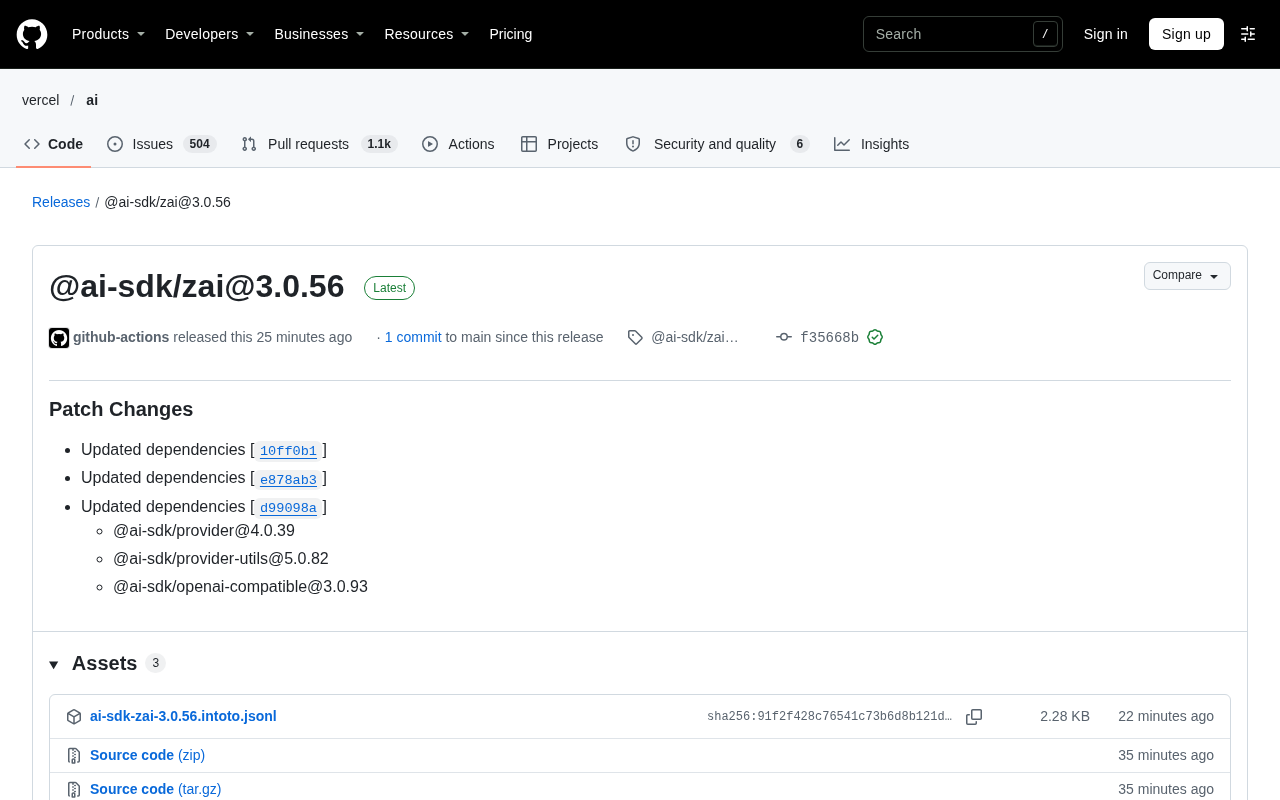
The Z.ai adapter package in the AI SDK ecosystem has received a minor version update. @ai-sdk/zai@3.0.56 has been published via GitHub, with changes focused on dependency synchronization rather than adjustments to the public API.
What Changed in This Update
According to the release page, this version is marked as Patch Changes, and the commit record shows the changes consist of three dependency updates. In other words, this is a typical maintenance release: the package's own logic has not been rewritten, mainly to keep pace with upstream package versions.
The dependencies involved include @ai-sdk/provider (bumped to 4.0.39), @ai-sdk/provider-utils (bumped to 5.0.82), and @ai-sdk/openai-compatible (bumped to 3.0.93). These three packages correspond to the AI SDK's Provider abstraction layer, utility function layer, and OpenAI compatibility layer, respectively.
This release pattern is common in multi-package monorepos like the AI SDK. Upper-layer adapter packages (such as zai) depend on the generic provider interfaces; once patch-level fixes are made to the underlying interfaces or utility functions, each adapter package needs to follow suit to prevent users from encountering behavioral inconsistencies across packages.
@ai-sdk/provider is the core abstraction layer defined by the Vercel AI SDK. It establishes a unified interface contract for all model providers (such as OpenAI, Anthropic, Google, and Z.ai in this article), including method signatures and data types for capabilities like language models, embedding models, and image generation. Adapter packages only need to implement this interface to seamlessly integrate with the AI SDK's calling system. @ai-sdk/provider-utils is a collection of utility functions for Provider implementers to reuse, covering common logic such as streaming response parsing, error standardization, and JSON Schema validation, which reduces duplicate code across adapter packages. @ai-sdk/openai-compatible is a middleware layer specifically designed for service providers that "follow the OpenAI API style." It encapsulates OpenAI's request/response format into a reusable Provider factory, so services like Z.ai that expose OpenAI-compatible interfaces can quickly build adapter packages on top of it. Together, the three form a top-down dependency chain, where a patch update to any link may affect upper-layer behavior.
Why Dependency Synchronization Matters
For most callers, upgrading an adapter package at the patch version level is usually transparent—no business code changes are needed after installation or upgrade. However, synchronizing the dependency chain has real significance.
@ai-sdk/provider defines the unified contract that model providers follow when integrating with the AI SDK, while openai-compatible carries a large share of the capability for integrating services that follow the OpenAI API style. Upstream patches often include protocol detail fixes or edge-case handling; if adapter packages do not follow suit, differences in calling behavior may arise.
Therefore, such releases are better understood as actions to "maintain consistency" rather than feature iterations. Attention should be paid to the changelogs of upstream provider packages, not the zai package itself.
In the Semantic Versioning (SemVer) system, the patch number (such as 56 in 3.0.56) represents backward-compatible bug fixes that do not introduce new features or breaking changes—which is why this upgrade is usually "transparent" to callers. However, in a monorepo multi-package architecture, patch-level changes may still involve cross-package behavioral consistency. For example, if @ai-sdk/provider fixes how a field is passed in a streaming event, and an adapter package still relies on the parsing logic of an older provider-utils version, data loss or type mismatches may occur. Thus, while dependency synchronization does not change the public API, it is a necessary means of ensuring behavioral consistency across the entire chain. Understanding this helps developers decide, when they see a release note saying "dependency updates only," whether they need to consult the upstream package's changelog to confirm potential impact.
Who Needs to Follow This Upgrade
Projects that directly use @ai-sdk/zai are advised to upgrade at their usual pace. If a project has pinned versions of multiple AI SDK-related packages, pay attention to version alignment to avoid mismatches between provider and provider-utils versions.
Projects that do not directly use this adapter package and only depend on it indirectly through an upper-layer framework generally need no manual intervention—just wait for the framework-side upgrade.
The release was automated by github-actions, and the commit has a GitHub-verified signature, making it a standardized automated release pipeline.
The Maintenance Cadence Behind the Version Number
The version number 3.0.56 shows that this package has undergone many patch iterations. The high frequency of patch releases reflects that the AI SDK ecosystem is still evolving rapidly, and adjustments to the underlying abstraction layer cascade down to each adapter package.
For developers, rather than tracking each patch package individually, it is better to periodically align with the overall AI SDK version matrix. Incorporating adapter package upgrades into existing dependency management processes is more hassle-free than handling each individual release specially.
One-line Summary
@ai-sdk/zai 3.0.56 released, synchronizing only three upstream dependencies with no API changes.
Paragraph Summary
@ai-sdk/zai has released patch version 3.0.56, with changes consisting solely of three dependency synchronizations: @ai-sdk/provider bumped to 4.0.39, provider-utils to 5.0.82, and openai-compatible to 3.0.93, with no public API adjustments. The article notes that this is a common maintenance release in the AI SDK multi-package monorepo, aimed at following upstream patches and keeping adapter packages behaviorally consistent. Projects that directly use this package can upgrade at their usual pace while paying attention to version alignment; projects with indirect dependencies can simply wait for the framework-side upgrade. The release was automated by github-actions and signature-verified, and the high-frequency patch iterations also reflect that the AI SDK's underlying abstractions are still evolving rapidly—developers should periodically align with the overall version matrix rather than tracking each one individually.
Related articles

Prompt Engineering for Beginners: From Writing Prompts to Engineering Thinking
Starting from the essence and four functions of prompts, this article systematically explains the six-step process, four success criteria, learning value, and practical limitations of prompt engineering to help you build a complete understanding.

Anthropic Launches Nasdaq IPO: AI Giant's Listing and Risk Disclosures
Anthropic officially launches its Nasdaq IPO under ticker ANT, with market valuation expected to potentially exceed SpaceX's record. The prospectus devotes nearly 100 pages to AI risks, while first-half revenue grew over 14x but net losses widened sharply, reigniting the AI bubble debate.

Rust cURL Clone Uses 4,832 unsafe Blocks—Is the Memory Safety Myth Broken?
A Rust cURL clone uses 4,832 unsafe keywords, challenging Rust's memory safety narrative. We analyze what unsafe really means, compare Fil-C, and examine rewrite motives.