AI Search + 1,350 Open Source Software Directory: Find Alternatives to Paid Apps in One Click
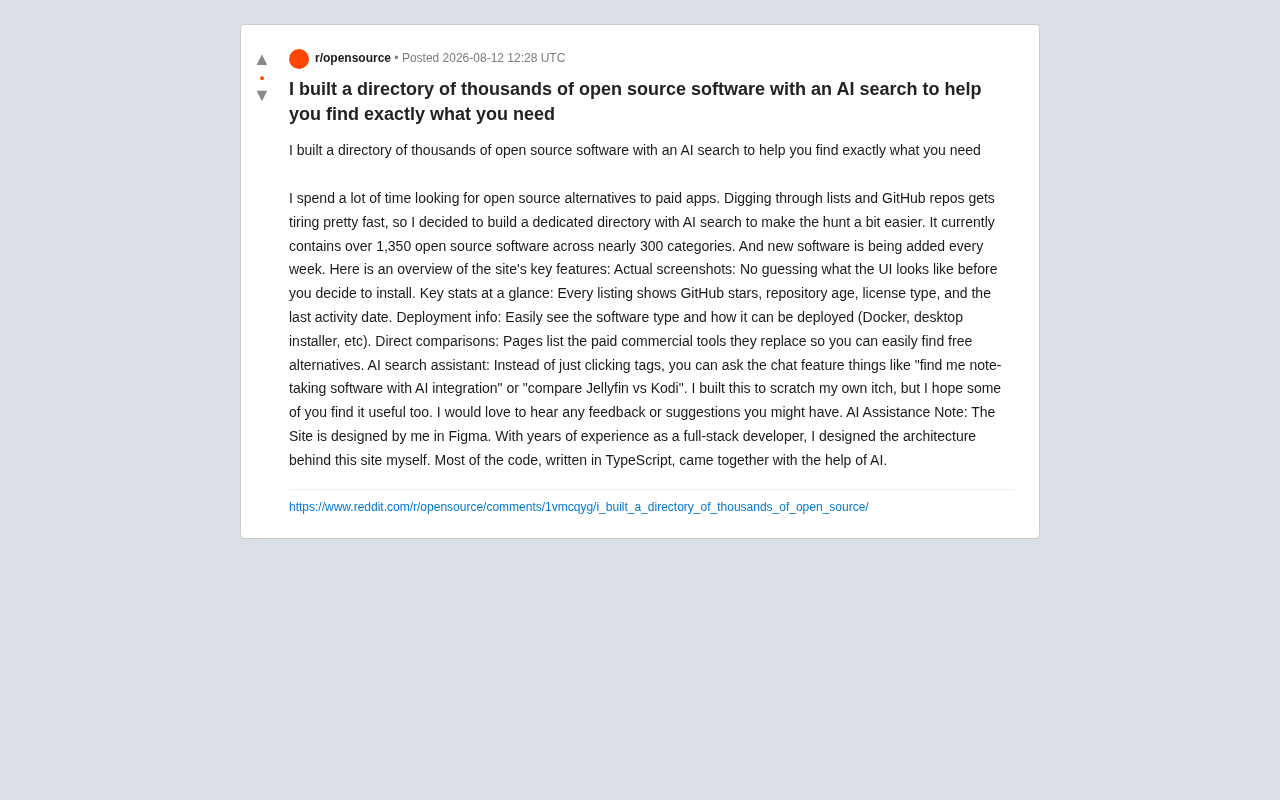
AI-powered directory of 1,350+ open source apps helps users find free alternatives to paid software.
A full-stack developer created a comprehensive directory website featuring over 1,350 open source software entries across nearly 300 categories. The platform stands out with real UI screenshots, GitHub metrics, deployment details, and direct comparisons to paid commercial tools. Its AI search assistant lets users describe needs in natural language to get precise recommendations, transforming traditional browsing into an intelligent consultation experience.
The Pain Points of Finding Open Source Alternatives to Paid Software
For many developers and tech enthusiasts, searching for open source alternatives to paid applications is practically a daily need. Yet this process is often more tedious than expected — you need to sift through forum recommendation lists, GitHub repositories, and community discussions, comparing features, activity levels, and deployment methods one by one. Information is scattered and inconsistent in quality, making the entire search process incredibly time-consuming.
It's precisely this pain point that motivated a full-stack developer with years of experience to share his latest project on Reddit: a directory website dedicated to open source software, integrated with an AI search assistant. According to his introduction, the directory currently includes over 1,350 open source applications across nearly 300 categories, with new entries added every week.
Core Features: More Than Just a Link List
Unlike traditional "open source alternatives lists," this directory puts considerable effort into information presentation, aiming to solve the problem of needing extensive secondary research after finding software.
Real Screenshots and Key Data at a Glance
The creator emphasizes that every software entry comes with real interface screenshots, so users don't have to guess about the UI before installing. This is particularly useful for evaluating a software's maturity and user experience.
Beyond that, each entry prominently displays a set of key data points:
- GitHub Stars: Reflects the project's community recognition
- Repository age: Helps judge the project's maturity
- License type: Helps users confirm compliance for use and commercial purposes
- Last active date: A critical metric for assessing whether an open source project is still being maintained
This centralized data presentation helps users quickly filter out projects that have been abandoned or have inactive communities, avoiding wasted time on defunct projects.
GitHub Stars and Open Source Project Health Assessment
GitHub Stars are the most intuitive popularity metric in the open source community, representing how many developers have bookmarked a project. While Star count doesn't directly equate to code quality, it does reflect a project's visibility and influence. Generally speaking, projects with over 1,000 Stars typically have a solid user base, while 5,000+ Stars indicate high recognition in a specific domain. However, assessing open source project health requires combining multiple indicators: Fork count reflects developer participation, Issue response time shows maintainer activity, and Commit frequency reveals development pace. In recent years, some projects have inflated their numbers through Star-buying schemes, so it's necessary to evaluate projects across multiple dimensions. For enterprise-level applications, contributor distribution also matters — if core code is maintained by a single developer, there's a significant maintenance risk.
Open Source Licenses: The Choice Dilemma from MIT to GPL
Open source licenses determine the rights to use, modify, and distribute software, forming the legal foundation for compliant use of open source software. The most permissive licenses — MIT and Apache 2.0 — allow commercial use and closed-source modifications, making them ideal for enterprise integration. The GPL (GNU General Public License) family, on the other hand, requires derivative works to also be open source, earning it the nickname 'viral' license, which makes many commercial companies wary of GPL projects. The increasingly popular AGPL (Affero GPL) goes even further, requiring open sourcing even when services are provided over a network, posing challenges for SaaS companies. Some projects adopt dual-licensing strategies: a community edition under GPL and a commercial edition with a proprietary license. The Mozilla Public License (MPL) strikes a balance between the two, only requiring the modified portions to be open source. Choosing the wrong license can lead to legal disputes — there were multiple lawsuits in 2022 for GPL violations — so it's essential to carefully review license terms before incorporating open source components.
Deployment Information and Commercial Software Benchmarking
The directory also clearly labels each software's type and deployment method, such as whether it supports Docker or offers desktop installation packages. For self-hosted enthusiasts, this kind of information often determines whether a tool is worth trying.
Self-hosted and Docker: The Technical Barrier of Open Source Deployment
Self-hosted refers to users deploying and running software on their own servers rather than relying on third-party cloud services. The core advantage of this model is that data remains entirely under the user's control, avoiding privacy leaks and vendor lock-in risks. Docker has dramatically lowered the technical barrier for self-hosting — through containerization technology, developers can package applications and their dependency environments into standardized images, and users can start a service with a single docker run command without dealing with complex dependency installation and environment configuration. Docker Compose further simplifies multi-container application deployment by defining the entire tech stack in a single YAML file. However, self-hosting also means users bear the responsibility for server maintenance, security updates, backup recovery, and more. Kubernetes, which has emerged in recent years, is suitable for larger-scale deployments but has a steep learning curve. For individual users, visual management tools like Portainer and CasaOS provide a friendlier entry point, allowing non-professionals to enjoy the benefits of self-hosting.
Even more practical is the direct benchmarking feature — each page lists the paid commercial tools that the open source software can replace. This means when you want to break free from a subscription-based software, you can directly reverse-search for its open source alternative, significantly lowering the search barrier.
AI Search Assistant: Finding the Right Open Source Tool with Natural Language
The project's biggest highlight is its built-in AI search assistant. Traditional directory websites typically only allow filtering through tags or categories, but here users can directly express their needs in natural language.
The creator gave two typical use cases:
- "Find me a note-taking app with AI integration"
- "Compare Jellyfin and Kodi"
This shift in interaction essentially upgrades "searching" to "consulting." Users no longer need to know the correct category name or keywords in advance — they can describe their vague needs as if talking to a person, and let the AI understand the intent and provide precise recommendations or side-by-side comparisons. For a field like open source software, where there are countless options with varied naming conventions, the value of AI search is particularly significant.
Natural Language Search and Vector Database Technology
Traditional search engines rely on keyword matching and Boolean logic, while AI-based natural language search retrieves content by understanding semantics. The core technology is Embedding (vector embedding) — converting text into numerical vectors in high-dimensional space, where semantically similar texts are closer together in vector space. When a user inputs "note-taking app with AI integration," the system converts the query into a vector, then performs a similarity search in a vector database (such as Pinecone, Weaviate, or Qdrant) to return the semantically closest results. This approach can understand synonyms, context, and implicit intent, allowing users to find relevant content even without knowing precise technical terms. The integration of Large Language Models (LLMs) like GPT and Claude enables the system to not only retrieve but also reason and perform comparative analysis. Implementing such features typically requires combining OpenAI API or open source models (like Llama) with frameworks like LangChain for RAG (Retrieval-Augmented Generation) processing. In terms of cost, the computational overhead of vectorization and search is significantly higher than traditional search, but the improvement in user experience has made it a standard feature for modern content platforms.
AI-Assisted Development: How One Person Built a Content Product at Scale
It's worth noting that the creator openly disclosed the development approach behind this project — which itself is a microcosm of current software development trends.
He stated that the website's overall design was completed by himself in Figma, and the underlying architecture was independently designed based on his years of full-stack development experience. At the code implementation level — primarily written in TypeScript — he heavily leveraged AI assistance.
TypeScript's Role in Full-Stack Development
TypeScript is a superset of JavaScript that addresses JavaScript's maintainability issues in large projects by adding a static type system. Since its release by Microsoft in 2012, TypeScript has become the de facto standard for modern frontend development — according to Stack Overflow's 2023 survey, over 38% of professional developers use TypeScript. Its core advantage lies in compile-time type checking, which catches a large number of potential errors before code runs, while also providing more precise IDE intellisense. In full-stack development, TypeScript enables front-end and back-end type sharing: through tools like tRPC and GraphQL Code Generator, API type definitions can be automatically synced to the client, eliminating inconsistencies in API documentation. Major frameworks such as React, Vue, Angular, and Next.js all provide first-class TypeScript support. However, TypeScript also increases learning costs and build complexity, and may be over-engineering for small projects. In recent years, new runtimes like Bun and Deno natively support TypeScript without a compilation step, further simplifying the development workflow. Combined with runtime validation libraries like Zod, TypeScript builds a full-chain type safety system from compilation to runtime.
The Workflow Revolution of AI-Assisted Programming
The emergence of AI programming assistants is redefining the software development process. Tools represented by GitHub Copilot, Cursor, and Claude have evolved from simple code completion to understanding requirements, generating complete feature modules, and even providing architectural recommendations. A typical AI-assisted workflow has developers responsible for system design, technology selection, and core logic, while AI handles boilerplate code, API calls, test cases, and other repetitive work. Research shows that using AI programming tools can boost development efficiency by 30-50%, which is especially significant for indie developers. However, this model also brings new challenges: over-reliance on AI can lead to declining code quality, generated code may contain security vulnerabilities or fail to follow best practices, and developers need the ability to review and optimize. Another controversy is copyright — the legality of AI training data sources remains disputed. The deeper impact is the shift in professional skills: the importance of coding ability decreases while system design, problem decomposition, and code review skills become more critical. From a tooling perspective, Cursor supports multi-file context understanding, Claude excels at explanation and refactoring, and GPT-4 performs well in algorithm implementation — developers need to choose the right tool combination based on the task.
This model of "humans leading architecture and design, AI assisting with code implementation" is becoming the standard workflow for an increasing number of indie developers. It preserves the developer's control over system design while dramatically boosting coding efficiency through AI, making it more feasible for a single person to independently build a content-rich product. In a sense, this project is both a directory of open source tools and a real-world example of AI-assisted programming in practice.
Where Is the Long-Term Value of an Open Source Software Directory?
The creator admits that the project was initially built to solve his own practical needs, but he also hopes it can help others in the community, and has openly solicited feedback and suggestions.
From a product perspective, the moat of such aggregation-type content sites often lies not in the technology itself, but in the quality, completeness, and ongoing maintenance of the data. The scale of 1,350+ applications across nearly 300 categories already provides considerable practical value, while the promise of "weekly updates" tests the sustained operational investment. AI search is a bonus, but what truly keeps users coming back is the reliable, curated, and structured data behind it.
For users who frequently need to find open source alternatives, a directory that combines screenshots, data, deployment information, and commercial benchmarking — all with natural language query support — undoubtedly provides a more efficient path.
Key Takeaways
Related articles
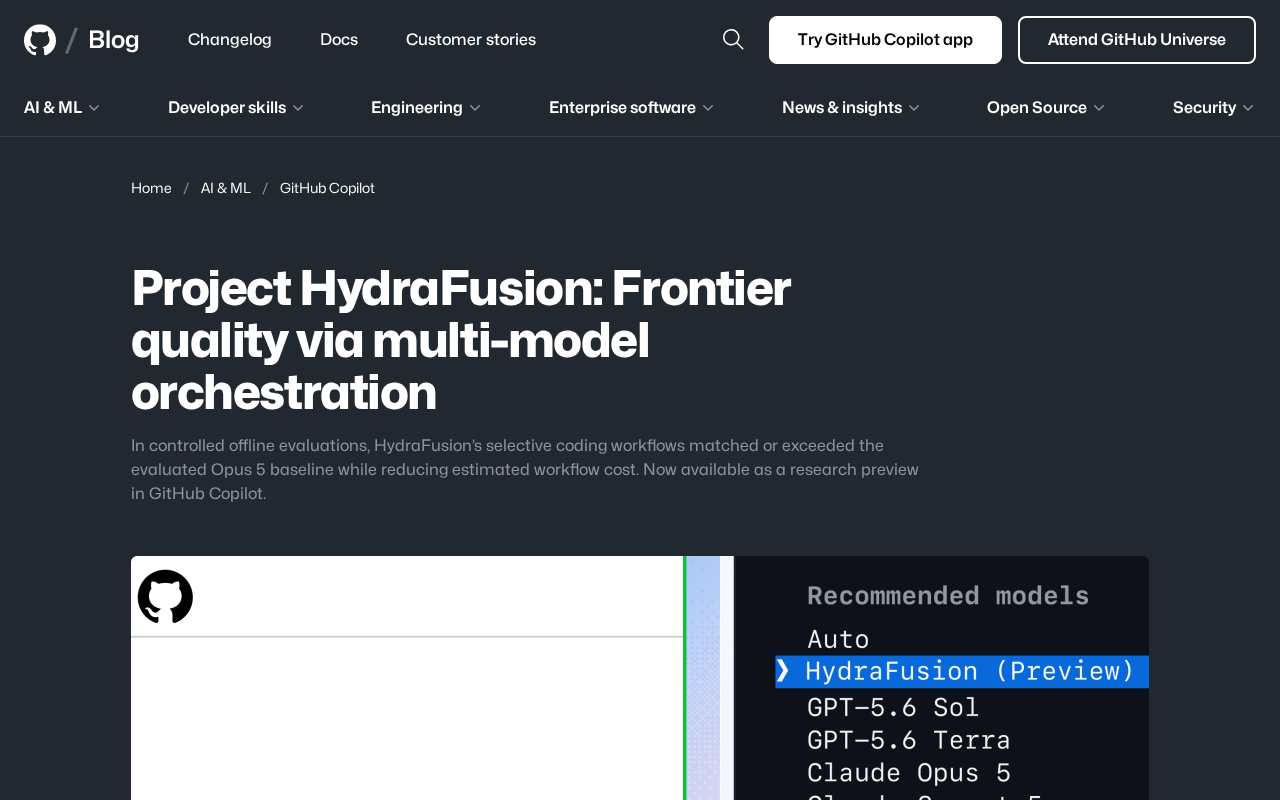
GitHub HydraFusion: How Multi-Model Orchestration Approaches Frontier Quality While Cutting Costs
Deep dive into GitHub Project HydraFusion's multi-model orchestration architecture: how intelligent routing and selective coding workflows match Opus 5 quality while cutting inference costs.
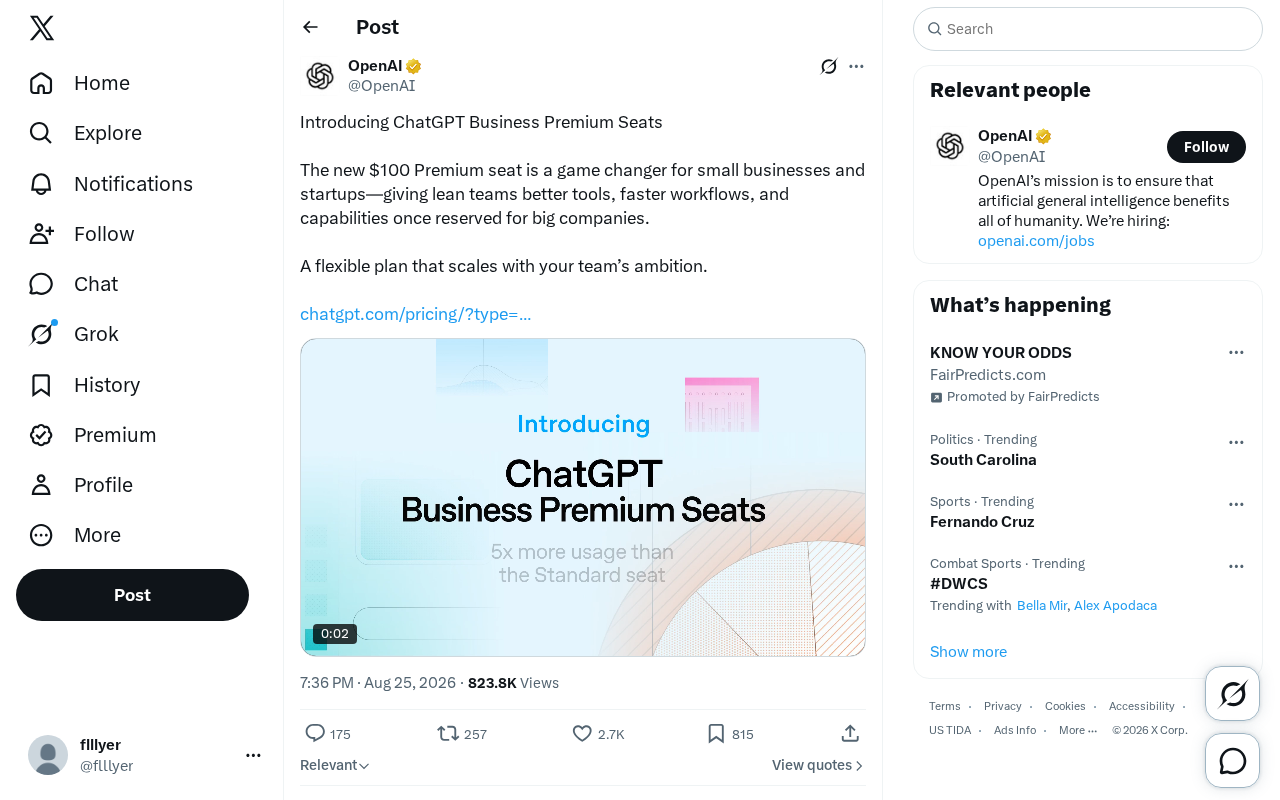
ChatGPT Business Premium Seats: A Deep Dive into the $100/Month AI Plan for SMBs
OpenAI launches ChatGPT Business Premium Seats at $100/seat/month for SMBs and startups. A detailed analysis of pricing, features, market positioning, and impact on the startup ecosystem.
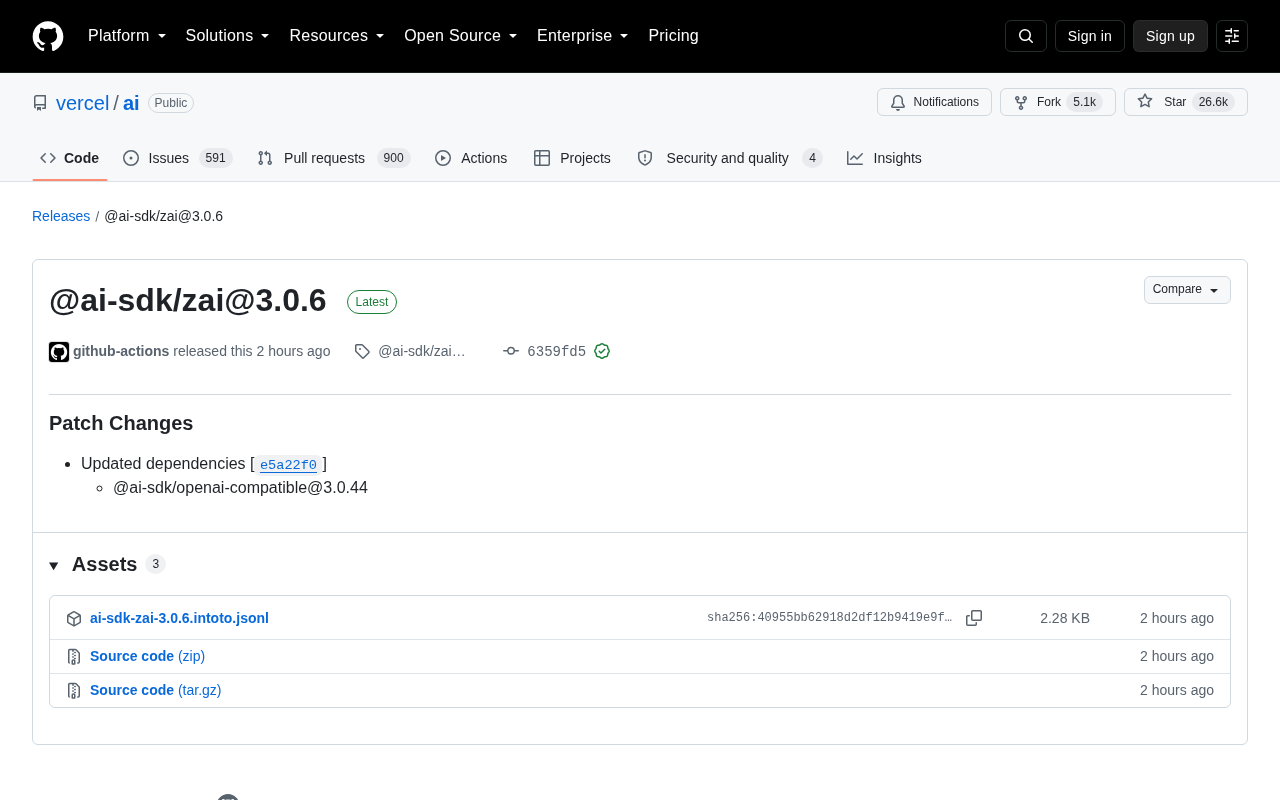
Vercel AI SDK @ai-sdk/zai 3.0.6 Update: A Deep Dive into Zhipu Model Integration
A deep dive into the @ai-sdk/zai 3.0.6 patch update — covering its openai-compatible architecture, dependency upgrade details, and what it means for Zhipu GLM developers.