Diving into PostgreSQL Internals: A Free, Open-Source Guide to Database Principles
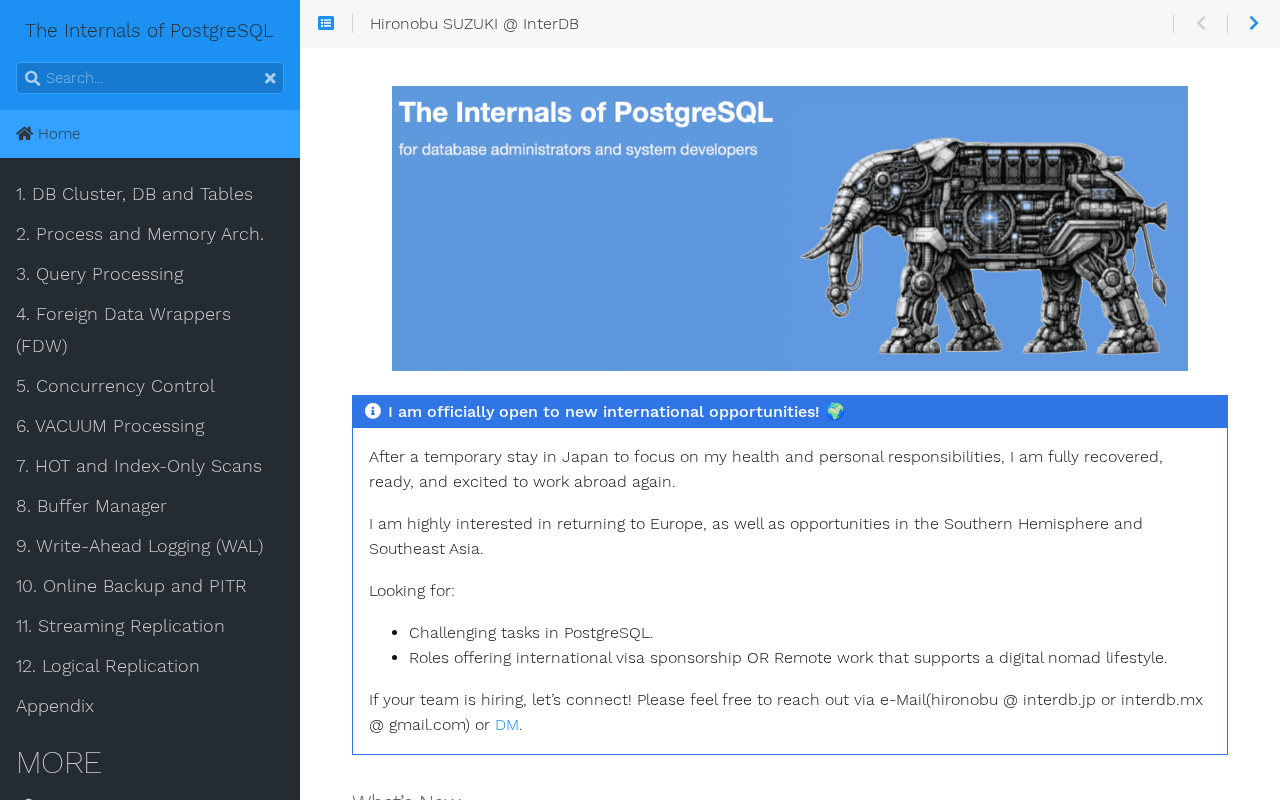
The free online book *The Internals of PostgreSQL* systematically explains PostgreSQL internals, ideal for developers looking to level up.
*The Internals of PostgreSQL*, maintained by Japanese developer Hironobu Suzuki, is a free online book that systematically explains PostgreSQL's internal workings rather than serving as a usage tutorial. It covers process architecture, storage layout, query processing, MVCC concurrency control, and WAL durability. Positioned between operations books and source-code analysis, it can serve as a roadmap for reading the source code and is suitable for DBAs, backend engineers, and advanced database developers to consult as needed. The book received 288 upvotes and 23 comments on Hacker News.
An Underrated Learning Resource for Database Internals
On Hacker News, a post about The Internals of PostgreSQL received 288 upvotes and 23 comments. Maintained by Japanese developer Hironobu Suzuki, the project is an online book that systematically explains how PostgreSQL works internally, and it is completely free and publicly available.
For most developers, everyday use of PostgreSQL stays at the level of SQL syntax and index optimization. But when the system hits performance problems that are hard to explain, a lack of understanding of internal mechanisms often leaves people helpless. The value of this book lies precisely in filling that gap—it doesn't teach you how to use PostgreSQL, but explains why it works the way it does.
Content Structure and Technical Depth
The Internals of PostgreSQL organizes its chapters around the core flow of database operation, starting with process architecture and memory structures, then gradually moving into query processing, concurrency control, transaction logging, and vacuum mechanisms.
From Process Model to Storage Layout
The opening section analyzes PostgreSQL's process architecture: how the postmaster forks child processes, how each backend process's memory contexts are divided, and how the responsibilities of shared buffers and local buffers differ. This content directly relates to the underlying logic behind connection-count configuration and memory-parameter tuning.
On the storage side, the book explains in detail the internal layout of heap table pages, the relationship between line pointers and tuples, and how the TOAST mechanism handles extremely long fields. This knowledge is essential for understanding table bloat and storage-efficiency issues.
The TOAST Mechanism
PostgreSQL's page size is fixed at 8KB. When a row of data (such as long text or large JSON) exceeds about 2KB, the TOAST (The Oversized-Attribute Storage Technique) mechanism automatically steps in. It first compresses the oversized field; if it is still over the limit, it splits the field and stores it in a separate TOAST table, keeping only a pointer to the TOAST table in the main table's row. The TOAST table is linked to the main table via OID and is transparent to users. Understanding TOAST helps explain why some queries on large fields incur extra I/O, why SELECT * can be much slower than fetching only the necessary columns, and how adjusting a column's storage strategy (such as EXTERNAL or MAIN) can optimize storage and access efficiency.
Query Processing and the Executor
The query processing chapter covers the complete chain from parsing and rewriting to plan generation and the executor. The book not only describes the role of each stage but also shows how the executor pulls data step by step through a node tree. Understanding this flow helps developers read EXPLAIN output and determine whether a query bottleneck lies in plan selection or in the execution stage.
Concurrency Control and MVCC
Multi-version concurrency control is one of PostgreSQL's core features. The book explains transaction ID assignment, the rules for determining snapshot visibility, and the root causes of behavioral differences across isolation levels. This content explains why long transactions block vacuum and why some queries see "stale" data.
Transaction IDs and Transaction ID Wraparound
PostgreSQL assigns each transaction a 32-bit transaction ID (XID), with a total of about 4 billion. When XIDs are exhausted and wrap around, old transactions may be mistaken for new ones, causing data visibility confusion. To prevent this, PostgreSQL introduces a freeze mechanism: row versions old enough are marked as "frozen," making them visible to all transactions without relying on XID comparisons. In addition to reclaiming dead tuples, vacuum is also responsible for performing freeze operations. Understanding this makes it clear why failing to run vacuum for a long time can force the database to shut down due to XID wraparound risk, and why monitoring age(datfrozenxid) is important.
Snapshots and Visibility Determination
A snapshot records the set of XIDs of all active transactions at a given moment. When determining whether a tuple is visible to the current transaction, PostgreSQL compares the tuple's xmin (creating transaction ID) and xmax (deleting transaction ID) with the transaction states in the snapshot: if xmin has committed and is not in the snapshot's active set, and xmax is empty or uncommitted, the tuple is visible. This XID-based visibility rule is the core of MVCC, and it also explains why long transactions hold old snapshots, preventing vacuum from cleaning up old tuple versions that may still be needed, which in turn leads to table bloat.
WAL and Durability
The write-ahead logging chapter explains how WAL buffers, log segment files, and checkpoints cooperate, as well as the process of replaying logs during crash recovery. This is the foundation for understanding PostgreSQL's durability guarantees and replication mechanisms.
Checkpoints and the Background Writer
A checkpoint is the synchronization point between WAL and data files: it forces all dirty pages in shared buffers to be flushed to disk and records a checkpoint record in WAL. During crash recovery, only WAL from the last checkpoint onward needs to be replayed, rather than the entire log. Checkpoint frequency is controlled by checkpoint_timeout and max_wal_size; too frequent increases I/O load, while too sparse lengthens recovery time. The background writer is responsible for smoothly writing out dirty pages between checkpoints to avoid sudden I/O spikes at checkpoint time. Understanding how these two cooperate helps in reasonably configuring parameters such as shared_buffers and wal_level, and in balancing performance against recovery time.
Comparison with Other Learning Paths
Most PostgreSQL books on the market focus on operations and SQL development, while source-code-analysis materials often have too high a barrier to entry. The Internals of PostgreSQL sits between the two: it doesn't require readers to read through the source code, but it cites key data structures and function names to help readers locate the source-code level when needed.
For readers who want to go further, this book can serve as a map for reading the source code—first understand the mechanism design, then look at the specific implementation with questions in mind, which is far more efficient than grinding through code directly.
Target Audience and Usage Suggestions
The book is best suited for three types of readers: DBAs who need to troubleshoot complex performance problems, backend engineers working on database selection or secondary development, and advanced developers curious about database theory.
There's no need to read it cover to cover. It's recommended to consult it as needed based on actual work scenarios—for example, when encountering vacuum delays, focus on the relevant chapters and use output from pg_stat views to verify your understanding. The book includes many diagrams; understanding page structures and flows alongside the figures is much more efficient than reading text alone.
It should be noted that the book focuses on mechanism principles rather than differences in version features, and some details may change as PostgreSQL versions evolve. When reading, it's best to cross-check with the official documentation to confirm the specific behavior of the current version.
Why It's Worth Attention
Databases are a core dependency of most applications, but the proportion of developers who truly understand their internal workings is very low. The Internals of PostgreSQL lowers that barrier by being freely available online, and the discussion heat on Hacker News also shows that the community has sustained demand for this kind of in-depth material. For developers who want to advance from "knowing how to use a database" to "understanding a database," this is a learning resource worth investing time in.
One-line Summary
The free online book The Internals of PostgreSQL systematically explains PostgreSQL's internal mechanisms, making it ideal for developers who want to advance their skills.
Paragraph Summary
The Internals of PostgreSQL is a free online book maintained by Japanese developer Hironobu Suzuki that systematically explains PostgreSQL's internal workings rather than serving as a usage tutorial. The article introduces the book's content structure, covering core topics such as process architecture, storage layout, query processing, MVCC concurrency control, and WAL durability, and notes that its positioning lies between operations books and source-code analysis—it can serve as a roadmap for reading the source code. The book is suitable for on-demand consultation by DBAs troubleshooting complex performance problems, backend engineers, and advanced database developers. The article also mentions that the book received 288 upvotes and 23 comments on Hacker News, reflecting the community's sustained demand for in-depth database material.
Related articles

DeepSeek Harness Quick Start Guide: From Installation to 5 Real-World Cases
What is DeepSeek Harness? Based on a Bilibili tutorial, this article covers how this AI Agents software works, installation and setup, four working modes, and five real-world cases: a 3D racing game, official website, music player, science animation, and self-developed plugin—plus token money-saving tips.

Breaking Down DeepSeek's Super-agent Architecture: How Router+Worker Solves the Multi-Session Management Bottleneck
An analysis of DeepSeek's Super-agent paper: how the Router+Worker two-tier architecture uses Fast Pass, Chain of Recall, and storage-compute separation to solve multi-AI-session management bottlenecks, and how much it truly alleviates the human attention bottleneck and what engineering trade-offs it makes.

19K Stars in 5 Days: Why DeepSeek's Open-Source AI Programmer Went Viral
DeepSeek's open-source AI programmer hit 19K GitHub stars in 5 days. Why it went viral: the agent boom, AI writing its own code, and the shift from Q&A tools to AI employees.