AI Search Optimization in Practice: Making AI Engines Understand Your Business Expertise

AI search optimization needs technical crawlability, content structure, and multi-signal measurement to make websites understood and cited by AI.
The article explores AI search optimization (AEO/GEO), noting its goal is not ranking but being cited in generative answers. It offers practical advice across technical implementation, content structure, and measurement: service pages should be organized by search intent, technical crawlability is the baseline, structured data must match visible content, expertise should be shown with evidence, and measurement should combine technical health, Search Console data, conversions, and documented AI answer tests.
AI-driven search experiences are changing how users discover software service providers. Instead of seeing just a list of links, users now get a direct answer that has been understood, retrieved, and generated. For developers and technical teams, this means websites need to be understood not just by people, but by AI systems — this is the core proposition of AI Search Optimization.
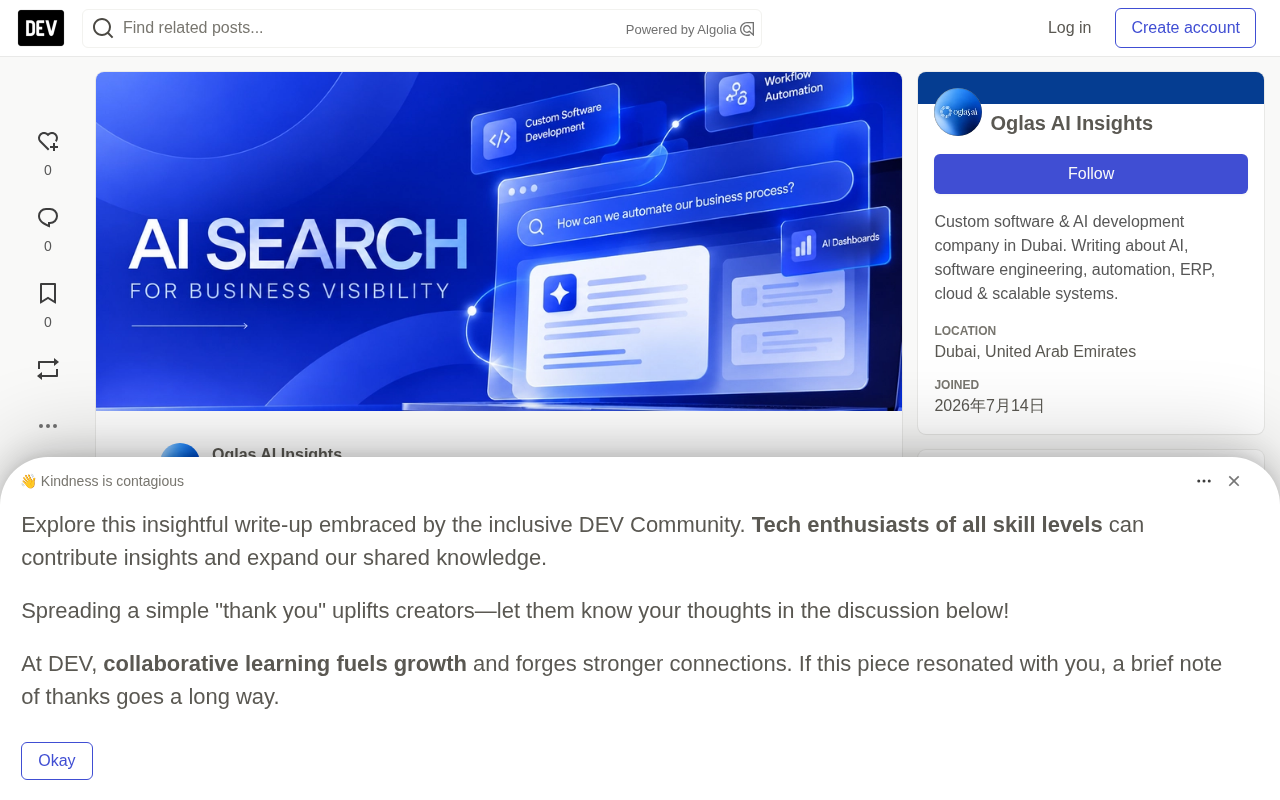
This article breaks down how to make AI search engines present your technical expertise more accurately, across three dimensions: technical implementation, content structure, and measurement methods.
The Relationship Between AI Search Optimization and Traditional SEO
Answer Engine Optimization (AEO) and Generative Engine Optimization (GEO) are recently emerged concepts, but their underlying logic is nothing new: make content crawlable, understandable, and trustworthy. The difference is that traditional SEO aims for rankings, while AI search optimization aims to be "cited" — appearing in generative answers from ChatGPT, Google AI Overviews, and similar systems.
This means developers need to focus not just on keyword matching, but on the completeness and contextual richness of answers. A traditional query might be "workflow automation services," but in an AI search scenario, a user would ask: "How can a security company reduce manual report processing while keeping its existing systems?" The latter includes problem context, constraints, and a specific industry — content must respond to these dimensions, not just match a phrase.
AI search optimization doesn't replace SEO; it's a visibility strategy layered on top of technical foundations and quality content.
TOFU/MOFU/BOFU (Funnel Stages) is a common framework for understanding search intent layering. TOFU (Top of Funnel) corresponds to the awareness stage, where users search for industry problems or concepts; MOFU (Middle of Funnel) corresponds to the evaluation stage, where users compare solutions, vendors, or technical approaches; BOFU (Bottom of Funnel) corresponds to the decision stage, where users look for specific service providers, pricing, or implementation details. Traditional SEO often centers on keywords, easily mixing content for different stages on the same page; AI search optimization, however, requires pages to clearly serve a single intent segment. For example, "What is workflow automation" is TOFU and should provide conceptual explanations; "Workflow automation platform comparison" is MOFU and should provide evaluation criteria; "Dubai workflow automation implementation services" is BOFU and should provide delivery scope, integration capabilities, and case evidence. Splitting pages by funnel stage allows AI systems to more accurately judge the match between a page and a query, and also facilitates subsequent measurement of citation and conversion performance for each stage.
Organizing Page Structure by Search Intent
Cramming all services into one broad page is a common mistake. Custom software development, workflow automation, and data analytics each need their own dedicated pages, connected through a clear site structure.
Each page should clearly answer: who it's for, what problem it solves, what the technical approach is, which system integrations are involved, and how success is measured. For example, a workflow automation page needs to explain triggers, approval processes, exception handling, notification mechanisms, and system integration methods; an AI dashboard page should explain data sources, refresh frequency, metric definitions, access control, and the specific decision scenarios it supports.
Another common trap is creating nearly identical pages for "Dubai" and "UAE," only swapping the place name. Only when regional pages provide genuinely differentiated information is it worth publishing them separately.
Making Service Pages Actually Answer Questions
AEO emphasizes direct answers, while GEO emphasizes the citability of information in generative experiences. Both benefit from clear content structure.
An effective service page can follow this hierarchy: first, a paragraph that directly defines the service; then, a description of the business pain point; next, the technical solution; then, a list of relevant integration systems; and finally, a real case study with constraints such as security, data quality, or human review.
Don't just claim "we provide AI dashboard services in Dubai" — explain how the dashboard integrates ERP, CRM, and operational data, how calculation logic is verified, and whether AI supports prediction, anomaly detection, or natural language queries — or whether it supports none of these.
Google's "People-First Content" guidelines are a practical editorial benchmark: content should satisfy visitor needs and demonstrate relevant expertise. Deliberately piling on AI jargon while ignoring the applicability of traditional software solutions actually undermines credibility.
Technical Crawlability Is the Baseline
Pages that are blocked, broken, or incompletely rendered directly hinder discovery, which is especially common in React sites, client-side routing, and Headless CMS builds. Developers need to check HTTP status codes, visible headings and content one by one, investigate unexpected robots.txt or noindex settings, and ensure canonical URLs, internal links, and XML sitemaps are consistent.
Server-side rendering or static generation can expose core content in the initial HTML, but not every site must adopt this.
Crawler access policies vary by platform. OpenAI has separate documentation for OAI-SearchBot (used for ChatGPT search experiences) and GPTBot. Before modifying permissions, consult the official crawler guidelines. Allowing crawler access doesn't guarantee rankings or citations — it simply removes a potential access barrier. Private and sensitive routes still need protection.
When troubleshooting crawlability issues, HTTP status codes are the most fundamental diagnostic signal. 200 means the page returns normally; 301/302 indicates a redirect, and overly long chains dilute authority and increase the chance crawlers give up; 404 means the page doesn't exist, so ensure important pages don't return 404 due to routing configuration errors; 410 indicates content has been permanently removed, suitable for pages explicitly taken down; 5xx indicates a server error that directly blocks crawling. For client-rendered sites like React and Vue, the initial HTML may contain only an empty shell — if crawlers don't execute JavaScript, they can't see the body content. In this case, server-side rendering (SSR), static generation (SSG), or pre-rendering is needed to expose core content. Additionally, Disallow rules in robots.txt, page-level noindex tags, and incorrect canonical pointers can all make quality content "invisible" in search and AI systems. It's recommended to cross-validate using Search Console's URL inspection, third-party crawler simulation tools, and server logs to ensure important pages return 200, are indexable, and have visible body content.
Correct Use of Structured Data
Structured data provides machine-readable context. JSON-LD is a common format, with relevant types including Organization, Service, and Article.
Organization markup describes business information; Article markup can identify title, author, and publication date. The key point: markup must be consistent with visible content on the page. For developers managing numerous pages, reusable metadata and schema components improve consistency, but you shouldn't replace descriptions across all pages with the same text.
Structured data doesn't guarantee rich results or AI citations. After implementation, validate it and follow each search platform's documentation requirements.
JSON-LD (JavaScript Object Notation for Linked Data) is the embedded structured data format recommended by search engines, typically placed in a <script type="application/ld+json"> tag. It declares the Schema.org vocabulary via @context, specifies entity types (such as Organization, Service, Article) with @type, and then describes entity relationships with properties. Compared to Microdata and RDFa, JSON-LD is decoupled from HTML structure, making it easier to reuse and maintain in component-based frontends. For service-oriented businesses, Organization can declare name, logo, contact information, and sameAs links for the same entity across platforms; Service can describe service name, service type, provider, and service area; Article is suitable for blogs and technical documentation, identifying title, author, publication date, and modification date. It's particularly important to note that every key field in the markup should be visible to users on the page, otherwise it may be considered misleading markup. After implementation, use Google's Rich Results Test and Schema Markup Validator to verify syntax and entity completeness.
Demonstrating Expertise with Evidence
Claims like "advanced AI" don't explain how a team solves problems. Technical evidence is what makes service content genuinely useful.
Within the limits of client confidentiality, case studies should describe the original challenge, the systems and data involved, implementation decisions, failure or permission handling approaches, and how results were measured. Never fabricate client outcomes or performance data. If details cannot be disclosed, explicitly label them as illustrative scenarios or anonymize transparently.
For example, you can trace a complete workflow path from form submission, validation, approval, to database updates and notifications. An AI dashboard case study can show how data is standardized before metric calculation.
Measuring with Multiple Signals, Not a Single Metric
No single metric can fully reflect search and AI visibility. It's recommended to monitor four dimensions simultaneously: technical health, organic search performance, business conversions, and AI visibility.
Technical health focuses on whether important pages are crawlable, indexable, and return expected status codes; organic search performance is viewed through Google Search Console for queries, impressions, clicks, and page trends; business conversions link visits to actions like inquiry requests through analytics tools; AI visibility requires regularly testing representative customer questions, recording the platform, date, answer content, and cited sources.
Before making any changes, record baseline data for priority pages: current queries, clicks, impressions, conversions, and known technical issues. Note publication dates and major updates so subsequent changes can be interpreted in context. Treat AI answer checks as observations rather than rankings — results vary by wording, context, and platform. Track trends and update content for real gaps.
Google Search Console (GSC) is the core free tool for measuring organic search performance. It shows query terms, impressions, clicks, click-through rate (CTR), and average position, broken down by page, country, and device. For AI search optimization, GSC's value lies in identifying "high impression, low click" pages — these may be directly answered by AI overviews, so users don't need to click, but they also indicate the content is relevant to the query. Combined with the "Queries" report, you can discover long-tail questions users actually use, and work backward to identify content gaps. GSC also provides URL inspection, sitemap submission, Core Web Vitals, and mobile usability reports to help locate technical health issues. Note that GSC doesn't directly show cited sources in AI answers, so you still need to combine regular manual testing and documented records, cross-interpreting GSC data with AI visibility observations to avoid drawing conclusions from a single metric.
Regional Relevance Requires Substantive Content
Adding "Dubai" or "UAE" to every paragraph doesn't make a page localized. What really works is explaining service areas, industry context, implementation environments, and relevant operational challenges.
A UAE custom software development page should describe the applications and integration solutions delivered; a workflow automation company should explain which processes it can improve and how it collaborates with existing systems; an AI dashboard page should show how its approach supports reporting and decision-making. Place name keywords are a starting point, not a substitute for substance.
Frequently Asked Questions
What is AI search optimization?
AI search optimization is the practice of making website information easier for AI-driven search systems to discover, understand, and potentially cite. It combines technical accessibility, clear content, useful context, and credible evidence, complementing rather than replacing traditional SEO.
What's the difference between AEO and GEO?
AEO focuses on making content effectively answer specific questions, while GEO focuses on making information understandable and citable in generative AI experiences. The two overlap, and neither guarantees visibility.
Can structured markup guarantee appearing in AI answers?
No. Structured data helps systems interpret supported information, but no universal schema type guarantees inclusion or citation. Use markup that accurately reflects visible content and follow platform documentation requirements.
How do you measure AI search visibility?
Combine Search Console data, website analytics, conversion events, technical checks, and documented tests of AI answers. Record questions, platforms, dates, and cited sources, then review patterns regularly. No single metric covers all AI search displays.
The Ultimate Goal
AI search hasn't eliminated the need for solid web development and quality content — it has made clear information architecture, crawlability, accurate descriptions, and verifiable expertise even more important.
Developers can support discoverability by building pages around real user needs, keeping content accessible, using structured data appropriately, publishing evidence-based case studies, and continuously measuring results. The goal isn't to force mentions, but to build a website that clearly explains expertise to both people and search systems.
One-line Summary
AI search optimization requires making websites understandable and citable by AI through technical crawlability, content structure, and multi-signal measurement.
Paragraph Summary
The article explores AI search optimization (AEO/GEO), noting that its goal is not ranking but being cited in generative answers. The author offers practical advice across three dimensions: technical implementation, content structure, and measurement methods: service pages should be organized independently by search intent, clearly answering audience, problem, technical solution, integration systems, and success criteria; technical crawlability is the baseline, requiring checks of status codes, robots.txt, canonical, and SSR/SSG; structured data (JSON-LD) helps machines understand context but must be consistent with visible content; demonstrate expertise with real cases and evidence, avoiding vague claims; measurement should combine technical health, Search Console data, business conversions, and documented AI answer tests. Ultimately, it emphasizes that AI search hasn't diminished the value of web development and quality content — it has made clear architecture and verifiable capabilities even more important.
Related articles

DeepCell: One-Click AI Generation of Documents, Spreadsheets, and Slides
DeepCell tops Product Hunt with one-click generation of documents, spreadsheets, and slides, using the .deepcell format for linked updates, designed for System 2 tasks like modeling and sales reviews.

Doneas: 15-Minute Daily Accountability Calls That Keep Indie Developers From Procrastinating
Doneas is a daily accountability tool for indie developers: plan tasks on Monday, join a 15-minute call with five builders each day, and log deliveries on a public progress page. This article analyzes its core mechanics, effectiveness, and potential issues around retention and matching.

Fastlane 2.0: Fully Automated AI Ad Campaigns, From Creative to Optimization
Fastlane 2.0 is an AI ad automation tool: enter your website and it learns your brand, generates video and image ads, and runs and optimizes them on Meta, TikTok, Instagram, and YouTube.