AI Should Not Take Over Governance: A Deep Analysis of Why Democratic Legitimacy Outweighs Efficiency
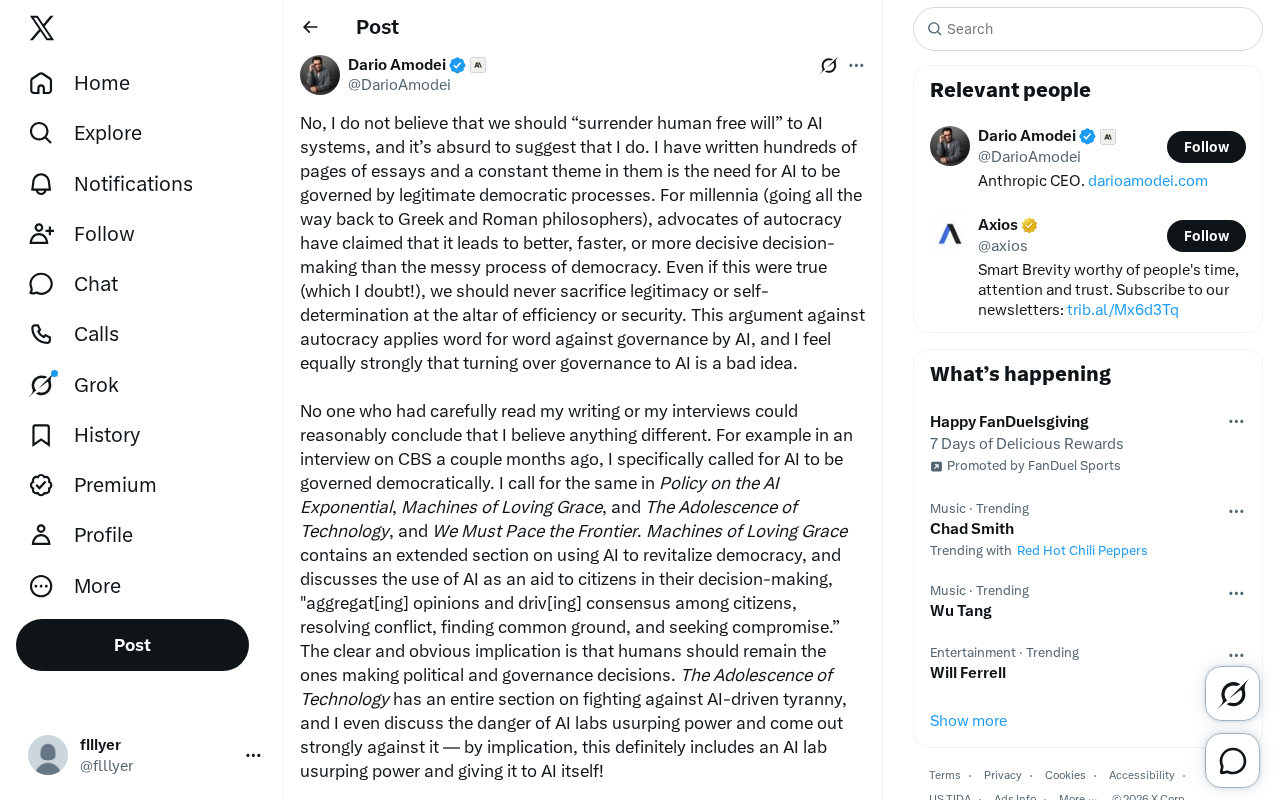
Amodei denies advocating the surrender of human free will to AI and stresses that AI must be governed by democratic processes.
The article centers on Anthropic co-founder Dario Amodei's response to the controversy over "AI taking over human governance." Amodei denies advocating the surrender of human free will to AI, calling the claim absurd, and cites public documents to prove he has consistently argued that AI must be governed by legitimate democratic processes. He distinguishes "global governance surrender" from "task automation," warning of four risks: recursive self-improvement, job disruption, AI use in alignment research, and human preferences. Legitimacy, he concludes, is not tradable.
1. The Origin of the Controversy: The Misrepresented "Surrender of Free Will"
Recently, discussion has heated up again over whether AI should take over human governance. Some argue that certain AI leaders advocate "surrendering" human free will to AI systems. In response, Anthropic co-founder Dario Amodei made a clear statement on social media: he has never advocated this view, and called the claim "absurd."
Amodei emphasized that he has written hundreds of pages of articles, and the consistent theme throughout is that AI must be governed by legitimate democratic processes. He cited history, noting that since the ancient Greek and Roman philosophers, advocates of authoritarianism have always claimed that tyranny produces better, faster, and more decisive decisions than the messy democratic process. But even if this claim were true (and he doubts it), we should never sacrifice legitimacy or self-determination in the name of efficiency or safety. This logic against tyranny applies word for word to opposing AI governance.
This response directly highlights a core disagreement in current AI governance discussions: efficiency first or legitimacy first. Amodei's position is very clear—legitimacy is non-negotiable.
2. The Evidence Chain: What Did He Actually Say?
To support his position, Amodei listed several public documents and interviews:
- In a CBS interview, he explicitly called for democratic governance of AI.
- In articles such as "Policy on the AI Exponential," "Machines of Loving Grace," "The Adolescence of Technology," and "We Must Pace the Frontier," he repeatedly expressed the same view.
- "Machines of Loving Grace" devotes considerable space to discussing how AI can revitalize democracy, including using AI as a tool to assist citizens in decision-making—to "aggregate opinions, promote civic consensus, resolve conflicts, find common ground, and seek compromise." The clear implication is that humans should continue to hold political and governance decision-making power.
- "The Adolescence of Technology" includes a dedicated chapter on how to counter AI-driven tyranny, and even discusses the danger of AI labs seizing power and strongly opposes it—which naturally includes opposing AI labs handing power over to AI itself.
Amodei added that if he thought giving governance power to AI was a good idea, he would openly advocate it, just as he has advocated many unpopular views over the past few years. But he hasn't, because he thinks it's a bad idea.
This kind of self-defense based on public texts is not common in AI ethics debates, and it reflects the lack of fact-checking in current discussions.
3. Conceptual Confusion: Global Governance vs. Task Automation
Amodei pointed out that a conceptual confusion frequently appears in current discussions: conflating "surrendering human free will to AI in the sense of global governance" with "as AI systems advance, they can complete specific tasks in a more automated way." The latter is not AI "ruling the world," but AI driving cars, designing anti-cancer drugs, or writing software end-to-end.
On task automation, his view is mixed. On the one hand, AI completing more complete or larger tasks has economic value and can drive major progress in software, medicine, transportation, energy, and other fields. In many cases this is clearly desirable and will save many lives. On the other hand, it also has drawbacks and may not be worth the cost in some areas.
He specifically listed four types of scenarios that require caution:
- The risk of recursive self-improvement (RSI): Using AI too autonomously to build the next generation of AI systems could lead to AI improving faster than humans can control and adjust. In early November, Anthropic publicly stated that it does not believe it is safe for Claude to fully autonomously build successive frontier models without meaningful human oversight or understanding.
- Job disruption: In some contexts, using AI too end-to-end could cause severe job disruption, and slowing or even stopping certain AI deployments to give people more time to adapt may be reasonable.
- Use of AI in alignment research: Although AI is a valuable tool for alignment research, caution is necessary because we may not be able to trust the work of AI systems.
- Human preferences: In many cases, people prefer to do certain activities themselves in order to maintain deep engagement with important matters, even if AI can do them better.
Amodei acknowledges that these issues have no simple answers and should not have a single decision-maker: some decisions are made by society, some by governments, some by AI companies, and some by individuals expressing their preferences in a decentralized way as consumers.
Recursive Self-Improvement (RSI) is one of the core risk concepts in the AI safety field. It refers to the ability of AI systems to autonomously design, build, and optimize the next generation of AI systems, thereby forming a positive feedback loop of capability improvement. The danger is that each generation of systems may improve the next generation faster than humans can, causing the capability growth curve to steepen sharply beyond the speed of human oversight, understanding, and correction. RSI is not an already realized phenomenon but a theoretical risk pathway. Especially given that training frontier models requires massive compute and engineering iteration, if model design, experimentation, evaluation, and other steps are handed end-to-end to AI, humans may lose substantive control over model behavior and goal alignment. Anthropic and other labs therefore advocate retaining meaningful human oversight at key R&D stages and avoiding a fully autonomous "AI building AI" loop.
Alignment Research aims to ensure that AI systems' goals and behaviors are consistent with human intentions and values, and is foundational work in AI safety. As model capabilities increase, researchers increasingly use AI itself to assist alignment research—for example, using AI to generate adversarial examples, review model outputs, and assist interpretability analysis. But there is a recursive dilemma here: if the AI system used for alignment research may itself be untrustworthy or unpredictable, then relying on it to ensure the safety of other AIs introduces new risks. Therefore, Amodei emphasizes that caution must be maintained when using AI to advance alignment, requiring independent verification, human review, and robust evaluation protocols, rather than treating AI's self-assessment as the final basis.
4. Industry Comparison: Product Convergence and "Vibes-Based" Positions
Amodei believes that other AI leaders or companies do not significantly disagree with him on the question of "whether specific tasks should be automated." He observes that the products offered by various companies show no substantive difference in the direction of task automation—every company is releasing models that are increasingly capable of completing tasks automatically, which is a general result of scaling AI training; every company also claims to understand the risks of automation and provides safeguards.
He further points out that if there is a difference, Anthropic is the most outspoken and proactive in acknowledging these drawbacks and trying to address them. He gave an example: some people cite his statement that "fully autonomous weapons may one day need to be used to defend democracy" to try to prove that he is different from other AI companies, which is quite absurd. Because at the time he was willing to risk the company's future by refusing to allow existing AI models to be used for autonomous weapons, even in the face of legal sanctions, and none of the other AI companies did so.
In Amodei's view, a current phenomenon is that some AI CEOs engage in "vibes-based business and political positioning," repeating slogans like "human control and agency" or "AI should just be a tool," but not doing anything different in their products, nor seriously addressing the difficult problems behind these slogans.
"Vibes-based positioning" is a term Amodei uses to criticize the public statements of some AI companies. It refers to corporate leaders repeating slogans that sound right and appealing in public communication—such as "humans should remain in control" and "AI is just a tool"—but these statements do not correspond to substantive differences in product design, deployment strategy, or safety investment. This kind of positioning is worth vigilance because it may lead the public and regulators to mistakenly believe that the industry has reached a consensus on governance principles, thereby obscuring the difficult issues that truly require trade-offs, such as the boundaries of task automation, the choice of deployment pace, and accountability. Amodei believes that serious positions should be reflected in verifiable actions, not just rhetorical gestures.
5. Conclusion: Legitimacy Is Not Tradable
Amodei's response can be summarized at two levels: on macro governance issues, he has consistently and clearly advocated that AI needs legitimate democratic processes, and that "surrendering human free will to AI systems" is a bad idea; on specific task automation, his views are more mixed but not fundamentally different from other AI companies.
The real value of this debate lies in reminding us that, at a time when AI capabilities are rapidly advancing, discussions about governance cannot remain at the level of slogans and labels. Distinguishing "AI-assisted decision-making" from "AI-replacing decision-making," and "task automation" from "surrender of governance," is the premise of any serious discussion. And legitimacy—whether democratic processes at the political level or individual autonomy at the personal level—should not become a sacrifice to efficiency.
One-line Summary
Amodei denies advocating the surrender of human free will to AI and emphasizes that AI must be governed by democratic processes.
Paragraph Summary
The article centers on Anthropic co-founder Dario Amodei's response to the controversy over "AI taking over human governance." Amodei explicitly denies ever advocating the surrender of human free will to AI, calling the claim absurd, and cites a CBS interview and several public documents such as "Machines of Loving Grace" and "The Adolescence of Technology" to prove that he has consistently argued that AI must be governed by legitimate democratic processes. He points out that the logic against tyranny also applies to opposing AI governance: legitimacy and self-determination should not be sacrificed in the name of efficiency or safety. The article further distinguishes "surrender in the sense of global governance" from "specific task automation." The latter view is mixed, and caution is needed regarding four types of risks: recursive self-improvement, job disruption, use of AI in alignment research, and human preferences. At the industry level, companies are converging on task automation products, and some CEOs' "human control" slogans lack substantive action. The conclusion is that legitimacy is not tradable and humans should retain final decision-making power.
Related articles

Netflix's Most Comforting Show Returns Quietly: A Hidden Gem Amid Streaming Content Overload
Netflix's library keeps expanding, and a show hailed as the most comforting has quietly returned with little fanfare. This article analyzes content overload in the streaming era, the limits of algorithmic recommendations, and how viewers can discover hidden gems.
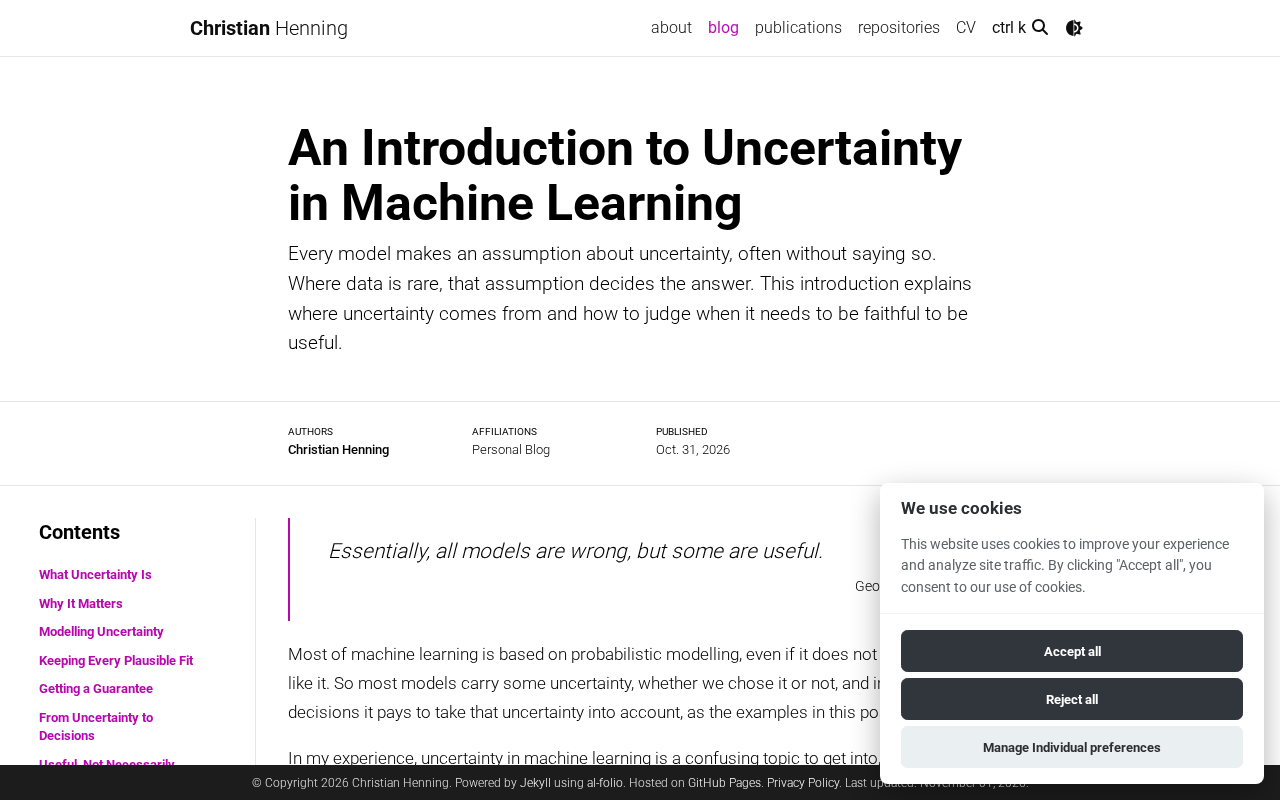
Uncertainty in Machine Learning: Concepts, Sources, and Mitigation
Machine learning models are not always deterministic. This article introduces the two major types of uncertainty in ML—aleatoric and epistemic—and discusses their sources, quantification methods, and practical significance in reliable AI systems.

Banks Seek to Dump AI Debt: A Risk Signal Behind the AI Investment Boom
Banks are seeking to sell AI-related debt assets, a move that reveals financial risk reassessment behind the AI investment boom. This article analyzes possible reasons for banks reducing AI debt and the impact on AI industry financing.