AI Silence Across the Pacific: Reddit Buzzes Over China's Open-Source Rise

A hot Reddit post reflects China's open-source AI quietly going global, with overseas developers anxious and divided.
The Reddit post "It's been too quiet on the other side of the Pacific" sparked heated discussion among overseas developers. Behind it is the continued penetration of China's open-source large models into the global AI landscape through a silent "model first, story later" approach. From DeepSeek to Qwen, GLM, and MiniCPM, these models frequently appear on the Hugging Face trending list and perform close to Western closed-source models, yet mainstream media coverage is clearly insufficient, creating an illusion of "quiet" from information asymmetry. Overseas developers have split into pragmatists, the wary, and the reflective, showing that Chinese AI models have shifted from objects of discussion to tools used daily.
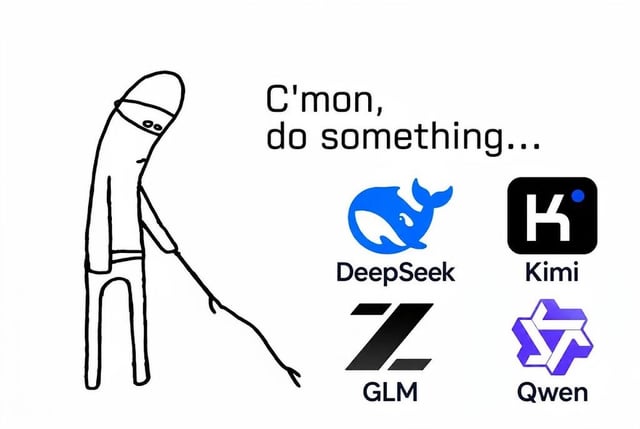
Recently, a post on Reddit sparked heated discussion, with a title consisting of just one sentence—"It's been too quiet on the other side of the Pacific." The accompanying image was a screenshot of a social media post (see below), pointing to the latest developments in China's AI field. The phrase may seem understated, but it precisely captures the anxiety of many overseas developers: while Silicon Valley is still debating the commercialization path of closed-source models, open-source models from China are quietly reshaping the global AI landscape in a "moistening things silently" way.
Why is it said to be "too quiet"?
The wording of this post itself is worth pondering. "Too quiet" doesn't mean there is no sound, but rather an unsettling silence—like the calm before a storm. In technical communities like r/LocalLLaMA on Reddit, this sentiment is not uncommon. Over the past year or so, open-source large models from China have frequently appeared on the Hugging Face trending list, from DeepSeekAd to Qwen, from GLM to MiniCPM. Almost every few weeks, a new version is released, with performance approaching or even surpassing Western closed-source models of the same level on certain benchmarks.
However, there is a clear gap between the coverage intensity of mainstream Western tech media and the actual influence of these models. This information asymmetry is precisely the source of the word "quiet."
Hugging Face is the world's largest open-source AI model hosting and distribution platform, where developers can upload, download, and evaluate model weights. Its Trending list ranks models by recent downloads, likes, and other metrics, and is often regarded as a barometer of open-source model popularity. For closed-source commercial models, vendors typically only provide APIs without disclosing weights, so they cannot directly appear on this list; whereas open-source models, once weights are uploaded, can be locally deployed, fine-tuned, or integrated by anyone. This makes the Hugging Face trending list an important window for observing the rise and fall of open-source forces. When the article mentions that DeepSeek, Qwen, GLM, and MiniCPM frequently appear on the list, it refers to the real usage heat these Chinese teams have gained in the global developer community after open-sourcing complete weights, rather than the exposure brought by media coverage.
China AI's "Silent Mode" Going Global
Unlike companies such as OpenAI and Anthropic, which favor high-profile releases and intensive PR, most Chinese AI teams choose the path of "release the model first, tell the story later." Model weights are uploaded directly to Hugging Face, technical reports are published on arXiv, and GitHub repositories are open-sourced simultaneously—no grand launch events, no star CEO speaking tours, but developers vote with their feet.
The effect of this strategy is twofold. On one hand, it allows active developers in the technical community to access the latest achievements immediately; on the other hand, it also disperses the attention of mainstream media, creating an illusion of "quiet." Many comments on Reddit point out that many Western developers only realize that a certain Chinese model has become part of their daily toolchain after being recommended by colleagues at work.
arXiv is a public academic preprint platform where researchers can publish papers before formal peer review. The AI field iterates extremely quickly, and many teams choose to publish technical reports on arXiv first in order to establish technical contributions, receive community scrutiny, and attract users as soon as possible. Unlike closed-source companies that usually only disclose a small amount of technical details alongside product launches, Chinese open-source teams often write key information such as model architecture, training data ratios, and evaluation results into arXiv reports, and then combine them with GitHub repositories and Hugging Face weights to form a "paper + code + weights" trio. This model lowers the barrier for external reproduction and also makes technical dissemination more dependent on developer word of mouth rather than media press releases, thus appearing "quiet" in the mainstream view.
The community's real reaction
Judging from the discussion sparked by the post, overseas developers' attitudes roughly fall into three categories. One is the pragmatic group, who don't care where the model comes from, only whether performance, cost, and license are friendly; another is the wary group, worried that over-reliance on a technology stack from a specific source could bring supply chain risks; and there is also a reflective group, who believe the Western AI industry needs to face up to competition rather than use "quiet" to cover up neglect.
This division itself shows that the overseas penetration of Chinese AI models has entered a new stage—no longer "an object of discussion," but "a tool being used."
In the use of open-source models, the license is one of the key factors determining whether they can be adopted by enterprises. Common open-source licenses such as Apache 2.0 and MIT allow free commercial use and modification, while some models use custom licenses that may impose conditions on commercial scale, use cases, or distribution of derivative models. For overseas developers, even if a model performs excellently, if the license is too restrictive, it may still be unable to enter a company's production environment. Therefore, in community discussions, "whether the license is friendly" is often a core consideration alongside performance and cost. When the article mentions that pragmatists don't care about the model's origin and only care about performance, cost, and license, it precisely shows that if Chinese open-source models can remain permissive in licensing, they will be more easily accepted into the global toolchain without friction.
Between noise and signal
The reason this sentence on Reddit resonates is that it touches on a deeper issue: in an age of information overload, real changes are often not announced by noise. The "quiet" on the other side of the Pacific may actually be the healthiest form of technology diffusion—no hype, only code and weights quietly flowing.
For those following the AI industry, rather than waiting for the next explosive news, it is better to regularly check the Hugging Face trending list. There are no press releases there, only download counts.
One-line Summary
A hot Reddit post reflects China's open-source AI quietly going global, with overseas developers experiencing both anxiety and division.
Paragraph Summary
The Reddit post "It's been too quiet on the other side of the Pacific" sparked heated discussion among overseas developers. Behind it is the continued penetration of China's open-source large models into the global AI landscape through a silent model of "release the model first, tell the story later." From DeepSeek to Qwen, GLM, and MiniCPM, these models frequently appear on the Hugging Face trending list, with performance approaching Western closed-source models, yet mainstream media coverage is clearly insufficient, creating an illusion of "quiet" caused by information asymmetry. Overseas developers' attitudes have split into pragmatists, the wary, and the reflective, reflecting that Chinese AI models have shifted from objects of discussion to tools used in daily work. The article argues that real technology diffusion is often not announced by noise, but shown in the silent flow of code and weights.
Related articles

How Big Can Stars Really Get? The Physical Limits of the Largest Stars
Red supergiants are the largest stars by volume, with radii up to 2,000 times the Sun, engulfing the inner solar system. But there is no precise upper limit on stellar size—models predict up to 15,000 solar radii. The most massive blue stars are far smaller than red supergiants—biggest and heaviest are two different things.

Apple HomeView Smart Display Full Feature Breakdown: Wall-Mount or Desktop, $299
Apple launches HomeView, a $299 smart display with wall-mount and desktop options, 12MP camera for facial recognition, smart home control, music playback, and recipe step-by-step cooking. Full breakdown of watch faces, apps, privacy, and cooking integration.

Where Did the Promised New Studio Go? Craft Computing Answers After Five Years
Craft Computing's host responds to viewer questions: the new studio promised five years ago was shelved as construction costs soared from $30,000 to $75,000, and was replaced by a 168-square-foot garage conversion.