AI Slop Is Drowning Tech Communities: Real Data from a Reddit Moderator

A Reddit moderator's data reveals AI-generated spam is overwhelming tech communities at alarming rates.
A Reddit MLOps community moderator shares startling data showing that 45% of posts and comments are being removed as AI-generated spam, while page views decline even as posting volume increases. The post catalogs common AI slop patterns — fake help posts with bot replies, hollow engagement bait, and deliberately imperfect human impersonation — and explores governance solutions including mandatory AI disclosure policies, highlighting the growing tension between community openness and content quality.
A Moderator's Dilemma
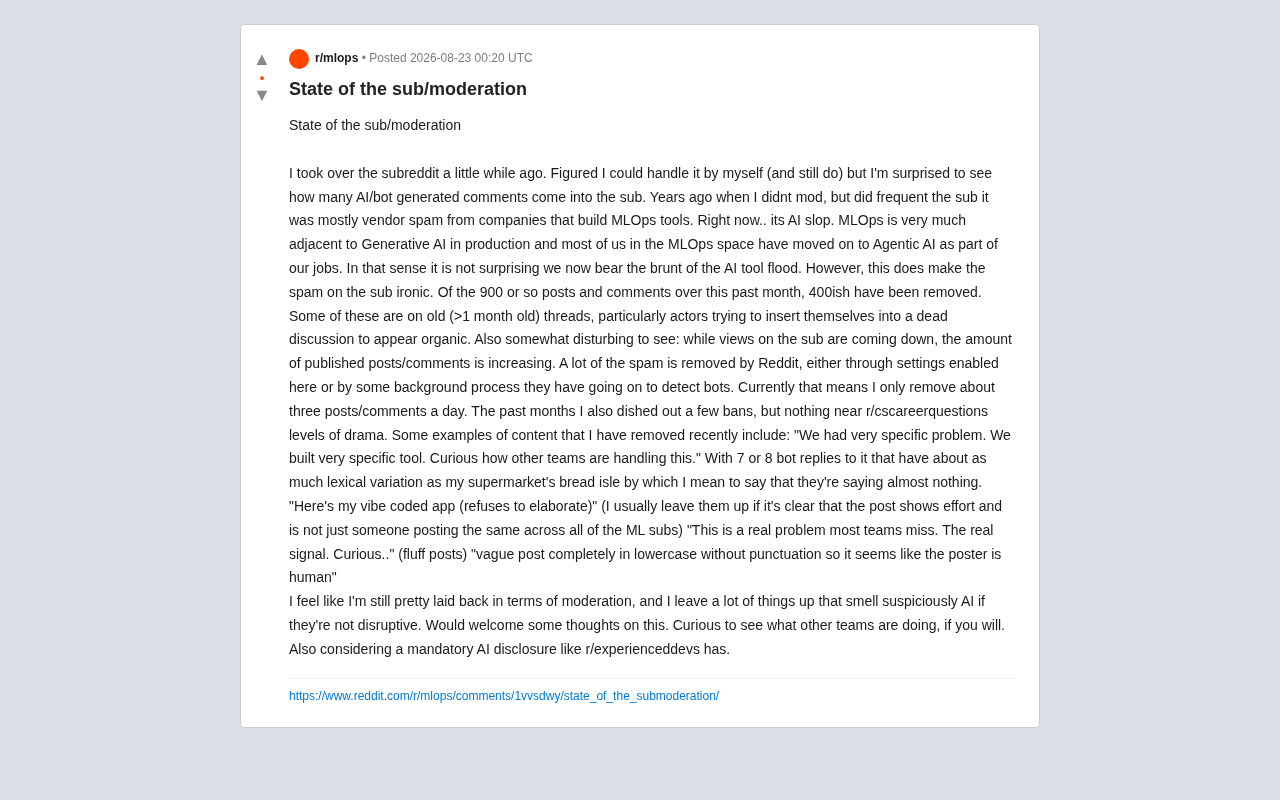
Recently, a moderator of an MLOps-related subreddit published a post about the state of community governance that struck a chord with many. Shortly after taking over the community, this moderator discovered a disturbing trend: AI-generated spam comments were flooding into the technical forum at an unprecedented rate.
"A few years ago when I was just a regular lurker on this sub, the most common issue was soft promotional content from MLOps tool vendors," the moderator wrote. "Now, what's flooding in is AI slop."
The term "AI slop" began circulating widely across the English-speaking internet in 2024, referring to low-quality content mass-produced by AI with little substantive value. Unlike traditional spam or manually written advertorials, AI slop is distinguished by its near-zero production cost and its ability to be deployed at extraordinary speed and scale. The word itself carries a strongly pejorative connotation — "slop" means swill or pig feed, vividly capturing how this type of content pollutes the information environment. With the proliferation of large language models like ChatGPT and Claude, AI slop has spread from social media to technical forums, academic peer review, product reviews, and virtually every scenario that relies on text-based communication.
This observation carries a layer of irony. MLOps (Machine Learning Operations) is inherently tied to the production deployment of generative AI, and most practitioners in this field have already shifted toward Agentic AI as part of their daily work. As a result, they've become the first to bear the brunt of the AI tool proliferation wave — drowning in the very technology they helped build.
MLOps stands for Machine Learning Operations. Borrowing from DevOps (Development and Operations) principles, it focuses on reliably deploying machine learning models from experimental environments to production, while continuously monitoring and maintaining their performance. A typical MLOps pipeline encompasses data pipeline management, model training automation, version control, A/B testing, model monitoring, and drift detection. With the rise of large language models (LLMs), the MLOps community's focus has been rapidly evolving — expanding from traditional Model Serving to prompt engineering management, RAG (Retrieval-Augmented Generation) architectures, LLM evaluation frameworks, and other emerging areas. Agentic AI represents an even more cutting-edge paradigm shift: unlike traditional single input-output patterns, AI agents can autonomously plan tasks, invoke tools, interact with environments, and iteratively complete complex objectives. It's precisely the maturation of this technology that has made automated content generation and distribution easier than ever — a single AI agent can automatically register accounts, analyze a community's topical style, generate professional-looking posts, and publish them in bulk, all without human intervention.
The Alarming Data Behind AI Spam
The moderator shared a set of concrete numbers that vividly illustrate the severity of the AI spam problem:
- Out of approximately 900 posts and comments in the past month, about 400 were removed — a deletion rate approaching 45%
- Some spam appeared in old posts over a month old, where posters attempted to insert content into "dead" discussions, disguising it as natural conversation
- Most concerning: community page views were declining, while the number of posts and comments was increasing
These numbers reveal a harsh reality — "content inflation" is happening in tech communities. Real user attention is declining while machine-generated noise is expanding exponentially. This divergence speaks to the core of the problem: this content isn't serving real readers — it exists for some automated marketing or manipulation purpose.
The concept of "content inflation" has a deep structural analogy with monetary inflation in economics. In a monetary system, when the money supply grows far faster than actual economic output, the purchasing power of each unit of currency declines. Similarly, in a content ecosystem, when content supply explodes due to AI but the actual volume of valuable information doesn't increase proportionally, the average information density and credibility of each piece of content drops sharply. For users, this means the "search cost for finding valuable information" keeps rising — they need to spend more time filtering and evaluating to find genuinely useful discussions amid the noise. This rising cost drives real users away (hence the decline in page views), creating a vicious cycle: fewer real users means lower information value in the community, which in turn drives more users away, until the community potentially devolves into an empty shell where only bots are "talking" to each other.
The strategy of inserting content into old posts is also worth noting — it's called "necroposting," a common tactic in the gray-hat SEO (Search Engine Optimization) industry. When search engines index content from forums like Reddit, they consider all replies within a post. Inserting a reply containing specific product mentions or links into an old post with an established discussion can leverage the original post's existing search authority to boost visibility. At the same time, since the post is no longer active, moderators and active users pay less attention to it, reducing the probability of detection.
Fortunately, most spam is filtered out by Reddit's own platform mechanisms, whether through subreddit settings or the platform's backend bot detection systems. This means the moderator only needs to manually remove about three pieces of content per day — a manageable workload.
Reddit's anti-spam system is a multi-layered defense. The first layer is AutoModerator — a rule-based automated moderation tool where moderators can customize keyword filters, account age thresholds, minimum karma requirements, and other conditions to automatically intercept or flag suspicious content. The second layer is Reddit's platform-level bot detection system, which uses behavioral analysis (such as posting frequency, cross-subreddit behavior patterns, and text similarity) to identify and ban automated accounts. The third layer relies on the community's own voting mechanism — low-quality content should theoretically be downvoted into obscurity. However, these mechanisms are showing their limitations against the new generation of AI spam: text generated by modern LLMs is increasingly difficult to distinguish from human writing in terms of grammar and style, AI agents can simulate more natural behavior patterns to evade behavioral analysis, and they can even accumulate karma through small amounts of genuine interaction to bypass threshold restrictions.
Typical Characteristics and Identification Methods for AI Spam
The moderator listed several categories of content they frequently remove, providing an invaluable "field guide" for identifying AI spam:
Disguised "Help" Posts with Bot Replies
"We ran into a very specific problem. We built a very specific tool. Curious how other teams handle this." These posts are typically followed by seven or eight bot replies that, in the moderator's words, have "about as much variation as the bread aisle at my grocery store" — meaning they say virtually nothing of substance.
This pattern is known in security research as "astroturfing" — fabricating grassroots discussion to create the illusion that a particular product or viewpoint is receiving widespread attention. With AI tools, the cost of scaling this tactic has dropped to nearly negligible levels. A single operator can deploy a set of AI agents playing the roles of "questioner" and "answerer," conducting seemingly natural multi-turn conversations within the same post, ultimately steering the discussion toward recommending a specific tool or service. For tech communities, this tactic is especially dangerous because technical decision-makers often rely on peer experiences in community discussions to evaluate tool selections — fake recommendations can directly influence enterprise technology procurement decisions.
Hollow "Engagement Bait" Posts
"This is a real problem most teams overlook. This is the real signal. Curious…" Posts filled with fluff but devoid of substance represent another hallmark of AI-generated content. They wrap themselves in seemingly profound language while containing absolutely nothing.
The operating logic behind these posts typically follows a "hook-traffic-conversion" funnel model: an attention-grabbing headline and vague problem description attract clicks (the hook), comments or direct messages guide users to external links or specific accounts (traffic), ultimately achieving product promotion or traffic monetization (conversion). AI has made the top of this funnel — the content production stage — replicable at virtually no cost. The same template can be deployed simultaneously across dozens of subreddits.
Deliberate Human Impersonation
The most cunning category consists of "all-lowercase, no-punctuation vague posts designed to make the poster look like a real person." This reflects how spam creators have already begun disguising their content against anti-AI detection mechanisms, deliberately introducing "imperfections" to evade identification.
This phenomenon marks a new phase in the "arms race" between AI spam and anti-detection technology. Early AI-generated text was often too fluent, too well-structured, and too formal — which paradoxically made it easy to identify. This is sometimes called the "uncanny valley" effect in reverse: content that's too perfect actually seems unnatural. Today, spam producers have learned to include instructions like "write casually," "add some typos," and "use colloquial expressions" in their prompts, and some even specifically train models to mimic the linguistic style and writing habits of particular communities. Advanced operations will even analyze the post history of high-karma users in target communities, extracting writing patterns as style references. This poses serious challenges to the accuracy of text-based AI detection tools like GPTZero and ZeroGPT.
Borderline Cases Worth Distinguishing
Interestingly, the moderator takes a relatively lenient stance toward "vibe coded app" showcase posts. "If the post clearly reflects the author's effort rather than just copy-pasting the same content across every ML subreddit, I'll usually keep it." This reflects a pragmatic governance philosophy — distinguishing between "using AI as an assistant" and "AI mass-producing junk."
"Vibe coding" is a concept introduced in early 2025 by Andrej Karpathy (former Tesla AI Director and OpenAI co-founder), describing a development approach where developers no longer write code line by line but instead describe their intent to AI in natural language, let the AI generate code, and then adjust based on results using intuition (vibe). This development style blurs the traditional question of "who is the real author." The distinction the moderator makes here essentially reflects a deeper philosophical judgment: what matters isn't whether content used AI tools, but whether there's a real person behind it investing thought and effort, and whether the content genuinely serves the purpose of community discussion.
The Dilemma Between Moderate Governance and Mandatory AI Disclosure
The moderator describes their management style as "still pretty lenient." They stated: "A lot of content smells suspiciously like AI, but as long as it's not destructive, I'll leave it up." Over the past few months they've also banned some accounts, but far from the "dramatic" levels seen in some high-conflict communities.
At the end of the post, they proposed a solution under consideration: implementing a mandatory AI disclosure policy, similar to the r/experienceddevs community. This would require posters to proactively declare whether their content was generated or assisted by AI.
AI disclosure policies are emerging as a new governance paradigm in internet communities and the broader content industry. On Reddit, r/experienceddevs (a community for senior developers) was among the first to implement this rule, requiring any post or comment assisted by AI to be clearly labeled, with violators facing removal or bans. Similar rules are spreading in academia — top journals like Nature and Science now require authors to disclose AI tool usage in paper writing; Stack Overflow briefly banned AI-generated answers entirely in 2023 before adjusting to require mandatory disclosure. At the regulatory level, the EU's AI Act also includes labeling requirements for AI-generated content. However, all these systems face a common enforcement challenge: they are fundamentally an "honor system" that depends on participants' voluntary compliance, and malicious spam producers are precisely the group least likely to follow the rules.
This proposal touches on the core dilemma of tech community governance today:
How do you resist AI noise while maintaining openness? Overly strict moderation may harm genuine users and legitimate AI-assisted creation; too much leniency lets the community gradually devolve into a bot echo chamber.
Is an AI disclosure policy actually effective? It relies on posters' honest self-reporting, and real spam producers won't follow the rules anyway. But it can at least establish community norms that give well-intentioned users clear boundaries and provide moderators with legitimate grounds for removing violating content. The real value of such a system may not lie in directly preventing malicious behavior, but in shaping community culture — when AI disclosure becomes a widely accepted norm, it creates social pressure that frames non-disclosure as dishonest, thereby raising the entire community's awareness of content authenticity.
This Isn't Just One Community's Problem
This moderator's experience is actually a microcosm of the profound changes sweeping across the entire internet content ecosystem. When generative AI drives the marginal cost of content production toward zero, every platform that relies on user-generated content (UGC) will face the same challenge.
UGC (User Generated Content) has been the core value engine for internet platforms since the Web 2.0 era. From Wikipedia to Reddit, from YouTube to Zhihu, these platforms' value propositions are built on a fundamental assumption: content is created by real human users based on real experiences, knowledge, and perspectives. This assumption underpins community trust mechanisms, platforms' advertising business models, and users' motivations for participation. Generative AI is fundamentally shaking this assumption. According to NewsGuard's research, by the end of 2024, over 1,000 "pink noise" websites primarily filled with AI-generated content had appeared on the internet; platforms like Amazon and Goodreads are also facing massive influxes of AI-generated fake reviews. The far-reaching impact of this shift may be comparable to how search engines reshaped information access — except this time, the direction of change is a systemic degradation of information quality.
The anomalous data signal is worth deep reflection: page views declining while post volume increases. This can serve as a near-universal "community health" warning indicator. When a community's content supply decouples from real demand, it often means automated content is eroding the community's foundational value.
From a platform economics perspective, this signal reveals a deeper mechanism failure. A healthy UGC ecosystem depends on a positive flywheel: high-quality content attracts users → user participation produces more high-quality content → more users are attracted. AI spam creates a reverse flywheel: low-quality content drives away real users → fewer real users means less high-quality content → community value further declines. Once the reverse flywheel starts spinning, a community may experience what's known as a "death spiral" — perfectly mirroring Gresham's Law in economics, where bad money drives out good.
For all community operators, this post offers several practical takeaways: leverage the platform's built-in anti-bot mechanisms, establish clear content identification standards, find a balance between leniency and strictness, and consider using transparency rules (like AI disclosure) to shape community culture.
Ironically, as the moderator put it, MLOps practitioners "built this AI wave with their own hands, and now they're struggling to survive in it." Perhaps this is the most fitting metaphor for our technological era.
Key Takeaways
Related articles

Chain of Thought Isn't Just for AI: How Humans Can Use CoT to Improve Thinking Quality
Chain of Thought isn't just a prompt trick for large models. Starting from a Hacker News discussion, this article analyzes why CoT works for human thinking too, breaks down actionable ways to transfer it, and highlights the key differences between human CoT and machine CoT.
Cloudflare Teams Up with OpenAI: Closi…
Cloudflare Teams Up with OpenAI: Closing the Loop from Vulnerability Discovery to Defense with AI
Cloudflare uses OpenAI Daybreak to investigate security vulnerabilities and generate reviewable remediation plans, while developers use Codex to boost coding efficiency and quality.

Orca Multi-Agent Orchestration in Practice: A Guide to Parallel Collaboration with Claude and Codex
Orca is Stable AI's free open-source agent workbench supporting 34 agents like Claude Code and Codex in parallel. Learn its Git worktree isolation, multi-model orchestration, and mobile management.