AI SRE Arena: An Open-Source Benchmark for Evaluating Kubernetes AI Ops Agents

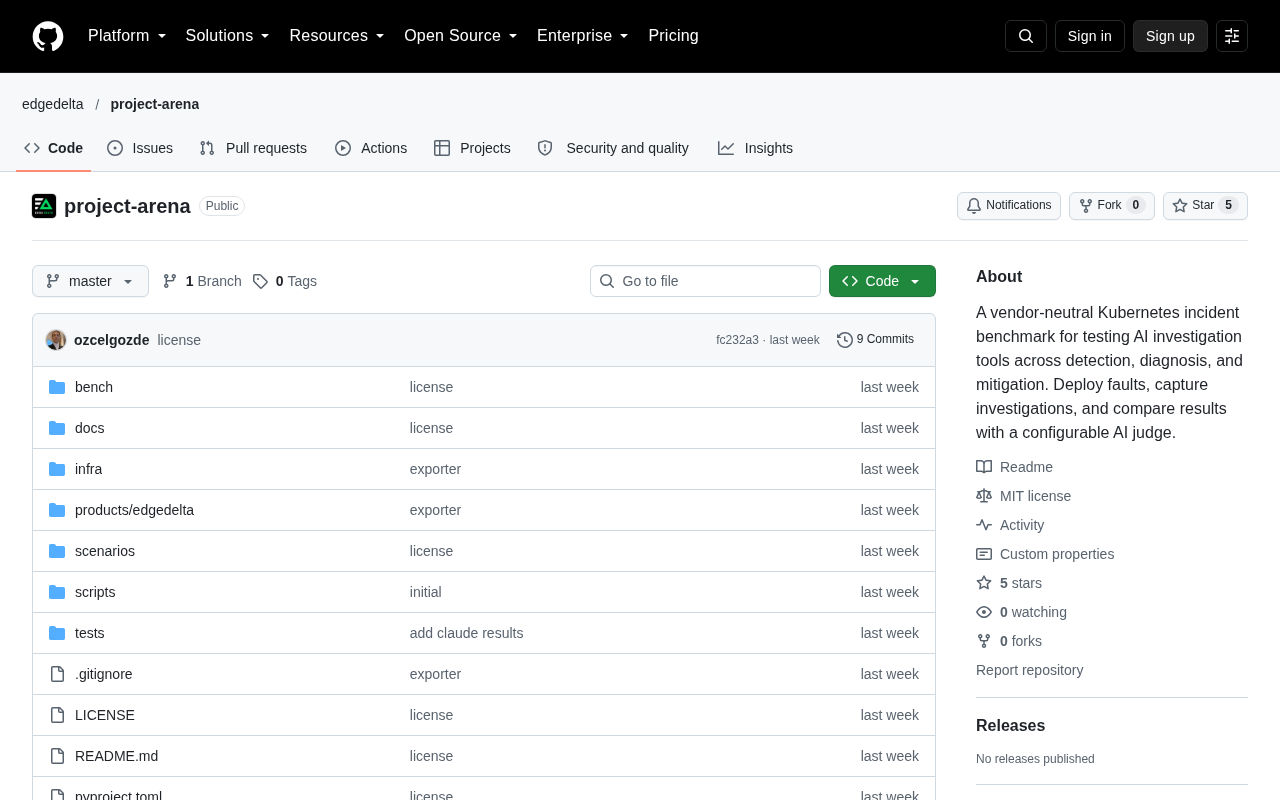
AI SRE Arena: the first open-source benchmark for evaluating AI agents on Kubernetes fault diagnosis.
AI SRE Arena is an emerging open-source benchmark designed to measure AI Agent performance in Kubernetes fault diagnosis and remediation. It fills a gap in AIOps evaluation — existing benchmarks focus on general tasks like coding or Q&A and fail to capture the observe-hypothesize-validate-remediate loop unique to SRE work. By using real fault injection scenarios, it assesses agents across multiple dimensions including information overload, cascading failure reasoning, and operational safety boundaries. The project launched via Show HN and is positioned as an SRE-domain equivalent of SWE-bench.
When AI Takes Over Operations: A New Evaluation Standard Emerges
As large language models continue to grow more capable, engineering teams are increasingly experimenting with AI Agents in Site Reliability Engineering (SRE) — letting AI troubleshoot Kubernetes cluster failures at 3 AM so you don't have to. But a critical question follows: are these AI SRE Agents actually reliable? How do they perform in real-world failure scenarios?
Recently, a project called AI SRE Arena appeared on Hacker News' Show HN section, aiming to answer exactly that. It positions itself as an open-source benchmark for Kubernetes environments, specifically designed to measure the real-world fault diagnosis and remediation capabilities of AI SRE Agents.
Why We Need a Dedicated SRE Benchmark
Most AI Agent evaluations today focus on general-purpose tasks like coding, Q&A, and reasoning. Benchmarks tailored to operations scenarios are comparatively rare. SRE work has its own distinct characteristics: it's not a one-shot code generation task, but rather a closed-loop process involving observation, hypothesis, validation, and remediation.
Kubernetes, the de facto standard of the cloud-native era, produces extraordinarily complex failure modes — from Pod crash loops (CrashLoopBackOff) and resource quota exhaustion, to inter-service network policy conflicts and misconfigurations. Each category tests an Agent's depth of understanding of distributed systems.
A qualified benchmark needs to reproduce these real-world fault injection scenarios and determine in a quantifiable way whether an Agent has actually identified the root cause and taken the correct remediation actions. That's exactly the gap AI SRE Arena aims to fill.
The Value of Open Source and Reproducibility
Open-sourcing a benchmark means any team can test their own Agent solution against the same standard and compare different models, prompt strategies, and toolchain combinations side by side. In a field that's still early-stage and lacks unified measurement criteria, this is particularly valuable. A reproducible test environment also enables the community to collaboratively evolve test cases, preventing each team from building in isolation with no common ground for comparison.
Challenges AI Agents Face in Kubernetes Environments
Running a complete diagnostic workflow in a real K8s environment is far more difficult than it might seem. An AI SRE Agent needs to invoke kubectl, read logs, parse monitoring metrics, identify anomalous signals from a flood of information, and then infer the fault chain.
Several typical challenges arise in this process:
- Information overload: Clusters generate enormous volumes of logs, events, and metrics. Agents need to effectively filter out noise.
- Causal reasoning: Many failures are cascading effects where the surface symptom may be far removed from the root cause.
- Operational safety: If an Agent's remediation action is misjudged, it could cause a broader service outage. Benchmarks must account for the safety boundaries of operations.
- Timeliness: Real SRE scenarios demand fast response times, making diagnostic efficiency an important dimension as well.
A well-designed Arena-style benchmark should incorporate all of these dimensions into its scoring system — not just check whether the Agent ultimately "guessed" the right answer.
CrashLoopBackOff is one of the most common abnormal Pod states in Kubernetes. It occurs when a container repeatedly starts and then immediately crashes, prompting kubelet to restart it with an exponential backoff strategy, creating a loop. Causes range from application startup errors and missing config files to unreachable dependencies and OOM (Out of Memory) conditions. The status label alone provides no indication of the root cause — you need to combine container logs, event streams, and resource usage curves to diagnose it. This makes CrashLoopBackOff a quintessential test case for evaluating an AI Agent's comprehensive diagnostic capabilities: the Agent must know where to look, extract key error information from unstructured logs, and ultimately provide actionable remediation recommendations rather than vague directional advice. An Arena-style benchmark that includes such multi-step reasoning scenarios will have far greater discriminative power than single-turn Q&A tests.
Community Reception and Early Observations
The project received initial attention on Hacker News, accumulating 13 upvotes and a small number of comments. As a Show HN project, it's still in its early stages with limited community discussion — but the direction it's taking addresses a genuine pain point in AIOps adoption.
For engineering teams evaluating AI operations tools, open-source benchmarks like this provide a relatively objective reference point. Rather than trusting vendor marketing claims, running a standardized test suite and letting the data speak is a far more reliable approach.
Conclusion: AIOps Moves Toward Quantifiable Evaluation
The emergence of AI SRE Arena reflects a maturation in AI operations: the field is moving from "can we use it?" to "how good is it, and can we trust it?" Evaluation benchmarks are a necessary step in any technology's path to maturity — just as the programming world has SWE-bench, the SRE domain needs its own measuring stick.
Of course, an early-stage effort from a single project still needs time to validate the coverage of its test cases, the soundness of its scoring mechanisms, and the sustainability of community investment. But the direction itself provides a noteworthy evaluation framework for deploying AI Agents in production-grade infrastructure. Teams interested in this space would do well to follow its open-source progress — and perhaps even contribute real-world failure scenarios they've encountered themselves.
SWE-bench is a software engineering benchmark released in 2023 by Stanford and other institutions. It evaluates AI Agents by having them fix bugs on real GitHub Issues and their corresponding codebases, using test case pass rates as an objective scoring standard. Its release transformed the vague question of "can AI write code?" into a quantifiable, reproducible engineering metric, accelerating rapid iteration in the code agent space and becoming the accepted standard for comparing model capabilities across vendors. AI SRE Arena's inspiration from SWE-bench follows the same logic: converting an open-ended task (fault diagnosis) into a closed-loop test with a real environment and objective acceptance criteria, thereby avoiding reliance on subjective scoring or model self-evaluation. The key difference is that SRE evaluation requires interaction with a live runtime environment, making state management and side-effect control significantly more complex.
Background
SRE (Site Reliability Engineering) originated at Google as a practice framework that applies software engineering methodologies to operations. Its core philosophy is managing system reliability through code and automation, with engineering decisions governed by quantitative metrics like SLOs (Service Level Objectives) and error budgets. Unlike traditional operations, SRE emphasizes a blameless post-mortem culture and observability — understanding system internal state through the three pillars of logs, metrics, and tracing. It is precisely this highly data-driven, multi-source nature of SRE work that makes it an ideal stress test for evaluating an AI Agent's reasoning and tool-calling capabilities. General-purpose benchmarks like MMLU and HumanEval cannot capture this kind of "taking the right action in a real environment" capability, which is why vertical domain-specific evaluation benchmarks offer irreplaceable value.
Related articles

ChatGPT Space Launches: Team Collaboration and New Pages Features Explained
ChatGPT Space is OpenAI's new team collaboration feature with Pages, real-time collaboration, and Slack/Google Drive sync. We break down its privacy design, multi-platform integration, and the full workflow from conversation to document.

Migrating Apache Spark UDFs to GPU Acceleration with AI Agents
NVIDIA developer blog explains how AI Agents rewrite Apache Spark UDFs for GPU acceleration, covering migration criteria, agent rewriting and verification workflows, plus pitfalls like result consistency and CPU-GPU transfer overhead.

Zed Editor v0.40.4-rc2 Released: Usage Credits Now Available Without Upgrading
Zed editor releases v0.40.4-rc2, allowing users to use usage credits for AI features without upgrading to a paid plan, lowering the trial barrier.