AI Subscription Service Trust Crisis: When Credits Don't Arrive, Why Are Annual Subscribers Furious?

A Reddit complaint about missing AI subscription credits reveals a growing trust crisis in the industry.
Starting from a Reddit user's complaint about missing monthly credits on an annual AI subscription plan, this article examines the systemic issues behind AI subscription billing—including credit delivery failures, opaque reset rules, and inadequate customer support—while offering practical advice for users to protect their rights and urging providers to prioritize fulfillment transparency.
An Industry Concern Behind a Single User Complaint
Recently, a Reddit user posted a strongly worded complaint: "Terrible service, even worse than I imagined. I paid annually for the Max plan but didn't receive the monthly credits I'm entitled to."
This brief complaint may seem like an isolated user experience incident, but when examined against the backdrop of today's booming AI subscription services, it reflects an issue gaining attention from more and more users: As AI products transition from free trials to paid subscriptions, the gap between service promises and actual delivery is becoming a trigger for trust crises.
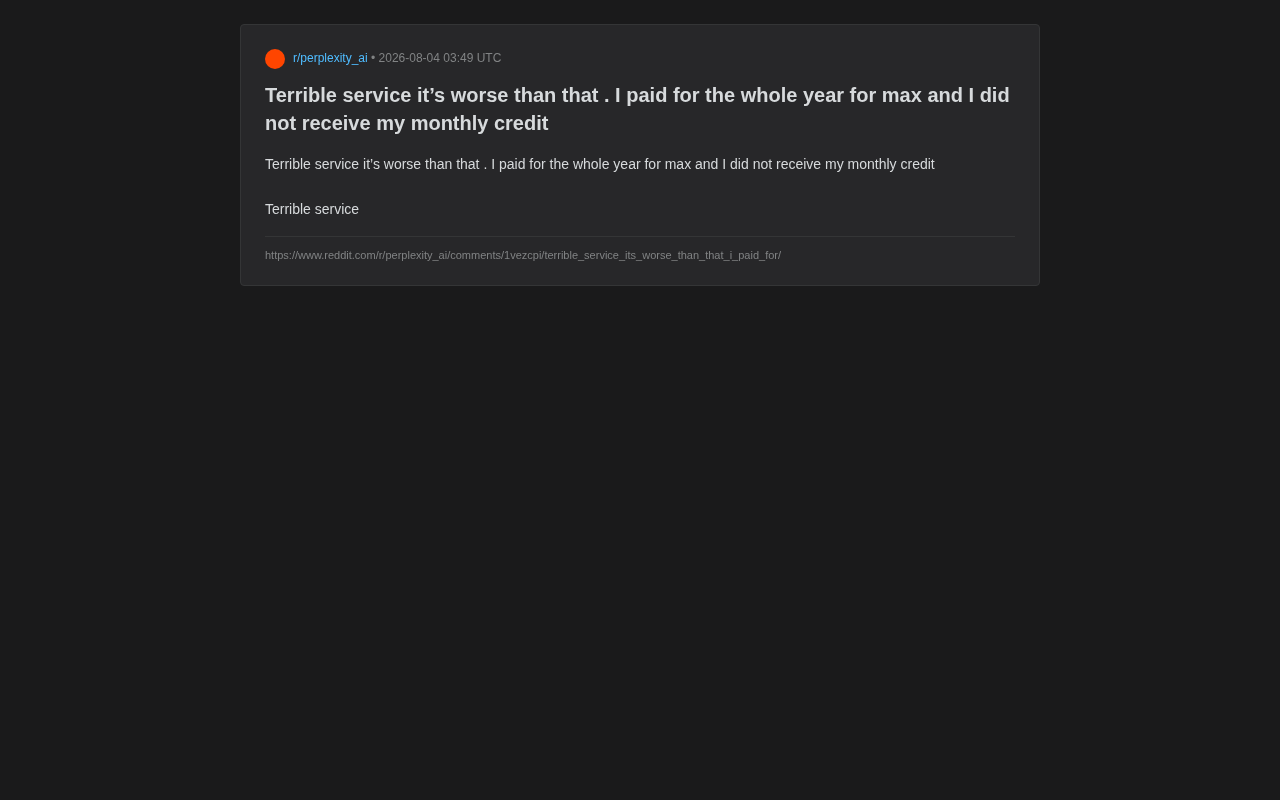
From this user's statement, we can reconstruct a typical consumer scenario: they chose an annual plan (which usually offers better pricing than monthly), expecting to receive corresponding usage credits each month. However, the promised "monthly credits" never arrived. For users who depend on these credits to complete their work, this isn't just a financial loss—it's an interruption to their workflow.
The "Credits" Trap in AI Subscription Models
The Root Causes Behind Frequent Credit Issues
Current mainstream AI services—whether conversational AI, code assistants, or image generation tools—predominantly adopt a hybrid "subscription + credits" billing model. Users pay a fixed subscription fee and receive a certain number of API calls, token quotas, or credits in return.
The evolution of this billing model has deep industry roots. Early cloud computing services primarily used pure pay-as-you-go pricing, but this model created revenue volatility and unpredictable user costs. After OpenAI's ChatGPT Plus (a fixed $20/month subscription) with GPT-4 usage caps proved commercially successful, the industry followed suit. The underlying logic is clear: fixed subscription fees ensure stable cash flow for providers, while credit caps control GPU computing costs. For large language models, each inference call consumes significant computational resources—a single GPT-4-level inference can cost dozens of times more than GPT-3.5—so providers must use credit mechanisms to balance user experience with operational costs.
It's worth explaining that "tokens" in "token quotas" are the basic units that large language models use to process text, and they don't simply equate to a single character or word. In English, one token corresponds to approximately 4 characters or 0.75 words; in Chinese, one character typically corresponds to 1-2 tokens. When users interact with AI, both the input prompts and the model's generated responses consume tokens, and each conversation's token consumption is directly tied to the provider's GPU computing costs. When a provider promises "monthly credits," they're essentially committing to reserving a certain amount of computational resource quota for the user.
This model is perfectly reasonable in itself, but its complexity also creates numerous hidden risks:
- Misalignment between annual payments and monthly credits: Users pay for the entire year upfront, but credits are distributed monthly. This logic requires backend systems to precisely track each account's billing cycle and distribution timing—any failure in the chain can cause credits to "disappear." Notably, annual discounts are a standard customer acquisition strategy in the SaaS industry, typically offering 15%-40% lower prices than monthly billing. The purpose is to lock in cash flow early, reduce churn rates, and minimize payment processing fees. However, annual plans also create unique technical challenges—systems must continuously track entitlement distribution status over 12 months, involving complex scenarios like billing cycle alignment, timezone handling, and mid-plan change transitions. Many fast-growing AI startups prioritize model capability development in their technical architecture, often relying on basic features from third-party payment services like Stripe for billing, lacking deep customization for complex credit logic. This is the technical root cause of frequent issues.
- Opaque credit reset rules: Many services lack clear explanations about whether credits accumulate, when they reset, or how they're reissued. Users often discover these ambiguities only after problems arise.
- Compatibility issues during system migrations and plan upgrades: AI companies iterate rapidly and frequently adjust their plan structures. Existing users can easily become victims of "system gaps" during these transitions.
The Source of Paying Users' Anger
Interestingly, this user employed strong language like "terrible" and emphasized it was "even worse than imagined." Behind this emotional expression lies paying users' extremely high expectations for service reliability.
From a behavioral psychology perspective, this involves the breach of a "Psychological Contract." The concept was first introduced by organizational behaviorist Chris Argyris in the 1960s, referring to expectations and obligations that both parties implicitly assume exist but aren't explicitly written into formal agreements. In subscription service contexts, the psychological contract formed after a user pays far exceeds written terms—they expect not only functional availability but also service stability, timely problem resolution, and the feeling of being respected as a paying customer. Research shows that the negative emotional intensity from psychological contract violations often exceeds the actual economic loss itself, which explains why a single credit failure can trigger such strong language.
When users transition from free to paid, the psychological contract upgrades accordingly—they're paying not just for access, but for trust in service stability and responsiveness. Once that trust is betrayed, especially when money has already been paid, user disappointment is dramatically amplified.
Examining AI Service Providers' Accountability Through This Case
Delivery Promises Must Be Clear and Verifiable
This complaint serves as a reminder for all AI service providers: The core of subscription models is fulfillment, and the prerequisite for fulfillment is the verifiability of promises. Providers should clearly display in their user interfaces:
- The total credit allocation included in the current plan
- The distribution cycle and next distribution date
- Real-time status of used and remaining credits
- Compensation and appeal channels when issues arise
When this information is transparent and accessible, even if occasional system errors occur, users can quickly self-diagnose and initiate effective support requests, rather than accumulating frustration in an information black box.
Customer Support Quality Determines Reputation
For SaaS products, problems aren't scary—what's scary is problems that don't get resolved promptly. Annual subscribers are high-value customers who should enjoy priority support channels. If this user had to publicly post on Reddit after experiencing missing credits just to get attention, it indicates their official support channels have already failed.
In today's world of highly developed social media, a single angry complaint can be seen by thousands of potential users, with negative impact far exceeding the loss of a single customer. According to consumer behavior research, dissatisfied customers share negative experiences with an average of 9-15 people, and in the social media era, this number can be amplified hundreds of times. Reddit, as one of the world's largest forum communities with over 1.7 billion monthly active users, has an upvote mechanism that allows resonant complaint posts to quickly reach the front page of a subreddit or even the site's front page. For AI service providers, subreddits like r/ChatGPT and r/artificial have become important battlegrounds for user sentiment, where a single highly-upvoted complaint can have more impact than dozens of positive reviews. Proactive, rapid, and sincere remediation is a required course for AI service providers to protect their brands.
Practical Advice for AI Product Users
Facing increasingly complex AI subscription services, ordinary users can take defensive measures to protect their rights:
- Start with monthly plans to test the waters: Before confirming that the service is stable and credits are distributed normally, avoid locking into annual payments. While annual plans typically save 15%-40%, the cost of 1-2 months of monthly billing is far less than the potential losses from persistent issues after annual commitment.
- Keep payment receipts and plan descriptions: Screenshot and save the plan benefits page at the time of purchase as evidence for future disputes. AI companies frequently adjust pricing and plan structures, and website pages may change at any time—preserving evidence of original promises is crucial.
- Regularly check credit status: Don't wait until you need to use credits to discover they're missing. Develop a habit of regularly checking your account. It's recommended to proactively verify that credits have arrived 1-2 days after each monthly billing cycle resets.
- Utilize official appeal channels: Prioritize feedback through formal channels like support tickets and email, keeping records of all communications. If official channels don't respond within 48 hours, then consider public feedback via social media to gain attention.
Conclusion: Trust Is the Foundation of AI Commercialization
This seemingly trivial Reddit complaint actually reveals a hurdle that the AI industry must overcome as it transitions from technological excitement to commercial maturity. No matter how advanced the technology, if providers can't even deliver on the basic promise of "credits arriving on time," user trust will eventually erode.
For AI service providers, algorithmic capabilities are certainly important, but reliable billing systems, transparent service terms, and responsive customer support are the true moats for retaining paying users. As AI competition enters its second half and model capability gaps gradually narrow, differentiation in service quality and user experience will become the decisive factor. Whoever achieves excellence in fulfillment details will win users' lasting trust.
Related articles

Workbuddy for Absolute Beginners: How a Desktop AI Agent Fits Into Real Workflows
A beginner's guide to the Workbuddy desktop AI agent: installation, claiming credits, file management, and building automated workflows—compared with CodeX for fit and cost, helping professionals shift from AI question-askers to AI managers.

OpenAI's New Agent Stack: Computer Use, Decisions API, and Ultra-Fast Workflows
OpenAI Dev Day unveiled a new agent stack: Computer Use outperforms humans, Decisions API delivers ultra-low-latency classification via Luna, Agents API opens the same Computer Use capabilities, and GPT-6.1 Sol costs only one-seventh of Astra. Core updates, benchmark data, and developer insights.

Liang Wenfeng Open-Sources DeepInfo Inference Framework, Takes On U.S. Ban
DeepSeek open-sources its DeepInfo inference framework after its models, featuring GPU/CPU cross-pipelining, small-model prediction with large-model verification, and full Huawei Ascend and NVIDIA chip support—facing the U.S. federal ban head-on. This article analyzes its significance for AI deployment and open-source strategy.