AI Task Routing for Cost Reduction: A Framework for Smaller Teams to Evaluate ROI

A realistic assessment of AI task routing ROI for smaller teams, with a phased implementation guide.
Task routing — directing simple requests to lightweight self-hosted models and complex ones to general-purpose LLMs — is widely recommended for cutting AI costs. But the engineering overhead of building routing logic, training specialized models, and managing self-hosted infrastructure is often underestimated. This article breaks down who task routing actually makes sense for, and offers a data-driven, incremental approach for smaller teams.
Introduction: The "Standard Answer" to Cost Optimization
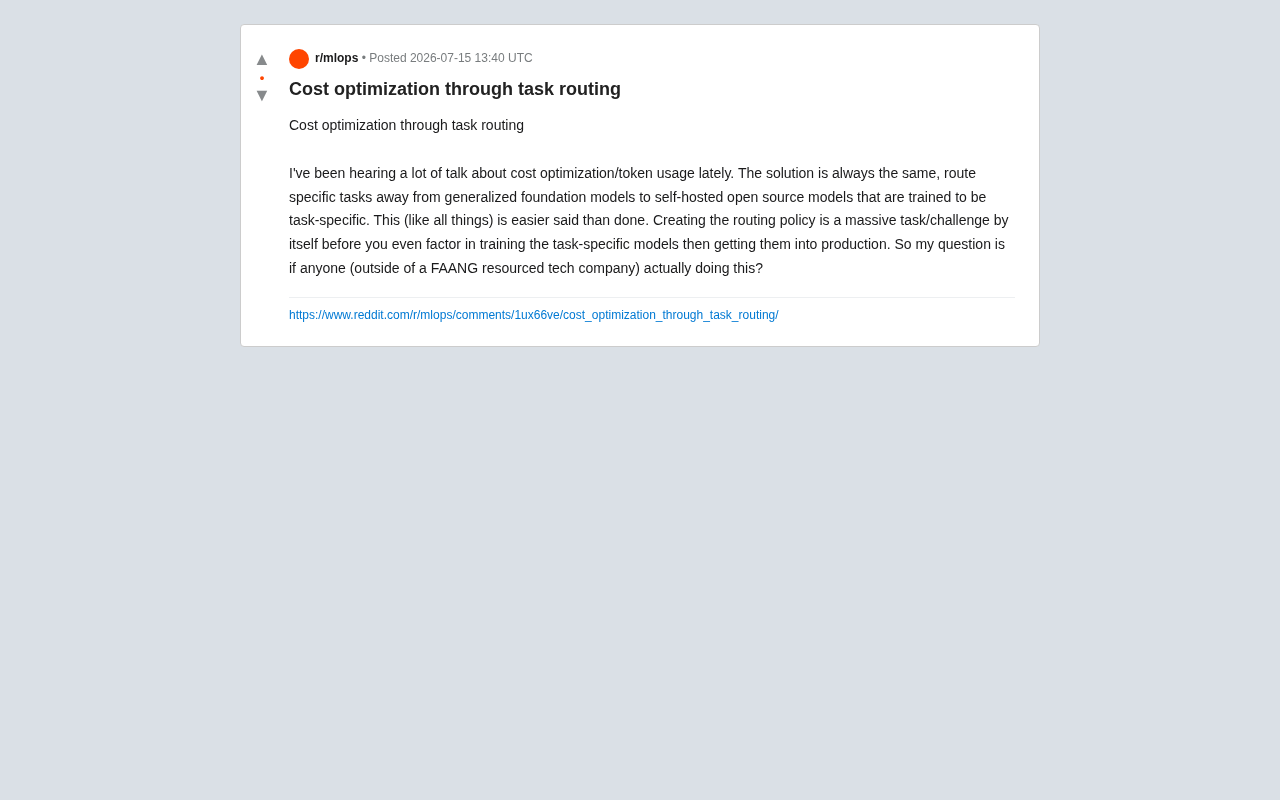
Discussions around LLM cost optimization and token consumption have been heating up. Whenever the topic of reducing AI application operating costs comes up, the community almost always converges on the same "standard answer": route specific tasks away from general-purpose foundation models (like GPT-4 or Claude) and onto self-hosted, task-specific fine-tuned open-source models.
The logic sounds airtight — general-purpose large models are expensive and slow, while task-specific small models often deliver comparable results at a fraction of the cost in vertical use cases. But as one developer on Reddit put it, this approach is "easier said than done." The real question is: beyond FAANG-scale companies with unlimited resources, are regular teams actually doing this?
What Is Task Routing?
The Core Idea
Task routing is essentially a triage system. When a user request comes in, the system first assesses the task type and complexity, then decides which model should handle it:
- Simple / structured tasks (e.g., classification, entity extraction, format conversion) → routed to a lightweight, self-hosted open-source model
- Complex / open-ended tasks (e.g., multi-step reasoning, creative writing) → routed to a general-purpose large model
In theory, if 80% of requests are simple tasks, stripping that 80% away from expensive API calls yields significant cost savings. That's the fundamental reason task routing keeps getting recommended as a silver bullet for LLM cost reduction.
Why It's Not That Simple
While the principle is clear, engineering task routing in production involves three commonly underestimated challenges:
- Building the routing strategy itself is a substantial challenge — how do you accurately and with low latency determine which path a request should take?
- Training task-specific models — requires labeled data, compute, and ML engineering expertise.
- Deploying models to production — inference serving, elastic scaling, monitoring and alerting, version management: each one carries real operational overhead.
In other words, task routing transforms the simple problem of "calling one API" into the complex problem of "maintaining an entire MLOps infrastructure."
MLOps (Machine Learning Operations) extends DevOps principles to ML systems, covering the full lifecycle of model training, versioning, deployment, monitoring, and continuous iteration. Building a task routing system means the team must simultaneously possess both model engineering and platform engineering capabilities — a significant capability leap for most application-focused teams, not merely a shift in technology choices.
Routing Strategy: The Hidden Cost Most People Overlook
The Router Itself Needs to Be "Smart"
Many people assume routing is just a few if-else rules, but reality is far more complex. To accurately classify task types, the router often needs its own classification model to assist with decisions — creating a paradox:
If the routing decision uses a small model, it may misclassify tasks, sending complex requests that need a large model to an underpowered one and causing output quality to collapse. If the routing decision uses a large model, the overhead of routing itself offsets the savings.
Designing a routing strategy therefore requires constant tradeoffs among accuracy, latency, and cost. A poorly designed router can end up worse than simply sending everything to the general-purpose model — adding system complexity while saving nothing.
The Hidden Cost of Misrouting
There's another risk with task routing that's frequently overlooked: the cost of misrouting is hard to quantify. When a complex request is incorrectly sent to an underpowered small model and produces an answer that "looks reasonable but is actually wrong," that quality degradation won't show up on your bill immediately — but it will steadily erode user trust. For consumer-facing products, this cost can far exceed whatever token savings were achieved.
Who Is Actually Doing This? A Realistic Breakdown
Large Tech Companies and Leading AI Firms
For large tech companies with substantial ML teams and infrastructure, task routing is a completely reasonable choice. They have dedicated teams to maintain model training pipelines, mature inference platforms, and massive datasets for training specialized models. Even saving a fraction of a cent per call adds up to significant returns at billions of requests.
On the self-hosted inference side, these teams typically leverage high-performance frameworks like vLLM and TGI (Text Generation Inference), using techniques like PagedAttention to dramatically improve GPU utilization and batch throughput. For model fine-tuning, parameter-efficient methods like LoRA (Low-Rank Adaptation) are widely adopted — requiring far less memory by training only a small number of additional parameters, making task-specific model training significantly cheaper than full fine-tuning. Even with these modern tools, the complete pipeline from data annotation and model training to production-grade inference serving typically requires weeks to months of engineering investment and dedicated ML engineers for ongoing maintenance.
The Reality for Smaller Teams
For the vast majority of small-to-medium teams and startups, the answer is usually the ROI doesn't justify the investment. The reasons are straightforward:
- Engineer time costs more than tokens — the labor cost of months spent building routing systems and training specialized models may take a very long time to recoup through API savings.
- Models iterate too fast — a specialized small model trained today may be surpassed in a few months by a newer, cheaper, more capable general-purpose or open-source model, making the upfront investment worthless.
- Self-hosting operational burden is heavy — GPU procurement or rental, inference optimization, high availability guarantees: each requires dedicated follow-through.
For smaller teams, more pragmatic AI cost optimization paths typically look like:
- Start with prompt engineering and caching — Semantic caching uses vector similarity matching to reuse historical LLM call results, recognizing semantically similar requests phrased differently and dramatically reducing actual API calls without sacrificing user experience. Combined with prompt compression techniques like LLMLingua, which can compress prompts by 30%-50% while preserving semantics, these low-cost approaches can deliver immediate cost reduction with no changes at the model layer.
- Leverage tiered model APIs — Major LLM providers have already built model matrices spanning different capability tiers. Take OpenAI as an example: the per-million-token price gap between GPT-4o and GPT-4o-mini can exceed 10x, yet lightweight models perform comparably to flagship models on a large share of common tasks. Anthropic's Claude Haiku vs. Claude Opus, and Google's Gemini Flash vs. Gemini Pro follow similar tiered logic. Teams can achieve coarse-grained "soft routing" simply by switching model versions within the same provider — with zero infrastructure to build. This is the lowest-barrier implementation of the task routing concept.
- Only invest in specialized optimization for high-volume core scenarios — When a particular task has sufficient call volume and a stable enough pattern, then consider investing in self-hosted specialized models.
Progressive Routing: A More Realistic Approach for Most Teams
Rather than building a complex routing system all at once, a more realistic approach is incremental evolution:
- Phase 1: Route everything through general-purpose models. Collect real request data and cost distribution to identify where the biggest cost drivers are.
- Phase 2: For the task types with the highest cost share and clearest patterns, introduce simple rule-based routing (start by switching between different price-point models within the same provider).
- Phase 3: Once sufficient data has accumulated and the volume of a given task type proves positive ROI, then consider fine-tuning or self-hosting open-source models.
The core advantage of this approach is that every step is driven by real data, avoiding premature investment in heavy infrastructure before the benefits have been validated, significantly reducing decision risk.
Conclusion: Run the Numbers First
Task routing as an LLM cost reduction strategy is theoretically sound, but its implementation threshold is far higher than the community discussion's "standard answer" implies. Routing strategy design, specialized model training, and production deployment — each step represents real engineering investment.
For most teams, the real wisdom isn't in blindly following the "route to specialized models" mantra, but in first quantifying your cost structure, then deciding whether the investment is worthwhile. In an era of rapidly declining model capabilities and prices, "wait and use the existing tiered APIs" is often more rational than building a custom routing system. The first principle of AI cost reduction is always to run the numbers first.
Key Takeaways
Related articles

The Truth Behind Codex 'Build a Website in 5 Minutes': AI Isn't Creating Sites—It's Helping You Copy Them
Exposing the truth behind viral Codex 5-minute website videos: creators aren't building original sites with AI—they're copying shared prompts or scraping others' work. Learn AI coding tools' real limits.

Getting Started with AI Agent Development: A Complete Guide from Concept to Practice
A comprehensive guide to AI Agent architecture and development, covering automated marketing, intelligent customer service, and investment analysis scenarios with single and multi-agent collaboration.

The Truth Behind Codex 'Build a Website in 5 Minutes': AI Isn't Creating Sites — It's Helping You Copy Them
Exposing the truth behind viral Codex 5-minute website videos: creators aren't building original sites with AI — they're copying shared prompts or scraping others' work.