AI Text Detection and Privacy Protection: The Dual Dilemma of LLM Security

Why AI watermarking stalls in practice and how differential privacy protects LLM training data.
This article examines two frontier AI security challenges — detecting AI-generated text and protecting privacy in LLMs — through the lens of talks by leading researchers from IISc and IIT Madras. It explains why watermarking remains technically viable but commercially undeployed, how differential privacy defends against membership inference attacks, and why machine unlearning is harder to verify than it seems.
As large language models permeate education, content creation, and healthcare, two seemingly opposing yet deeply intertwined security challenges are coming to the fore: how to identify AI-generated content, and how to prevent LLMs from leaking sensitive data. This article draws on two technical talks by Professor Danish Pruthi of the Indian Institute of Science (IISc) and Professor Krishna Pillutla of IIT Madras to map out the core mechanisms, real-world obstacles, and future directions in these two frontier areas of AI security.
AI Text Detection: Technology Ready, Deployment Stalled
According to OpenAI, roughly one in ten people worldwide are now weekly active users of its systems. This has fueled widespread concerns about misuse — students using ChatGPT to ghostwrite assignments, with reports of one UK university catching over 400 students cheating with ChatGPT in a single sweep. At a broader level, there are fears that AI-generated content could sway elections and spread disinformation. Professor Pruthi offered a somewhat pessimistic forecast: by 2027 or 2028, the internet as we know it may be flooded with "AI slop."
Systems capable of distinguishing AI-generated text from human writing have therefore become critical. This need comes not only from educators and regulators, but also from major corporations like Microsoft and Google — companies that have no interest in training their models on a competitor's output (such as Gemini), whether for copyright, legal, or quality reasons.
Reality Check on Three Technical Approaches
The first approach is storage and retrieval: model developers save all generated content and match it after the fact. But this path is riddled with problems — it only works for first-party models; users can evade exact matching with minor edits; users generally distrust vendors storing their conversation history; and it is entirely useless against open-source models.
The second approach is watermarking, the research direction that won Best Paper at ICML 2023. The core idea is to embed a statistical signal during generation: the vocabulary is randomly partitioned into a "green list" and a "red list" based on a hash of the previous token. Hard watermarking outright bans red-list tokens, but breaks fixed collocations like "Barack Obama." The practical variant is soft watermarking — adding a small delta preference to the logits of green-list tokens during decoding. Detection involves counting the proportion of green-list tokens in a piece of text and running a statistical test to produce a p-value, indicating whether the text likely came from that model.
The Information-Theoretic Foundation of Watermarking: The green/red list partitioning mechanism in watermarking is grounded in fundamental principles of information theory. At each generation step, a language model is essentially sampling from a probability distribution over a vocabulary. By using a hash function to split the vocabulary into two sets and systematically biasing the sampling probabilities, the watermark signal is encoded as a statistical property of the text rather than its literal content. This is fundamentally different from steganography: steganography modifies the content itself, while watermarking alters the statistical patterns of the generation process. The ICML 2023 Best Paper, authored by John Kirchenbauer et al., provides mathematical guarantees grounded in a hypothesis-testing framework — given sufficiently long text, the z-statistic of the green-list token proportion can identify watermark provenance at a controlled false positive rate.
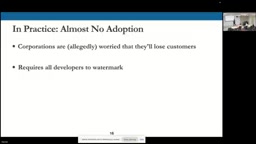
Research from Pruthi's team shows that watermarking has minimal impact on model accuracy and is technically "deployable," while also offering some resistance to paraphrase attacks (since the watermark operates at the decoding stage). But the reality is harsh: virtually no vendors have actually deployed watermarking. The reason is straightforward — companies fear losing users. ChatGPT usage drops noticeably after the end of each semester; students are a core user base, and once they realize their outputs carry traceable signatures, they will switch to other platforms.
Rolling out watermarking ultimately depends on regulatory mandates. In December 2023, a Biden administration executive order led Microsoft, Anthropic, OpenAI, Google, Amazon, and others to pledge to watermark their models. But on his first day in office, President Trump revoked that order, and all such plans collapsed.
Commercial Detectors: Surprisingly High Accuracy
The third approach is statistical classification detectors, with products like GPT Zero and Pangram as leading examples. Pangram claims 99.98% accuracy and boasts 17 million users. Their methodology is clever: take a Wikipedia article from before 2022 (pre-ChatGPT) as a "human writing" sample, have AI generate a "synthetic mirror" on the same topic, with the same opening and similar length, then build millions of such cross-domain paired samples to train a large classifier.
The results are surprisingly accurate. Pangram reports a false positive rate of around one in ten thousand, verified by independent research. These detectors capture the statistical fingerprints of AI writing — the frequent use of words like "tapestry," "vibrant," and "delve into," heavy use of em dashes, and negative parallelism constructions like "not just… but also…"
Linguistic Statistical Features of AI Writing: There is a deep linguistic explanation behind the statistical features that detectors capture. Large language models tend to select "safe," high-probability tokens during autoregressive generation, causing their outputs to be systematically lower on metrics like Type-Token Ratio and lexical richness. Words like "delve," "tapestry," and "vibrant" were reinforced during RLHF (Reinforcement Learning from Human Feedback) fine-tuning because they received higher reward signals, gradually becoming preferred expressions. From an information-theoretic perspective, AI text has a more uniform "surprisal" distribution, lacking the high variance characteristic of human writing that arises from knowledge boundaries, emotional states, and expressive habits. Perplexity and Burstiness (the burstiness of vocabulary use) are two metrics commonly used in academic detection research; human text typically shows higher Burstiness — heavy use of certain words in some passages and complete avoidance in others.
Peer Review Audits: The Boundaries of a "Polish Only" Policy
The academic community's response is also worth examining. Top venues have introduced explicit "polish only" policies, but enforcement standards remain vague — where exactly is the line between polishing and ghostwriting? Pruthi's team audited thousands of ICLR papers and found that roughly one-third of abstracts showed signs of heavy AI generation or rewriting, far more than expected. This figure leaves the academic community in a bind: overly strict restrictions penalize researchers who are not native English speakers, while a permissive stance risks eroding the authenticity of academic writing.
Detectors also face serious practical challenges. The statistical profiles of writing by younger students and AI outputs can be remarkably similar, raising the risk of false positives; non-native English writers are particularly vulnerable to misclassification. The more fundamental dilemma is this: detection is inherently an arms race — the stronger the detection technology, the more sophisticated the evasion techniques become; no single detection method can remain robust across all scenarios.
LLM Privacy Protection: A Harder Problem Than It Looks
If AI text detection is about "identifying external outputs," then LLM privacy protection deals with "preventing internal leakage." Professor Pillutla's talk centered on a core question: when an LLM is trained or fine-tuned on sensitive data — medical records, financial information, personal communications — how do we prevent that data from being recovered or inferred through various attacks?
Three Major Privacy Threats
Membership Inference Attacks (MIA) are the most direct threat: an adversary attempts to determine whether a specific data record was part of the training set. This may sound like a technical nuance, but the consequences are serious — if someone can infer that a patient's medical record was used to train a healthcare model, that effectively reveals their medical history.
The Threat Model of Membership Inference Attacks: MIA was first systematically introduced by Shokri et al. at the CCS 2017 conference. The threat model rests on a key observation: ML models tend to exhibit higher confidence or lower loss on training samples (i.e., overfitting), and adversaries can exploit this gap to build binary classifiers. In the LLM context, MIA typically uses perplexity as a proxy for membership — models generally have lower perplexity on training data than on unseen data. More sophisticated attack variants (such as Min-K% and Min-K%++) improve attack precision by analyzing the distribution of low-probability tokens. Notably, as model scale and training data volume grow, MIA success rates do not change monotonically; large-scale pretraining sometimes makes membership inference harder, adding extra complexity to privacy evaluation.
Training data extraction attacks are even more aggressive: through carefully crafted prompts, they directly "recite" raw training data from the model. Researchers have demonstrated that GPT-2 can, under specific prompts, reproduce verbatim real email addresses, phone numbers, and personal names from its training set. The memorization capacity that boosts model performance simultaneously becomes a channel for privacy leakage.
Attribute inference attacks fall somewhere in between: even without recovering raw data, adversaries may infer statistical properties of the training data from the model's output distribution — such as the health status distribution or income range of a particular group.
Differential Privacy: Strong Theory, Real Costs
The most theoretically grounded defense against these threats is Differential Privacy (DP). The core idea is to clip per-sample gradients during training and inject calibrated Gaussian noise, so that the influence of any single training record on the model's output is mathematically bounded. DP-SGD is the standard algorithm for incorporating differential privacy into deep learning.
The Mathematical Formalization of Differential Privacy: Differential privacy was introduced by Cynthia Dwork et al. in 2006 and remains the most rigorous mathematical framework in the privacy-preservation field. Its core definition states: for any two datasets D and D' differing by a single record, and for any possible output set S, a mechanism M satisfying differential privacy must guarantee P[M(D)∈S] ≤ e^ε × P[M(D')∈S]. Here ε (epsilon) is the privacy budget, the central parameter governing privacy strength. A smaller ε means stronger privacy protection, but typically requires injecting more noise and results in greater utility loss. DP-SGD (Differentially Private Stochastic Gradient Descent), proposed by Google in 2016, achieves privacy guarantees during training by clipping per-sample gradients by their L2 norm and adding Gaussian noise. It is currently the most widely applied differential privacy mechanism in large-scale machine learning. Apple and Google have already deployed similar mechanisms for on-device data collection.
But the costs are real. Experiments by Pillutla's team show that under strict privacy budgets (small ε values), model performance degrades noticeably, especially on tasks requiring precise memorization such as medical and legal applications. The "Privacy-Utility Tradeoff" is an inescapable fundamental tension in differential privacy.
Moreover, differential privacy faces new engineering challenges at scale: the computational overhead of per-sample gradient clipping is substantial, and how to maintain privacy guarantees while enabling efficient training is one of the hottest research topics in the field.
Machine Unlearning: Can a Model Forget Specific Data?
Another emerging direction is Machine Unlearning: once a model has already been trained, can it be made to "forget" a specific data record without retraining from scratch? This need arises both from users' "right to be forgotten" (explicitly granted by GDPR and similar regulations) and from companies seeking to mitigate copyright risk.
Machine Unlearning and the Legal Context of GDPR: The legal impetus for machine unlearning comes primarily from Article 17 of the EU's General Data Protection Regulation (GDPR) — the "Right to be Forgotten" — as well as similar provisions in the California Consumer Privacy Act (CCPA). These regulations require data controllers to delete personal data under certain conditions, but traditional data deletion cannot cover information already internalized in model weights. Exact Unlearning requires retraining the model from scratch on data excluding the target records, a computational cost that is virtually prohibitive for large models. Approximate unlearning methods include Gradient Ascent, selective weight perturbation, and knowledge distillation, but as Pillutla's team points out, these methods struggle to provide verifiable unlearning guarantees. The FTC's 2023 investigation into OpenAI and the advancing EU AI Act are pushing machine unlearning from an academic question into a practical regulatory compliance requirement.
Most existing approaches rely on approximate unlearning — using gradient ascent or weight perturbation to reduce the model's memorization of target data. But Pillutla's team notes that approximate unlearning is difficult to verify in any rigorous sense: has the model truly "forgotten," or does it merely behave as if it has forgotten when tested by membership inference? These two cases are technically hard to distinguish, forming the core methodological challenge in machine unlearning research.
The Deeper Connection Between These Two Problems
On the surface, AI text detection and LLM privacy protection are entirely different problems: one focuses on the model's outputs, the other on its inputs and training data. But at a deeper level, they share the same structural tension: the more capable the model, the greater the potential risk.
Models that better memorize training data perform better on generation tasks, but are also more prone to privacy leakage. Models that better capture human writing styles are also better at evading detectors. This is not merely a technical issue — it is a question of values about how we want AI systems to be deployed, by whom they should be governed, and whom they should serve.
Both professors emphasized that purely technical solutions are insufficient to address these problems. Watermarking requires regulatory enforcement; differential privacy requires regulations that set clear compliance standards for privacy budgets; machine unlearning requires auditable verification mechanisms. In the field of AI safety, the boundary between technology and governance is blurring rapidly — and that may be the true frontier.
Key Takeaways
Related articles
Deep Dive into vLLM Worker-Side GPU KV Cache Initialization
Deep dive into vLLM's Worker-side KV Cache GPU memory allocation, covering the full pipeline from KVCacheConfig generation to physical memory binding via ModelRunner.
Zepto Builds AI Customer Service with MLflow: An Evaluation-Driven Practice Guide
Deep dive into how Zepto built an evaluation-driven AI customer service system using MLflow and Databricks, achieving 60% faster responses and 40% less manual handling. From technical architecture to practical insights.

Iran Captures U.S. Underwater Drone in Strait of Hormuz: A Comprehensive Analysis
Iran announces capture of U.S. Navy underwater drone in Strait of Hormuz. In-depth analysis of the incident, strategic value of UUVs, U.S.-Iran geopolitical competition, and implications for global energy security and military dynamics.