AI VFX Evolution: An X-Ray Visual Effects Experiment

AI VFX tools are bringing professional-grade visual effects within reach of solo creators, shifting value from technical skill to creative judgment.
A Reddit-viral work called XRAY / VFX STUDY — with all effects completed by one person — demonstrates AI-driven VFX closing in on professional quality. Using audio-reactive presets, it transforms human performance into X-ray-like visuals entirely within Uisato Studio. The case highlights a key trend: by packaging complex technical parameters into presets, AI is simultaneously lowering skill barriers, boosting efficiency, and expanding creative freedom. That said, AI VFX still has clear limitations in long-shot consistency and physical realism. For creators, the scarce skill is shifting from technical execution to creative judgment and storytelling.
AI Visual Effects Are Closing In on Professional Quality
In the world of visual effects (VFX), shots that once required professional teams, expensive equipment, and weeks of production time are being rapidly transformed by AI tools. A work titled XRAY / VFX STUDY, which sparked discussion on Reddit, demonstrates the level of polish that AI-driven effects can now achieve. The creator described it as "a radiographic intervention" — transforming a human performance into dynamic X-ray-like visuals.
The significance of this work lies not in its spectacle, but in what it reveals: the quality curve for AI VFX is rising steeply. Effects that were once considered high-barrier are steadily entering the toolkit of independent creators.
The Collaborative Chain Behind One Work
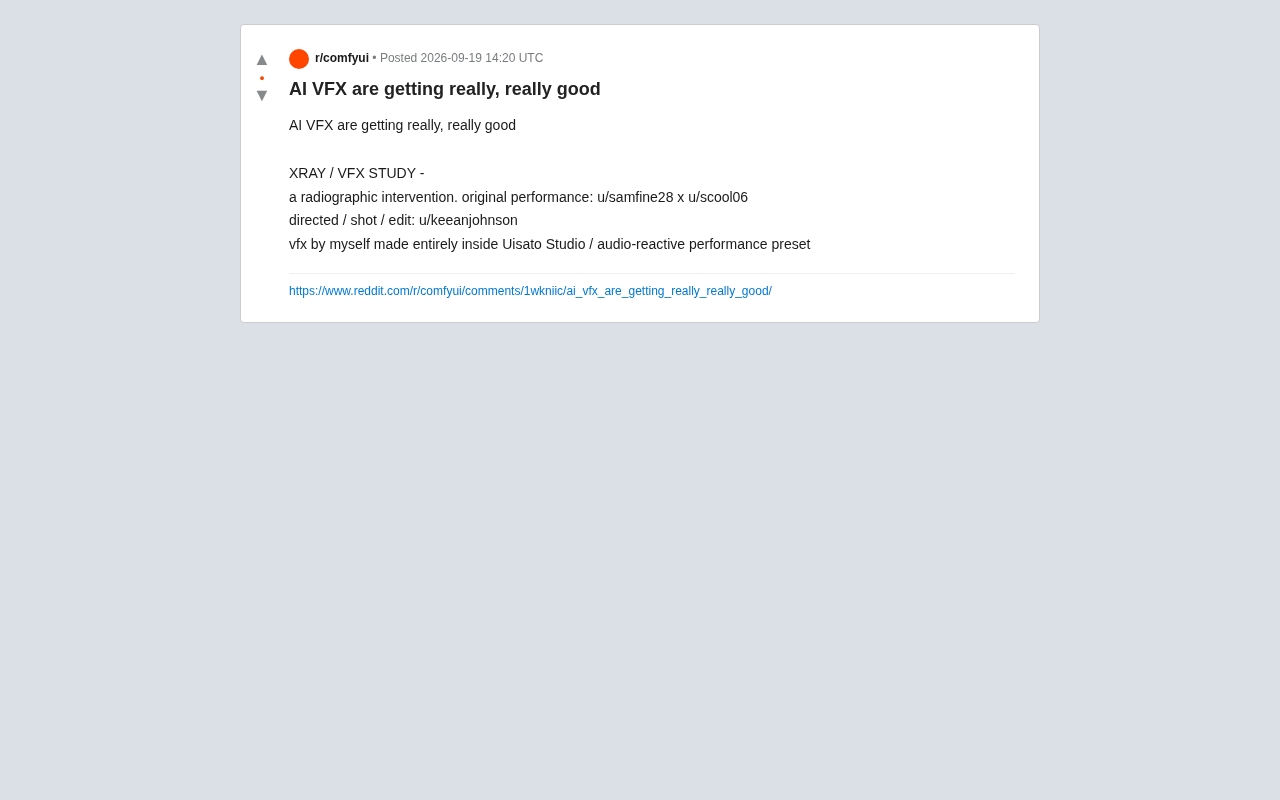
What's worth noting is the production division of labor. The original performance was captured by u/samfine28 and u/scool06, direction, cinematography, and editing were handled by u/keeanjohnson, and all VFX were completed by the creator independently within Uisato Studio, using an "audio-reactive performance preset."
This workflow makes one thing clear: AI VFX hasn't replaced traditional film collaboration — it's been embedded into existing creative pipelines. Performance, cinematography, and editing remain human-led, while AI handles the visual transformation in post-production. The term "audio-reactive" refers to effects that can generate corresponding visual changes in real time or semi-automatically based on audio signals, creating a tighter rhythmic bond between image and sound.
The Value of Audio-Reactive Effects
Audio-reactive effects are not a new concept — they've existed for years in VJ performance visuals and generative art. But when combined with AI generative capabilities, creators can rapidly apply complex visual logic through "presets" without manually adjusting frame by frame. This dramatically compresses the time between idea and finished output, and is a key reason works like this can be completed by a single independent creator.
From a technical standpoint, audio-reactive effects typically work by analyzing an audio signal's amplitude, frequency, or beat detection to drive visual parameters — such as brightness, particle density, or deformation intensity. In traditional toolchains (like TouchDesigner or After Effects' expression system), this requires creators to manually build mapping relationships between audio and visual parameters, with a steep learning curve. "Presets" package this mapping logic into ready-to-use templates: the creator simply imports footage and audio, and the algorithm automatically handles the computation and rendering of those relationships. At its core, this mechanism encodes "domain expert knowledge" into a reusable, distributable form — enabling creators without deep technical backgrounds to produce complex effects with strong rhythmic and audiovisual synchronization.
Why the Barrier to AI VFX Is Collapsing
The traditional barriers to VFX come down to three things: specialized software proficiency, hardware and compute costs, and massive amounts of repetitive manual labor. AI tools are attacking all three simultaneously.
- Skill barrier: Presets and models encapsulate complex parameters, so creators don't need to master full node-based compositing workflows.
- Production efficiency: Effects that once required frame-by-frame processing can now be batch-generated by algorithms.
- Creative freedom: Abstract and surreal visuals like X-ray transparency are extremely difficult to achieve with traditional methods — AI actually excels at them.
This also explains the "really, really good" reactions in the Reddit thread. What viewers are reacting to isn't just the visuals themselves, but the fact that one person made this.
Node-based compositing is the core paradigm of traditional VFX workflows, with leading software including Nuke and Blackmagic Fusion. It abstracts each visual processing step (keying, color correction, particle simulation, compositing) into a "node," which creators connect to build a processing pipeline. The logic is clear, but the barrier to entry is extremely high — typically requiring years of professional training to master. AI tools disrupt this by compressing the parameter space behind these nodes into higher-level semantic instructions or presets. Creators describe what effect they want rather than how to achieve it step by step. This elevation in abstraction level is the core mechanism by which AI is reshaping the VFX learning curve.
A Sober View: This Is Still an Experimental Study
The "VFX STUDY" in the title is itself a form of self-positioning. This is closer to a technical proof-of-concept and stylistic exploration than a commercial-grade production. It's a reminder that AI VFX currently excels at stylized, experimental, and artistically expressive short-form content — but still has notable limitations when precise control, long-shot consistency, and strict physical realism are required.
In other words, AI VFX is great at "stunning moments," but supporting a "complete, controllable project" still requires human judgment, multi-stage collaboration, and significant manual refinement. This work happens to be a balanced example: AI delivers the visual impact, while humans handle the performance, narrative, and overall direction.
What This Means for Creators
For independent creators and small teams, cases like this offer a realistic path forward: you don't need to wait for a bigger budget or a larger team. With today's AI VFX tools, it's possible to achieve visual expressions that once belonged exclusively to professional studios. The truly scarce skill is shifting from "technical execution" to "creative judgment" — what you want to express, and how to embed AI's capabilities into meaningful storytelling, is what determines whether the work rises above the noise.
AI VFX is getting better and better — that's a fact. But what makes it meaningful is still the person behind the screen who knows what to keep, what to cut, and what to say.
Related articles

Chain of Thought Isn't Just for AI: How Humans Can Use CoT to Improve Thinking Quality
Chain of Thought isn't just a prompt trick for large models. Starting from a Hacker News discussion, this article analyzes why CoT works for human thinking too, breaks down actionable ways to transfer it, and highlights the key differences between human CoT and machine CoT.
Cloudflare Teams Up with OpenAI: Closi…
Cloudflare Teams Up with OpenAI: Closing the Loop from Vulnerability Discovery to Defense with AI
Cloudflare uses OpenAI Daybreak to investigate security vulnerabilities and generate reviewable remediation plans, while developers use Codex to boost coding efficiency and quality.

Orca Multi-Agent Orchestration in Practice: A Guide to Parallel Collaboration with Claude and Codex
Orca is Stable AI's free open-source agent workbench supporting 34 agents like Claude Code and Codex in parallel. Learn its Git worktree isolation, multi-model orchestration, and mobile management.