AI Website Builder Test: Generate a Website in 7 Minutes, No Server or Domain Required

AI website builder tested: describe your needs in one sentence, get a live website in 7 minutes.
This article reviews an AI-powered visual website building platform that generates complete websites from natural language descriptions in about 7 minutes. The platform offers visual editing, multi-device preview, and supports one-click deployment to Upage, Netlify, Vercel and more — no server or domain purchase needed. With a built-in template marketplace and comprehensive documentation, it's ideal for non-technical users looking to quickly build personal or business websites.
Want to build a website but don't want to deal with servers, DNS configuration, and code? Now, AI-powered visual website builders based on large language models are making this easier than ever before. The AI website builder I tested today is all about "one-sentence website creation" — just describe your needs in natural language, and it automatically generates a complete, immediately accessible website.
Describe Your Needs in One Sentence, AI Generates a Complete Website
The core philosophy of this AI website building platform is straightforward: replace code with natural language. You simply write out your website requirements — even if the description isn't very detailed, the AI will automatically fill in the gaps and generate a complete webpage.
The underlying technology powering this capability is the breakthrough of large language models (LLMs) like GPT-4 and Claude in code generation. These models, pre-trained on massive amounts of code and web data, can directly convert text descriptions into HTML, CSS, and JavaScript code. The models not only understand semantic intent but can also infer reasonable page structures, color schemes, and interaction logic, automatically filling in details the user hasn't explicitly specified — this is precisely the technical prerequisite that makes "one-sentence website creation" possible.
From hands-on experience, the overall generation speed is quite impressive — it takes about 7 minutes to produce a complete website page. Compared to traditional website building workflows, this represents an order-of-magnitude efficiency improvement — work that previously took days or even weeks is now compressed into minutes.
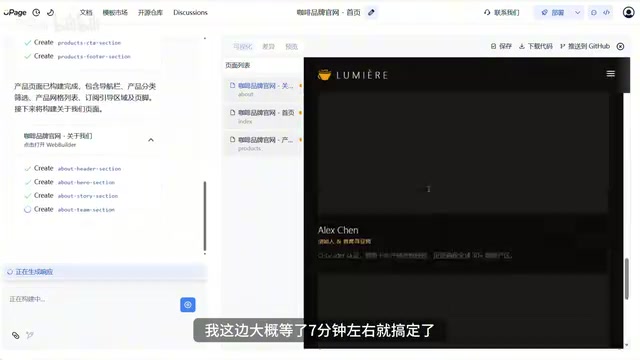
This "one-sentence website creation" approach dramatically lowers the barrier to zero-code website building. Whether you want to create a personal blog, product showcase page, or corporate website, you no longer need to learn front-end technologies like HTML, CSS, or JavaScript — the AI handles all the technical details for you.
Visual Editor: A True WYSIWYG Modification Experience
After the website is generated, the platform provides a comprehensive visual editing system. In the editing interface, virtually all elements on the webpage can be directly clicked and modified. The modification process is equally simple — just describe in one sentence what you want to change, such as adjusting styles or modifying layout logic, and the AI will automatically make the adjustments.
It's worth noting that this type of AI-driven visual editor is fundamentally different from traditional WYSIWYG editors. Traditional editors (like the early Dreamweaver) were notorious among professional developers for generating poor-quality, bloated code. The new generation of AI editors maintains a structured component tree under the hood — user natural language instructions are parsed into precise modifications to component properties rather than direct manipulation of raw HTML strings, resulting in cleaner code that's easier to maintain. This "semantic editing" mode is the core technical differentiator between AI website builders and traditional drag-and-drop tools like Wix and Squarespace.
The platform also offers several practical auxiliary features:
- Code View: View code changes in real-time, suitable for users with some technical background who want to understand what the AI is doing
- Preview Interface: Directly view the final result, editing and previewing simultaneously
- Multi-device Adaptation: Switch between desktop and mobile previews to ensure proper display across different devices
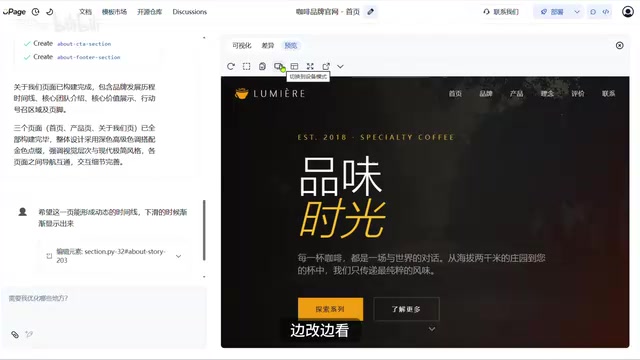
This "edit and preview" workflow means you basically don't need to worry about messing up the page. Even if something goes wrong, you can quickly fix it through natural language, making the entire process very hassle-free.
One-Click Deployment: Say Goodbye to Server and Domain Configuration
In my opinion, the platform's most attractive feature is one-click deployment. The traditional website launch process typically involves: purchasing a server, configuring the environment, buying a domain, setting up DNS resolution, uploading files... For non-technical users, each step can become a roadblock.
DNS (Domain Name System) configuration is particularly tedious — users need to add A records or CNAME records at their domain registrar to point the domain to the server IP, and DNS propagation typically takes anywhere from several hours to 48 hours. This is in addition to SSL certificate application (HTTPS encryption), server firewall configuration, and other steps. AI website building platforms provide platform-specific subdomains, completely encapsulating this underlying infrastructure — essentially trading platform infrastructure resources for user convenience.
This platform supports direct one-click deployment to Upage, with an extremely simple workflow:
- Obtain an API key
- Click "Deploy to Upage"
- Wait for deployment to complete
- Click "View Site" to access your website
After deployment, the platform gives you a dedicated URL — no need to buy a server, no need for DNS resolution — this URL is your dedicated domain that can be shared with anyone for immediate access.

Besides Upage, the platform also supports deployment to other mainstream hosting services:
- OnePanel: Requires filling in the server address and API key, then clicking connect
- Netlify: A well-known static website hosting platform, renowned for additional features like continuous integration and form handling, distributing website files to global nodes via CDN architecture
- Vercel: A deployment platform popular among front-end developers, built by the founding team of the Next.js framework, with exceptional support for front-end frameworks
Both Netlify and Vercel represent the "JAMstack" (JavaScript, API, Markup) hosting model, where static websites can run stably without traditional servers, significantly reducing operational costs. This is also the infrastructure prerequisite that enables AI website builders to achieve "serverless one-click deployment." Multi-platform support means you can choose the most suitable deployment solution based on your needs and preferences, offering high flexibility.
Template Marketplace: No Need to Start from Scratch
For users who don't want to start from zero, the platform also provides a template marketplace covering various types including personal blogs, corporate websites, and product landing pages. You can directly select an existing template as a starting point, then make personalized modifications through AI. This approach ensures both efficiency and flexibility.
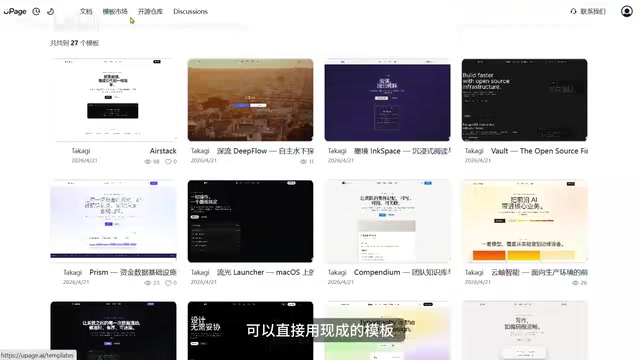
The documentation section is also fairly comprehensive, including deployment tutorials and usage guides that basically cover common issues users might encounter. For a new platform, this level of documentation completeness is commendable.
Summary: Who Is AI Website Building Actually For?
Looking at the overall experience, this type of AI website builder is redefining the barrier and efficiency of "building a website." Its core value lies in:
- Zero technical barrier: Natural language interaction, no programming knowledge required
- Full workflow coverage: From generation to editing to deployment, all in one place
- Instantly usable: Get an accessible online website within minutes
Of course, there's still room for improvement in areas like complex interaction logic and highly customized designs. But for use cases like personal portfolios, small business websites, event pages, and product landing pages, this AI one-click website building approach is already more than sufficient, with efficiency far exceeding traditional solutions.
As AI large model capabilities continue to improve, these tools will only become more powerful. If you have website building needs but lack technical background, give it a try now and experience the feeling of having your own website in just 7 minutes.
Related articles
 Product Reviews
The Programmer's Desk Setup Guide: Building a Workspace That Feels Like Home
Discover how programmers build productive, comfortable workspaces. From multi-monitor setups to ergonomic design, explore the desk philosophy that drives focus and flow.
 Product Reviews
Qoder vs Cursor Real-World Comparison: Which $20/Month AI IDE Is Better?
Hands-on comparison of Qoder vs Cursor AI IDEs: Agent autonomy, human interaction count, and architecture decisions. Qoder needed only 2 interactions vs Cursor's 8.
 Product Reviews
Cursor Cloud Agent Demo: Eliminating Bottlenecks Across the Entire Software Development Lifecycle
Deep analysis of Cursor's Cloud Agent demo showing how cloud VMs, automated test artifacts, and a full-chain control plane systematically eliminate human bottlenecks across the software development lifecycle.