AI Weekly: GPT-5.6 Launches in Three Tiers, Open-Source Inference Frameworks and Robot Safety Break Through Across the Board

GPT-5.6 launches in three tiers, open-source inference frameworks advance, and robot safety takes center stage.
OpenAI released GPT-5.6 in three tiers with the White House imposing export controls; DeepSeek and Peking University open-sourced the DSpark speculative decoding framework for 85% faster inference; Prime Intellect trained trillion-parameter models on just 28 H200s; Anthropic's Claude entered Slack as an 'AI colleague'; and embodied AI safety became a core industry focus.
This Week's Highlight: OpenAI Releases GPT-5.6 in Tiers, With the White House as a Behind-the-Scenes Variable
At the end of June 2026, the AI industry maintained its rapid pace of iteration. The most closely watched event this week was OpenAI's release of the GPT-5.6 series—adopting a three-tier layered strategy of Sol, Terra, and Luna. Its coding capabilities reached 91.9% on key benchmarks, and it scored 85.6% on the CyberGym safety evaluation, both surpassing its competitor Nexus 5.
OpenAI's three-tier architecture of Sol, Terra, and Luna continues the "capability-tiering" product logic it has followed in recent years: the low-tier model serves high-frequency, lightweight scenarios with low latency and low cost, the mid-tier model balances capability and cost, and the flagship model tackles complex reasoning and specialized tasks. This architecture bears a striking resemblance to Google's Gemini Ultra/Pro/Nano and Anthropic's Claude Opus/Sonnet/Haiku competitive logic, reflecting a convergence trend among leading AI labs on commercialization pathways. The introduction of CyberGym as an independent safety benchmark marks a shift in AI safety evaluation from internal red-team testing toward a standardized system that allows horizontal comparison across companies.
Notably, this release was deeply entangled with geopolitical factors. The White House required that advanced models be approved on a customer-by-customer basis when serving overseas users. OpenAI stated it would cooperate with the government, resulting in a delayed release of GPT-5.6 in some markets. An executive order signed by Trump further stipulated that models must pass AI safety testing before release—AI safety is evolving from a technical issue into a bargaining chip in national rivalry.
This policy framework has historical roots: in October 2022, the Biden administration imposed export restrictions on advanced semiconductors (especially GPUs like the A100/H100), later gradually extended to AI model weights and inference APIs. The "AI Diffusion Rule" introduced in early 2025 divided the world's countries into different compliance tiers, requiring U.S. AI companies to complete government filings before offering services in certain markets. The core logic of this mechanism is that advanced AI exceeding a certain capability threshold is regarded as a dual-use strategic asset, aligning with the control logic applied to nuclear technology and cryptographic tools.
The butterfly effect of this "export control" has already appeared in Asia: Japan has seen a wave of repurchasing, while the Chinese market is accelerating its push for AI self-sufficiency, with safety becoming a new keyword.
Three Major Breakthroughs in the Open-Source Camp: Inference, Training, and Memory
The open-source community was exceptionally active this week, with three developments particularly worth noting.
DeepSeek and Peking University Open-Source the DSpark Speculative Decoding Framework
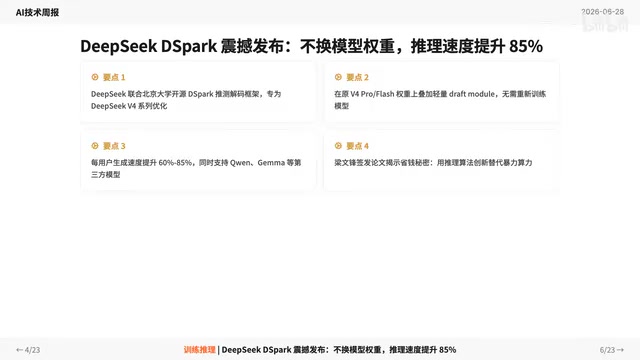
DeepSeekAd and Peking University jointly open-sourced the DSpark inference framework, centered on Speculative Decoding technology. Speculative decoding is a technique that accelerates large language model inference by introducing a small "draft model": a computationally cheap small model rapidly generates candidate token sequences, which the large model then verifies in parallel and selectively adopts—thereby substantially boosting throughput without altering output quality. This technique was systematically proposed by institutions such as Google and DeepMind between 2022 and 2023, with its core advantage being the ability to bypass the serial bottleneck of large models' autoregressive generation. DSpark reportedly improves inference speed by 85% and generation speed by 6–8%, all without requiring a change in model weights, directly reducing inference costs. For scenarios demanding high throughput and low latency, such "speed up without touching the weights" solutions offer significant practical value.
Prime Intellect Lowers the Threshold for Distributed Training
Prime Intellect's open-source PrimeRL 0.6.0 framework achieved an important breakthrough: it can train trillion-parameter-scale models using just 28 H200s, dramatically lowering the hardware threshold and cost of large model training. The NVIDIA H200 is a top-tier AI training GPU based on the Hopper architecture, with 141GB of HBM3e memory per card and peak compute of about 4.9 PFLOPS (FP8 precision). Training trillion-parameter models typically requires thousands of A100/H100 cards, but PrimeRL 0.6.0 compresses the threshold to 28 H200s, relying on techniques such as asynchronous pipeline parallelism, gradient compression, and cross-node memory sharing—essentially a systematic breakthrough on the communication wall problem in distributed training.
The "communication wall" is one of the core challenges in distributed training. It refers to how, as the number of GPU nodes increases, the communication overhead of gradient synchronization and parameter passing between nodes grows superlinearly, ultimately becoming the decisive bottleneck for overall training efficiency. At the trillion-parameter scale, the traditional AllReduce gradient synchronization protocol needs to synchronize terabytes of gradient data across thousands of cards, making network bandwidth a scarcer resource than computation itself. PrimeRL 0.6.0 combines overlapping computation with communication, compressing transmission volume, and reducing per-card memory pressure, enabling 28 H200s to approach the effective training efficiency of hundreds of cards under traditional architectures—substantively pulling the "capital threshold" of large model training down from supercomputing clusters costing hundreds of millions of dollars to mid-tier compute clusters costing tens of millions. For teams with limited compute, this greatly increases the possibility of participating in frontier model research.
Saying Goodbye to AI's "Goldfish Brain": A New Breakthrough in Agent Memory Frameworks
The Agent memory framework released by the Nous team addresses the "short-term memory" problem that has long plagued agents, cutting token costs by 96% while improving performance by 23%. The context window of existing Transformer architectures is essentially stateless—each conversation is independent and unable to accumulate long-term knowledge. The Nous framework's breakthrough lies in introducing hierarchical memory compression and selective recall mechanisms, converting memory that would need to be fully loaded into the context into on-demand external storage retrieval, thereby compressing token cost from O(n) to nearly O(log n). Memory management is currently the core bottleneck to making agents practical, and this dual optimization of cost and performance sends a positive signal.
Hardware and Compute: New Computers and Big Players Doubling Down in Parallel
At the compute level, two distinctly different paths emerged.
On one hand, a new type of computer based on "coupled oscillators" is attempting to replace the GPU. Coupled Oscillator Networks are an analog computing paradigm that uses the phase-synchronization phenomenon of physical oscillators to solve optimization problems, and are especially adept at combinatorial optimization scenarios such as the Ising model. Unlike the digital logic of GPUs, they perform computation directly through physical dynamics, theoretically reducing energy consumption by several orders of magnitude. This solution consumes only one-thousandth the power of a traditional GPU, with a performance loss of about 6.7%, and is fully open-source—dubbed the "Hello World" of a new computing paradigm. This path is still in an early validation stage, and its limited programming model is the main challenge on the road to general AI inference; but if the technical approach holds up, it could have a profound impact on energy-sensitive AI inference scenarios.
On the other hand, traditional giants continue to double down: Qualcomm spent $4 billion to acquire AI software company Modular, whose Mojo programming language directly targets NVIDIA CUDA's ecosystem dominance. CUDA (Compute Unified Device Architecture) is a parallel computing platform launched by NVIDIA in 2006. Through nearly 20 years of ecosystem accumulation, it has built a complete moat spanning frameworks (PyTorch/TensorFlow) to libraries (cuDNN/cuBLAS), with millions of AI developers worldwide deeply dependent on it. Modular's Mojo language, led by Chris Lattner (the father of Swift), is syntactically compatible with Python but approaches C in performance, with the core goal of building an AI programming ecosystem decoupled from CUDA.
Mojo's technical strategy is "progressive replacement": its syntax is fully compatible with Python to lower migration costs, its underlying compilation targets the MLIR intermediate representation for cross-hardware abstraction, and its performance approaches C through SIMD vectorization and zero-cost abstractions. CUDA's moat comes not only from technical performance but also from the path dependence accumulated over nearly 20 years—university AI courses worldwide use CUDA as the default programming model, PyTorch/TensorFlow operator libraries are deeply coupled with cuDNN, and historical attempts to shake CUDA (OpenCL, ROCm, etc.) have all failed due to incomplete ecosystems. The industry interprets Qualcomm's acquisition as a strategic move to bypass NVIDIA in the chip ecosystem battle, with success hinging on whether it can offer sufficiently attractive hardware price-performance as an incentive for developer migration. Meanwhile, Amazon invested another $13 billion to bet on AI and cloud infrastructure in India, with cumulative commitments reaching $48 billion, covering data centers and compute buildout.

Agents and "AI Colleagues": The Third Paradigm of LLMs
Anthropic's launch of the Claude Slack integration is quite emblematic. Users can activate it directly with @ in Slack, and it comes with persistent memory. Karpathy defines this always-on collaboration tool as "the third paradigm of LLMs"—compared with "API calls" (the first paradigm) and "RAG-augmented retrieval" (the second paradigm), the LLM as an always-on collaborator is deeply embedded in the workflow, continuously perceiving context and accumulating task memory, no longer just a one-off question-answering tool.
Even more striking is Anthropic's internal data: over 80% of code is written by AI, per-capita output is 8 times last year's, and the engineering bottleneck has shifted from "coding" to "product decision-making." This confirms a trend—as AI takes on the vast majority of implementation work, human value is migrating toward decision-making and judgment.
In addition, Shanghai AI Lab launched the Self-Harness framework, enabling AI to autonomously improve rules with performance gains of up to 60%, pushing agents to evolve from "being called" to "self-calling." CoreTech also launched an always-on Slack AI colleague, which has already helped write 65% of the product team's code.
Embodied Intelligence and Robotics: Safety Becomes the Core Issue
The robotics field was equally lively this week. NVIDIA launched HALOS, touted as the first full-stack physical AI safety solution, transplanting 18,600 engineering years of experience accumulated from autonomous driving to robotics. HALOS's three-layer architecture draws on the functional safety standards ISO 26262 and SOTIF from the autonomous driving domain, corresponding respectively to independent safety monitoring of the perception, planning, and execution layers. ISO 26262 focuses on hazards caused by systematic hardware and software faults, requiring redundant design graded by Automotive Safety Integrity Levels (ASIL A through D); SOTIF (ISO 21448) addresses scenarios where "the system operates as designed yet still causes hazards," i.e., the capability limitations of perception algorithms in rare edge cases. Transplanting this framework to embodied intelligence faces additional challenges: robots' degrees of freedom of motion and interaction scenarios are far more complex than vehicles', making traditional exhaustive scenario validation difficult to apply. The safety problem of embodied intelligence is more complex than that of pure software AI—once a robot loses control in the physical world, the damage is irreversible, which is precisely why the safety stack is shifting from a "bonus feature" to an "entry threshold." NVIDIA's choice to fully open-source HALOS and attract over 40 companies to participate is essentially about driving early anchoring of industry safety standards. Agility Robotics' Digit became the first robot to integrate NVIDIA HALOS, and safety is becoming the core threshold for the deployment of embodied intelligence.
At MWC Shanghai, 8 Chinese teams staged a humanoid robot penalty shootout, with fully autonomous competition throughout, prohibiting remote control and pre-programming—the core test being the robots' autonomous decision-making ability, drawing over ten thousand spectators. Such competitive scenarios are becoming a touchstone for testing the true level of embodied intelligence.
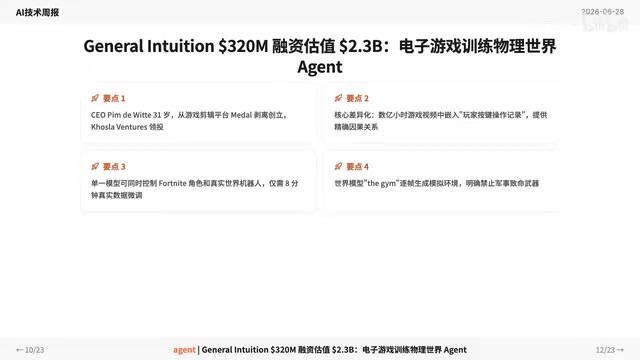
General Intuition completed a $320 million funding round at a $2.3 billion valuation. Its approach is unique: using hundreds of millions of hours of game video to train a single model that simultaneously controls game characters and real robots, requiring only 8 minutes of fine-tuning to complete transfer, and explicitly prohibiting military use. This approach traces back to early work such as DeepMind's DQN, with the core rationale being that game videos contain vast numbers of embodied decision sequences—how characters perceive the environment, weigh options, and execute actions—structurally highly isomorphic to the perception-planning-execution loop that robots require. By using a unified multimodal model to simultaneously process game frames and robot sensor inputs, only a small amount of real robot data is needed to complete domain adaptation, dramatically reducing the cost of expensive physical-world data collection. Researchers call this paradigm "games as a low-cost simulator of the physical world," philosophically consistent with Tesla's Dojo approach of using driving videos to train autonomous driving.
Capital Movements: Image Generation and Model Deployment Sectors Heat Up
The funding side shows a clear application-oriented tilt. The domestic video generation product Kling AI reached a $15 billion valuation, in a round led by Tencent, Alibaba, and Sequoia. With annualized revenue of $300 million, most of it from overseas, it plans to go public in Q1 2027.

Baseten, which focuses on helping enterprises deploy AI models at low cost, completed a $1.5 billion funding round with participation from Andreessen Horowitz and NVIDIA, valued at $13 billion, with annual revenue of $600 million—a surge of 2000%. AI safety company Patronus AI completed a $50 million Series B, with cumulative funding of $70 million, revenue growing 15x year-over-year, and coverage of nearly all mainstream frontier labs.
In image generation, Chroma open-sourced its Turbo version, which generates images in 2 seconds and opens up the original weights, with over 50 LoRAs already emerging in the community. LoRA (Low-Rank Adaptation) is a parameter-efficient fine-tuning technique that injects a low-rank decomposed incremental matrix alongside the original weight matrix, requiring the training of only a tiny fraction of parameters (typically less than 1% of the total) to adapt a base model to a specific style or task—without copying the full model. The rapid emergence of community LoRAs after opening the original weights is precisely thanks to this. However, the double-edged nature of open weights has also emerged: content safety guardrails can be bypassed by targeted LoRAs, and this risk is exactly the deeper driver of the rapidly growing market demand for AI safety companies (such as Patronus AI)—the tension between the downward diffusion of open-source capabilities and the failure of safety controls will be a structural contradiction the industry must continually face for a considerable time to come.
Conclusion
The main threads of the industry this week are clearly visible: technology is accelerating open-sourcing, compute paths are diversifying, agents are moving toward always-on collaboration, robots are focusing on safety, and geopolitics is deeply embedded. From DSpark's inference acceleration to Prime Intellect's low-cost training, open-source forces continue to lower the barrier to entry; while the White House's export controls remind us that AI competition has long transcended the purely technical realm, rising to a game at the level of national strategy. For practitioners, how to strike a balance between open innovation and compliance constraints will be a long-term question going forward.
Key Takeaways
Key Takeaways
Related articles

Workbuddy for Absolute Beginners: How a Desktop AI Agent Fits Into Real Workflows
A beginner's guide to the Workbuddy desktop AI agent: installation, claiming credits, file management, and building automated workflows—compared with CodeX for fit and cost, helping professionals shift from AI question-askers to AI managers.

OpenAI's New Agent Stack: Computer Use, Decisions API, and Ultra-Fast Workflows
OpenAI Dev Day unveiled a new agent stack: Computer Use outperforms humans, Decisions API delivers ultra-low-latency classification via Luna, Agents API opens the same Computer Use capabilities, and GPT-6.1 Sol costs only one-seventh of Astra. Core updates, benchmark data, and developer insights.

Liang Wenfeng Open-Sources DeepInfo Inference Framework, Takes On U.S. Ban
DeepSeek open-sources its DeepInfo inference framework after its models, featuring GPU/CPU cross-pipelining, small-model prediction with large-model verification, and full Huawei Ascend and NVIDIA chip support—facing the U.S. federal ban head-on. This article analyzes its significance for AI deployment and open-source strategy.