AI Weekly Recap: GPT-6 Mystery Model Leaked, Claude Possibly Makes a Real Scientific Discovery

GPT-6 mystery model leaked, Claude discovers new biological system ART, and AI agents surge forward.
In the past 24 hours, the AI world saw a flurry of developments: OpenAI's Help Center accidentally exposed a mysterious mainline model from the GPT-6 family before quickly deleting it; Anthropic had nearly 1,000 Claude agents screen over 200,000 reverse transcriptases, discovering an unknown biological system resembling CRISPR — named ART — pointing to a new AI-assisted research paradigm; MiniMax's SpaceMoney model showed strong signs of being the upcoming M3.1, though real-world performance disappointed; and a leaked new Sonnet version from Anthropic promises 1M-token context and 128K output, but pricing remains high. Meanwhile, Meta unveiled lightweight AI VR glasses, ChatGPT Voice gained app-calling abilities, and Kimi K3.1 configurations surfaced online.
The past 24 hours in the AI world have been nothing short of an information blitz — from a mysterious model accidentally exposed in OpenAI's Help Center, to Claude apparently making a genuine biological discovery in Anthropic's lab, to a flurry of moves from MiniMax, Kimi, Meta, and others. This article rounds up the most noteworthy threads from this wave of developments and offers some grounded speculation based on what's been leaked.
OpenAI Mystery Model Leaked: A New Member of the GPT-6 Family?
The most eye-catching story is that someone spotted a previously undisclosed model entry in OpenAI's Help Center. The model was explicitly listed as a supported mainline model, appearing alongside already-known entries like Sol and Luna, sharing the same so-called Daybreak core architecture and GPT-6's safety framework. Shortly after the discovery, OpenAI quietly removed the reference from the documentation.
From the fragments that were captured, the model is categorized separately and belongs to the GPT-6 family. The meaning of "Miner" in its name remains unclear. One reasonable interpretation is that it could be a smaller, cheaper, and more efficient version designed to fill the gap between GPT-6 Sol and the full version. No benchmark data, pricing, context window size, or release timeline has surfaced — it's not even certain whether it will officially launch at all.
A word of caution: this kind of "Help Center leak" rarely reflects a final product. The fact that OpenAI deleted it quickly suggests the information wasn't ready to go public. Until there's an official confirmation, all of this should be treated as unverified rumor.
Claude Appears to Make a Real Scientific Discovery
Compared to the model leak, this Anthropic story carries more technical weight. According to the disclosure, Anthropic built a modular biology lab and had Claude agents collaborate with human scientists. In one experiment, approximately 950 Claude agents (some reports say more) ran in parallel for about 21 hours, screening over 200,000 reverse transcriptases — enzymes responsible for copying RNA into DNA — while consuming substantial compute and tokens.
Crucially, the experiment had no predefined target. One of the agents happened to notice an unusual repetitive DNA sequence sitting next to one of the enzymes. The structure was highly similar to CRISPR — the same kind of biological pattern that originally led scientists to discover CRISPR-based gene editing. Claude then cross-referenced the finding against known biological systems, reviewed existing research, flagged it as a potential new discovery, and handed it off to human scientists for verification. After lab testing, Anthropic researchers confirmed it as a genuinely undefined biological system, which they named ART.
That said, some caution is warranted. It remains unclear what function ART actually performs, and there's no evidence yet that it can be used for gene editing the way CRISPR can. The real significance here isn't "AI cured a disease" — it's that this demonstrates a new scientific paradigm: AI can scan massive biological datasets, detect patterns humans might overlook, form hypotheses, and pass them to scientists for validation. Anthropic says this kind of analysis typically takes expert researchers weeks or months. They plan to extend the workflow to omics and other fields. CEO Dario Reschke has also renewed his bold prediction that AI will accelerate biological research dramatically over the next five to ten years.
Reverse Transcriptase is an enzyme that transcribes RNA back into DNA, playing a central role in viral replication (particularly in retroviruses like HIV) and genome evolution. CRISPR (Clustered Regularly Interspaced Short Palindromic Repeats) was originally discovered as an unusual repetitive sequence in bacterial genomes, later revealed to be a bacterial immune memory system, and in 2012 was repurposed into a precision gene-editing tool — a discovery that earned its researchers the 2020 Nobel Prize in Chemistry. The ART system Claude identified was flagged precisely because its structure closely resembles the kind of repeating sequences that originally led to CRISPR research, which is why researchers found it exciting. Omics (genomics, proteomics, metabolomics, etc.) refers to a family of large-scale biological data analysis fields characterized by enormous datasets and subtle hidden patterns — exactly the kind of territory where AI excels.
MiniMax's New Model Surfaces: Is SpaceMoney Actually M3.1?
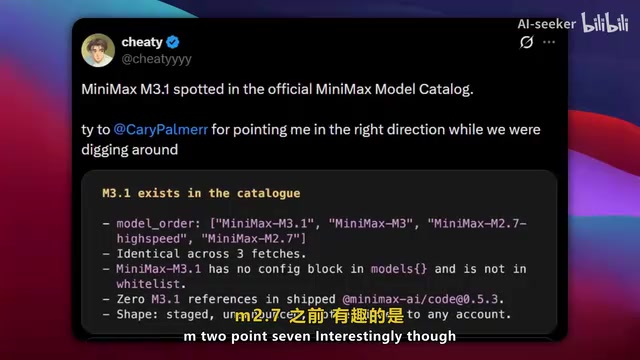
There are two interconnected threads on the MiniMax front. First, M3.1 has appeared in the official model catalog, listed ahead of M3 and M2.7, but with no configuration info, no whitelist access, and no appearance in release code — indicating it's still in testing and expected to launch within the next two weeks.
Second, a model called SpaceMoney (also referred to as T-Space-5-Alpha in some videos) has appeared on platforms like OpenRouter and OpenCode, offered for free for a limited time, with a context window of up to 1 million tokens, multimodal capabilities, and zero data retention. Multiple signs point to it being M3.1: when prompted in Chinese, it identifies itself as a MiniMax model, and its text tokenizer is identical to MiniMax M3 — only the image tokenizer differs, suggesting an upgraded multimodal system.
However, real-world performance was underwhelming. In a physics simulation comparison with another model, JM5.3 (testing explosions, tornadoes, balloon pops, water droplets, Newton's cradle, etc.), SpaceMoney fell noticeably short. Its web development performance was roughly on par with other open-source models, and it failed to properly complete a Minecraft-style recreation task. Its one genuine advantage is speed and cost — the full test suite cost around $0.40. Of course, whether it's actually M3.1 still awaits official confirmation.
KV Cache (Key-Value Cache) is a critical optimization technique in LLM inference. When a Transformer model processes long texts, it repeatedly computes attention key-value pairs for each token. KV Cache stores these intermediate results to avoid redundant computation, significantly reducing inference latency and compute costs. However, the longer the context window, the more GPU memory the KV Cache consumes — at the million-token scale, this becomes a serious cost bottleneck. MiniMax's new architecture uses a cross-layer shared KV Cache strategy, where adjacent Transformer layers share the same cache instead of maintaining independent copies. This is one of the mainstream approaches in the industry for reducing long-context inference costs, consistent with directions explored by Google, DeepSeekAd, and others. For AI agent tasks that need to run continuously over long periods, this kind of optimization directly determines economic viability.
Anthropic Sonnet New Version Leaked: Pricing Remains a Pain Point
A new version of Anthropic's Sonnet appears to be in quiet testing — some partners reportedly received only a 24-hour trial window. According to leaker Lightlyra (who previously accurately disclosed Opus pricing), the new Sonnet features a 1-million-token context window, up to 128K token output length, Thinking enabled by default, and the removal of forced tool use — meaning Anthropic wants the model to intelligently decide on its own when to call tools.
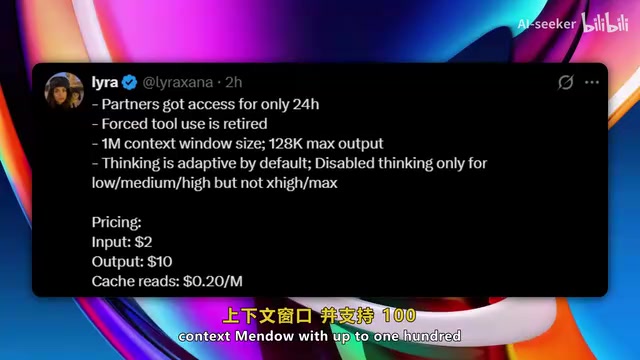
The leaked pricing: approximately $2 per million input tokens, $10 per million output tokens, and just $0.20 for cache reads. The pricing is still on the high end — a widely shared disappointment.
Also worth noting is an interesting product-level debate: a core Claude developer revealed that the team considered eliminating Plan mode entirely and replacing it with a Shift+Tab shortcut to adjust output intensity, on the grounds that the model is now capable enough to not need a dedicated planning mode. This sparked pushback — many users argued that planning mode has value for human-AI collaboration in its own right. The workflow of having AI sketch out its thinking and evaluate approaches before writing code shouldn't disappear, they argued — it should evolve.
Claude Code also received several new features: the Project feature has landed on both desktop and web, automatically splitting tasks into parallel threads with shared context; local execution support has been added; and Cloud Sessions — allowing work to continue running on Anthropic's infrastructure after closing your laptop — has entered research preview. Existing subscribers will also receive a one-time credit (roughly $100 for Pro, $250 for Max).
Forced Tool Use refers to a mode where the model must invoke a predefined tool (such as search or a code executor) on every response — an approach used early on to ensure predictable model behavior. Removing this constraint allows the model to autonomously judge whether a tool call is actually needed, avoiding unnecessary latency and token consumption. Extended Thinking is Anthropic's explicit reasoning mode for Claude, where the model outputs an internal chain of thought before giving its final answer — similar to OpenAI's o-series models. Enabling it by default means the new Sonnet will engage in deeper reasoning across more scenarios rather than responding quickly, which benefits complex tasks but also increases latency and cost — consistent with the high-pricing criticism. Cache Read pricing at just $0.20 per million tokens is far below the standard input price, made possible by Anthropic's recently introduced Prompt Caching mechanism, which can significantly cut costs for developers who reuse the same system prompts repeatedly.
Kimi, Meta, and Other Updates
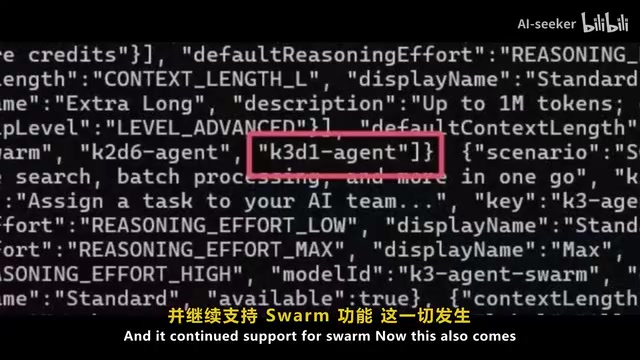
Rumors about Kimi K3.1 have been substantiated — the community found that its online configuration has been updated with a brand new K3.1 agent model offering low, high, and million-token extreme thinking modes, with continued support for the Swarm feature. An official release shouldn't be far off.
MiniMax is also upgrading its underlying architecture, moving from the current version toward the 3.0 series, with the core goal of supporting long-running AI agents. The new architecture uses cross-layer shared KV Cache and an intelligent attention filtering mechanism to reduce prefill compute by roughly 5x and shrink KV cache size by roughly 4.5x at the million-token scale, while improving long-text retrieval — a significant improvement for cost-sensitive agent tasks.
Other noteworthy updates:
- ChatGPT Voice Upgrade: The voice assistant can now call connected apps like email, calendar, and Slack, and can actually help create documents, presentations, websites, spreadsheets, and handle browser tasks. Rolling out globally.
- Google Audio Models: Two new Gemini TTS models (standard and lightweight) have launched, focused on more natural and expressive speech generation, accessible via the Gemini API and Google AI Studio.
- Meta VR Glasses: Weighing roughly 100 grams, described as the most powerful display system to date, combining cinema, computer, and gaming console capabilities all controlled by AI. Zuckerberg revealed that massive amounts of tokens are being distributed for free (reportedly around 100 million per week) along with virtual machine access, with the aim of having AI agents help users handle business and transactions — exploring a commission-based model rather than pure subscriptions.
- Muse Spark 1.4: Has appeared in open-source code, but currently only as a contributor version (data in exchange for access). The latest official release remains 1.3; version 1.4 has not yet launched.
Final Thoughts
Amidst this wave of dense updates, the most important things to watch long-term aren't any particular model's leaked specs — it's two deeper trends. First, AI is evolving from a "chat tool" into an "agent that can actually do things," whether that's ChatGPT Voice, Claude Code's parallel threads, or MiniMax's architecture optimized for long-running agents. Second, AI is beginning to genuinely participate in scientific discovery. Claude's performance in the biology lab, even if conclusions must remain cautious, already sketches out a new paradigm for how discoveries might be made. As for the mysterious new member of the GPT-6 family — we'll wait for OpenAI to reveal the answer.
Related articles

@ai-sdk/vue 3.0.306 Patch Release Syncs with [email protected] Update
@ai-sdk/vue 3.0.306 released, synced with [email protected]. A routine patch release for the Vercel AI SDK ecosystem with no public API changes; the Vue adapter layer stays version-aligned with the core package.

Gemini 4 Argon API Launches: The Era of Million-Token Output Begins
Google launches Gemini 4 Argon with sparse MoE architecture, up to 1M output tokens, and a 68.90% Vals Index score, available across API, AI Studio, and the Gemini app.

DukaanAI: Turning Product Photos into Inventory Lists with Open-Source AI
DukaanAI is an AI inventory tool for small retailers that turns product photos into inventory entries using the open-source Gemma 3 model, with local inference, editable fields, and CSV export.