AI Werewolf: Practical Lessons on Teaching Agents to Deceive and Survive
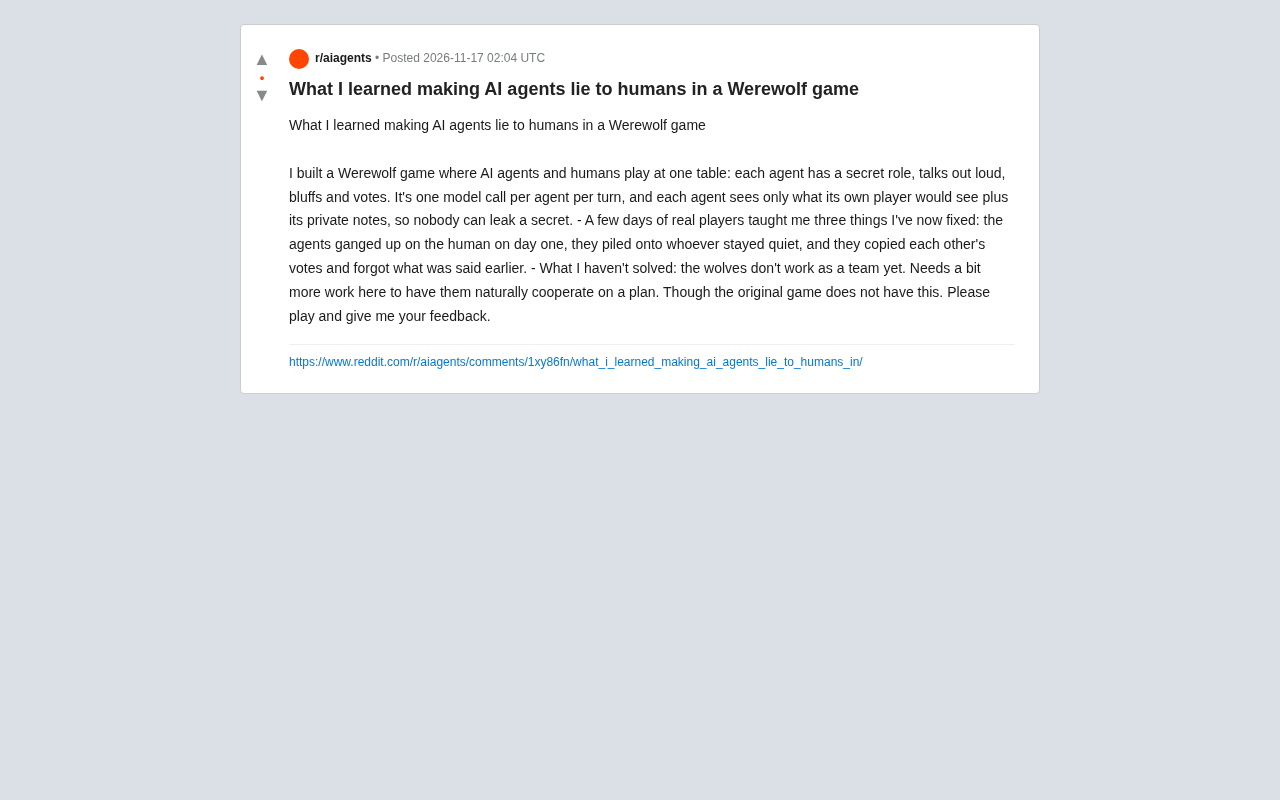
Developer builds an AI-human Werewolf game, revealing three key agent flaws and unsolved team coordination challenges.
A developer shares his AI-human Werewolf project where each agent calls the model once per turn and sees only its own perspective, structurally preventing cheating. Testing with real players exposed three key issues: agents gang up on humans on day one, focus attacks on silent players, copy each other's votes, and forget conversation history. Additionally, werewolf agents cannot yet coordinate as a team, involving deep challenges in theory of mind and multi-agent communication. The article notes that information isolation is foundational, social behavior needs fine-tuning, and team coordination is the hard part—offering practical insights for multi-agent social game system development.
When AI Sits Down at the Werewolf Table
Imagine this: you're sitting at a Werewolf game table, and the players across from you might be humans or AI agents. They have secret identities, they can speak, lie, and vote—and each agent can only see information from its own perspective, with no way to cheat and peek at hidden roles. This isn't science fiction; it's a real project a developer shared on Reddit.
He built a Werewolf game where AI and humans play together. Each agent calls the model once per turn and can only access information visible to "itself as a player" plus private notes, structurally eliminating any secret leakage. After several days of testing with real players, he identified three key problems and shared the challenges that remain unsolved. These lessons are valuable for anyone looking to build multi-agent social game systems.
Three Exposed Agent Behavior Flaws
During testing with real players, the developer discovered three issues that undermined the game experience, and he has already begun fixing them:
First, agents collectively gang up on human players on day one. This may be because agents, lacking sufficient information, tend to view humans—those "not of our kind"—as threats, or because the model itself has some alignment bias that causes them to unite against humans too early. The developer didn't disclose the specific fix, but clearly adjusted the agents' decision logic.
Second, they focus their attacks on silent players. In Werewolf, silence is often interpreted as suspicious, but the agents seem to over-amplify this signal, causing all agents to rush to vote for the quiet players. This reflects that models in social reasoning may rely on surface-level heuristics (such as speech volume) rather than deep logical judgment.
Third, they copy each other's votes and forget what was previously said. Agents lack effective use of conversation history, leading to convergent voting behavior and an inability to remember key information. This exposes current models' shortcomings in long-context understanding and independent decision-making.
These three problems collectively point to a core challenge: how to make AI agents exhibit complex, human-like strategies in social games rather than falling into simple, patterned behavior.
Alignment Bias in this context refers to a systematic divergence between a model's behavioral tendencies and the intentions or expected game experience of its human designers. In the Werewolf project, agents "collectively ganging up on human players on day one" likely reflects a latent alignment issue: the model may have learned patterns from training data suggesting "humans are external entities" or "non-allies are threats," leading to overly aggressive strategies when information is insufficient. More broadly, alignment research on large language models focuses on ensuring model behavior conforms to human values and intentions, but in multi-agent game scenarios, the meaning of "alignment" becomes more complex—it requires not only that individual agents behave reasonably but also that the emergent behavior of the entire multi-agent system meets the game designer's expectations. This kind of systemic alignment problem currently has no mature solution and often requires combining prompt engineering, behavioral constraints, and iterative testing to gradually calibrate.
The Unsolved Challenge: Werewolf Team Coordination
The developer explicitly states that the werewolves (AI agents) cannot yet work together as a team. They need more work to naturally cooperate and formulate plans. Interestingly, he notes that "the original game doesn't require this"—meaning that in human Werewolf games, werewolf team coordination happens naturally, yet AI agents struggle to achieve it.
The reason may lie in: agents lacking effective communication mechanisms, or models finding it difficult to coordinate actions while hiding their identities. Werewolves need to disguise as good players during the day and act in unison at night, which requires agents to possess "Theory of Mind"—understanding other agents' beliefs and intentions and adjusting strategies accordingly. Current large language models still have limitations in this regard.
The developer openly invites players to try the game and provide feedback, indicating the project is still iterating. For the AI research community, this kind of open experimental platform helps reveal real problems in multi-agent interaction.
Theory of Mind is a core concept in cognitive science and artificial intelligence, referring to an individual's ability to understand that others hold beliefs, intentions, desires, and knowledge states different from their own. In Werewolf, this ability is particularly critical: werewolves need to infer what good players believe and whom they suspect in order to decide how to disguise themselves; good players need to judge who is lying and whose speech logic contains contradictions. Although current large language models can generate seemingly plausible social discourse, they do not truly "possess" theory of mind—they imitate human conversation patterns at a statistical level rather than internally constructing explicit models of others' mental states. Recent research has attempted to elicit models' theory-of-mind capabilities through specific prompting strategies or fine-tuning, but in multi-agent adversarial environments, models often struggle to stably track belief changes across multiple agents—this is one of the deeper reasons why werewolf team coordination is difficult.
Implications for Multi-Agent System Development
Although this Werewolf project is a game, the problems it exposes have universal significance. Any application requiring AI agents to deceive, cooperate, or compete in social environments (such as negotiation, customer service, game NPCs) may encounter similar challenges.
First, information isolation mechanisms are fundamental. By restricting each agent's visible information, the developer ensured game fairness. This design is crucial in multi-agent systems; otherwise, agents might exploit global information to cheat.
Second, agents' social behavior requires fine-tuning. Collectively ganging up on humans, attacking silent players, copying votes—these behaviors are all "lazy" strategies models adopt when lacking proper guidance. Developers need to design reward mechanisms or prompt engineering to encourage more complex reasoning.
Finally, team coordination is the hard part. Cooperation among werewolves requires agents to build trust and coordinate in an adversarial environment, which is far more difficult than acting alone. Future research may need to introduce dedicated communication protocols or training methods.
Multi-Agent System (MAS) refers to a computational system composed of multiple autonomous agents that accomplish tasks difficult for any single agent through communication, coordination, and negotiation. In traditional MAS research, agents typically interact based on rules or reinforcement learning policies, with predictable behavior that is easy to formally verify. MAS based on large language models introduces new complexity: agent behavior is driven by natural language prompts, offering high flexibility and unpredictability, but also making "groupthink" or patterned behavior more likely. The Werewolf project is a typical LLM-driven MAS experimental ground—each agent makes independent decisions, communicates through natural language speech, and has adversarial objectives. Common challenges for such systems include: how to design effective communication protocols to avoid information overload, how to prevent behavioral convergence among agents, and how to maintain independent decision-making in partially observable environments.
Conclusion: Games as AI Testbeds
As a classic social deduction game, Werewolf provides an ideal testing platform for AI agents. It requires agents to possess deception, reasoning, memory, and cooperation capabilities—precisely the weak points of current AI systems. The developer's experience sharing reminds us: building truly intelligent social AI requires not only powerful models but also carefully designed interaction mechanisms and continuous iterative optimization.
If you're interested in multi-agent systems or social games, consider following the project's progress or trying it out yourself and providing feedback—after all, teaching AI to lie is about helping them better understand humans.
Related articles

Watching Movies in the Terminal: Building an SSH Streaming Service with Codex Multi-Agent Workflow
A creator uses Codex multi-agent workflow to build an SSH-accessible streaming service in the terminal, with planning, cloud async dev, AI-drawn scenes, and synced live channels.

AI Face Licensing: A New Micro-Drama Trend or a Hollywood Trap?
Actors are licensing their faces to micro-drama startups for AI digital doubles to perform. Popular in China, the model raises concerns in Hollywood over lost control and diluted bargaining power.

Amazon's First Digital Photo Frame Is 50% Off for Black Friday: Is the Alexa Frame Worth Buying?
Amazon's first digital photo frame, the Alexa Photo Frame, is nearly 50% off for Black Friday, with prices starting at $114. We analyze why this new product dropped in price just one month after launch, its positioning, who it's for, and buying advice.