AI Won't Replace Radiologists? Elastic Demand Is the Key

Radiology won't be rapidly automated by AI; elastic demand will drive up total workload rather than reduce employment.
Using the failure of Hinton's decade-old prediction that "AI will surpass radiologists within five years" as a starting point, the article explores AI and employment. The author notes radiology is multi-task, AI is limited by rare disease data bottlenecks and will first land as a triage tool, with full automation optimistically taking 3-5 years. More critically, elastic demand (Jevons Paradox): lower reading costs stimulate exponential scan volume growth, total workload may not decrease; cheap reading drives down scanner prices, preventive exams could grow 10-100x. Medicine evolves, creating new work, and with regulation and system inertia, radiologists will remain needed for a long time.
Starting with Hinton's Prediction
In 2016, Geoffrey Hinton publicly stated: "People should stop training radiologists now. It's just completely obvious that within five years, deep learning is going to do better than radiologists." Now, ten years later, reality has moved in the opposite direction—demand for radiologists is higher than ever. An AI researcher used this as a prompt on Twitter to launch a deep exploration of AI and employment, arriving at a core judgment: radiology will not be automated in the short term, and elastic demand will rewrite the outcome.
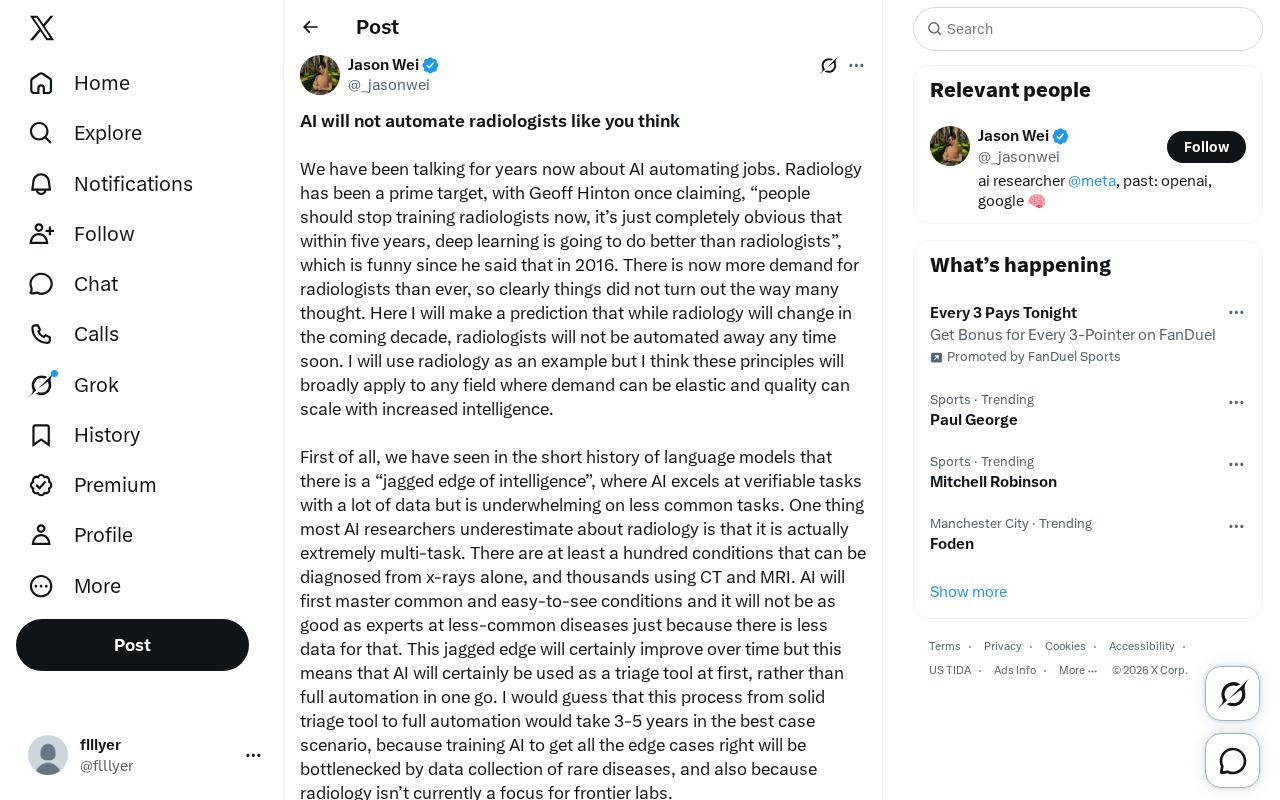
The value of this judgment extends beyond radiology. The author argues that any field where "demand is elastic and quality can scale with improvements in intelligence" will follow similar logic. Understanding this is more meaningful than debating "whether AI will take jobs."
The Jagged Edge of Intelligence: AI Will Do Triage First, Not Full Replacement
Radiology Is Multi-Task, Not Single-Task
Most AI researchers underestimate the complexity of radiology. An X-ray alone can diagnose at least a hundred diseases, while CT and MRI involve thousands. AI will first master common, easily identifiable conditions but will be far less capable than experts on rare diseases—for a simple reason: data on rare diseases is naturally scarce.
This is the "jagged edge of intelligence": AI excels at tasks with abundant data and verifiable outcomes but underperforms on low-frequency tasks. The author predicts that AI's first step in radiology will be as a triage tool, not one-time full automation. Moving from a reliable triage tool to full automation would optimistically take 3-5 years, with bottlenecks in collecting rare disease data and the fact that frontier labs are not currently focusing on radiology as a primary target.
Data Bottlenecks and Focus
This point is often overlooked: the speed of model capability improvement depends on the pace of data collection. Rare disease cases are scattered across hospitals and, constrained by privacy regulations and approval processes, are extremely difficult to aggregate. Even if algorithmic architecture advances rapidly, data-side limitations will still slow the pace of full replacement.
HIPAA (Health Insurance Portability and Accountability Act) is a federal law enacted in the United States in 1996, whose Privacy Rule sets strict regulations on the use and disclosure of protected health information (PHI). In AI medical imaging research, this means training data must be de-identified, and cross-institutional data sharing often requires signing business associate agreements or obtaining approval from an Institutional Review Board (IRB). An IRB is an independent committee that conducts ethical review of research involving human subjects, and its approval process typically takes months. While these regulations and processes protect patient privacy, they also significantly raise the threshold for multi-center, large-scale medical data aggregation, becoming an important non-technical bottleneck for AI's full deployment in radiology.
Elastic Demand: The Underestimated Counterforce to Automation
A Real-World Version of the Jevons Paradox
The author argues that elastic demand (the Jevons Paradox) is the most underestimated phenomenon when discussing AI automation. In software, this is already evident: with Claude Code, the author casually has it generate a three-thousand-line HTML viewer to visualize every reinforcement learning experiment—demand expands because costs decrease.
The same applies to radiology. If the marginal cost of interpreting an MRI approaches zero, doctors will tend to order more scans in advance to aid diagnosis. Suppose AI allows radiologists to read only 20% of admission scans, but total scan volume could grow fivefold—total workload may not decrease. In many developing countries, there are fewer than one radiologist per million people; once this suppressed demand is unleashed, it will further drive up overall reading volume.
The Jevons Paradox originates from 19th-century economist William Stanley Jevons's observation about coal consumption: when steam engine efficiency improved and the cost of using coal decreased, Britain's total coal consumption rose rather than fell. The reason is that efficiency gains lowered the resource cost per unit of output, stimulating larger-scale production and consumption, ultimately offsetting or even exceeding the resources saved per use. In discussions of AI and employment, this paradox means that increased automation and lower costs for a task do not necessarily reduce total human demand for that task; instead, total workload may increase because demand is unleashed and expanded. Radiology is a typical scenario for this logic—lower reading costs stimulate growth in scan volume, thereby maintaining or even driving up overall demand for radiologists.
Cheaper Scanners and Preventive Examinations
In the longer term, cheap and fast reading capability will create reverse incentives for scanning equipment to become cheaper. If MRI reading has almost no latency, equipment manufacturers will be motivated to develop cheaper, more frequently used MRIs, even for real-time intraoperative use. The author states bluntly: if a whole-body MRI cost only $100, he would be willing to do one monthly rather than once every two years. If radiology costs decrease by 10 to 100 times, people's scan frequency could increase by 10 to 100 times, mainly for preventive care.
Medicine Is Changing, and Problems Are Changing Too
New Treatments and New Scanners Create New Tasks
Even if a model surpassing top radiologists emerges someday, radiology work will not end. Medicine is a changing field: new treatment protocols may require interpreting images in ways current doctors are unfamiliar with; new scanners may reveal diseases that cannot be diagnosed by radiology alone today. Some radiologists' focus will shift from reading images to frontier research, translating new knowledge into updated models.
Higher Demands on AI
The author expects society will demand more from AI models—for example, using imaging to predict long-term disease probabilities. If prediction algorithms are good enough, cancer could be detected months earlier than now. Such research will attract substantial investment, in turn further driving demand for radiology and top-tier AI.
A triage tool in the radiology context refers to an AI system that performs preliminary priority sorting of images—for example, flagging suspected critical cases (such as pneumothorax or intracranial hemorrhage) as high priority for radiologists to read first, rather than directly providing a final diagnosis. The advantage of this model is that AI does not need to achieve expert-level comprehensive diagnostic capability; it only needs to perform reliably on specific high-frequency tasks to be embedded in existing clinical workflows, improving efficiency and reducing missed diagnosis risk. The triage positioning also fits the "jagged edge of intelligence" characteristic—AI performs excellently on common conditions with abundant data, while leaving rare and complex cases to human experts, forming a transitional form of human-AI collaboration.
System Inertia and Regulatory Reality
Healthcare systems typically adopt technology more slowly than tech companies, with heavier regulation, more legacy infrastructure, and medical centers that must continuously support patient operations, making integration of new technologies difficult. This is especially true in developing countries. Combined with restrictions such as HIPAA, de-identification, and IRB review, data access is naturally limited. These real-world factors mean radiologists will remain needed for a considerable time.
A More Promising Future
The author's conclusion is not pessimistic but rather more positive: the future demand for radiology will be greater and will require higher intelligent prediction capabilities. This is similar to the feeling in programming—despite dramatic changes, programming activity itself has flourished.
To be fair, Hinton also acknowledged in a recent podcast that his judgment back then was wrong and agreed with the elastic demand argument. This prediction correction spanning a decade reminds us: when discussing AI and employment, we cannot just look at "whether AI can do the job" but also at "how much humans will want once costs decrease." The latter question is often the decisive one.
One-line Summary
Radiology will not be rapidly automated by AI; elastic demand will drive up total workload rather than reduce employment.
Paragraph Summary
Using the failure of Hinton's decade-old prediction that "AI will surpass radiologists within five years" as a starting point, the article explores the relationship between AI and employment. The author points out that radiology is a multi-task field, AI is limited by rare disease data bottlenecks, and it will first land as a triage tool, with full automation optimistically taking 3-5 years. More critically, elastic demand (the Jevons Paradox): lower reading costs will stimulate exponential growth in scan volume, and total workload may not decrease; cheap reading will also inversely drive down scanner prices, with preventive examination demand potentially growing 10 to 100 times. Medicine itself is evolving, with new treatments, new equipment, and new prediction tasks continuously creating new work, and combined with regulation and system inertia, radiologists will remain needed for a considerable time.
Related articles

Chain of Thought Isn't Just for AI: How Humans Can Use CoT to Improve Thinking Quality
Chain of Thought isn't just a prompt trick for large models. Starting from a Hacker News discussion, this article analyzes why CoT works for human thinking too, breaks down actionable ways to transfer it, and highlights the key differences between human CoT and machine CoT.
Cloudflare Teams Up with OpenAI: Closi…
Cloudflare Teams Up with OpenAI: Closing the Loop from Vulnerability Discovery to Defense with AI
Cloudflare uses OpenAI Daybreak to investigate security vulnerabilities and generate reviewable remediation plans, while developers use Codex to boost coding efficiency and quality.

Orca Multi-Agent Orchestration in Practice: A Guide to Parallel Collaboration with Claude and Codex
Orca is Stable AI's free open-source agent workbench supporting 34 agents like Claude Code and Codex in parallel. Learn its Git worktree isolation, multi-model orchestration, and mobile management.