ai-worklog: A Local-First Tool for Tracking and Summarizing AI Coding Sessions
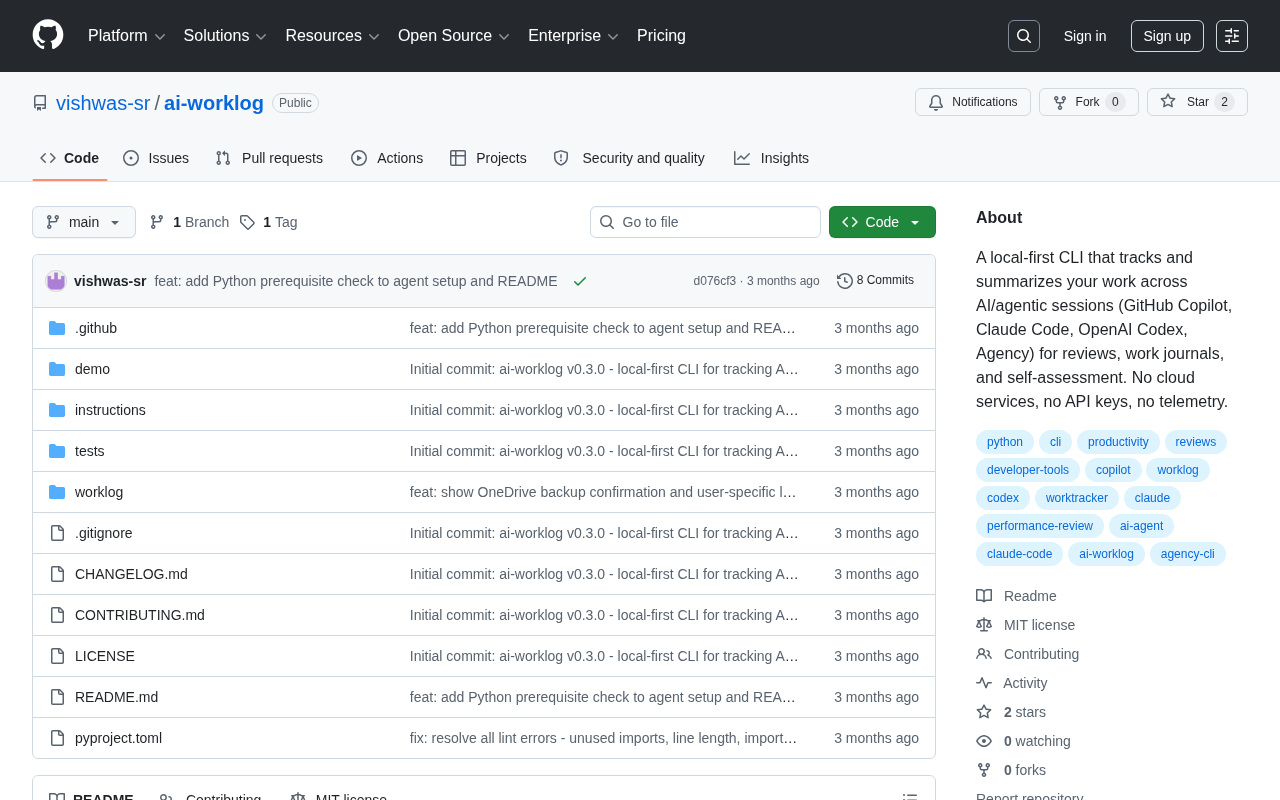
A local-first Python CLI that consolidates work logs across multiple AI coding assistants with full privacy.
ai-worklog is an open-source CLI tool designed to solve the fragmented work-record problem in the AI-assisted coding era. It aggregates session data from GitHub Copilot, Claude Code, OpenAI Codex, and more into structured summaries for performance reviews, work journals, and self-assessments. Its defining feature is a local-first architecture — all processing happens on-device with no cloud services, API keys, or telemetry. Currently at a very early stage (2 stars, 0 forks), it's more of a proof-of-concept than a production-ready tool, but it points to a real emerging need: as Agentic workflows proliferate, tracking the value of AI interactions will matter more and more.
A Work Logging Tool Built for the AI Coding Era
As more developers hand off their daily work to AI coding assistants like GitHub Copilot, Claude Code, and OpenAI Codex, a new problem has emerged: how do you systematically organize and review work records scattered across different tools and sessions? The open-source project vishwas-sr/ai-worklog aims to answer that question.
This is a local-first command-line tool written in Python. Its core function is to track and summarize your work across various AI/Agentic sessions, serving use cases like performance reviews, work journals, and self-assessments. The project's biggest selling point is right there in the description: no cloud services, no API keys, no telemetry.
What Problem Does It Solve
Now that AI-assisted programming has become the norm, a developer's work trail is increasingly fragmented. You might spend your morning using Copilot to autocomplete code, the afternoon having Claude Code refactor a module, and the evening using Codex to handle a script. By the time a weekly standup or quarterly review rolls around, it's hard to recall what meaningful work you actually accomplished.
ai-worklog is designed to fill exactly that gap. It aggregates session data across multiple AI tools — GitHub Copilot, Claude Code, OpenAI Codex, and Agency — and generates reviewable summaries. For developers who need to write weekly reports, prepare promotion materials, or do personal retrospectives, this kind of automated record-keeping can save a significant amount of manual effort.
Three Core Use Cases
The project description points to three primary scenarios:
- Performance reviews: Structurally present AI collaboration outcomes over a period of time as objective evidence for evaluations.
- Work journals: Automatically generate a daily activity log, replacing handwritten notes.
- Self-assessment: Help developers understand where their time goes and how their output is distributed.
The Design Trade-offs of Local-First
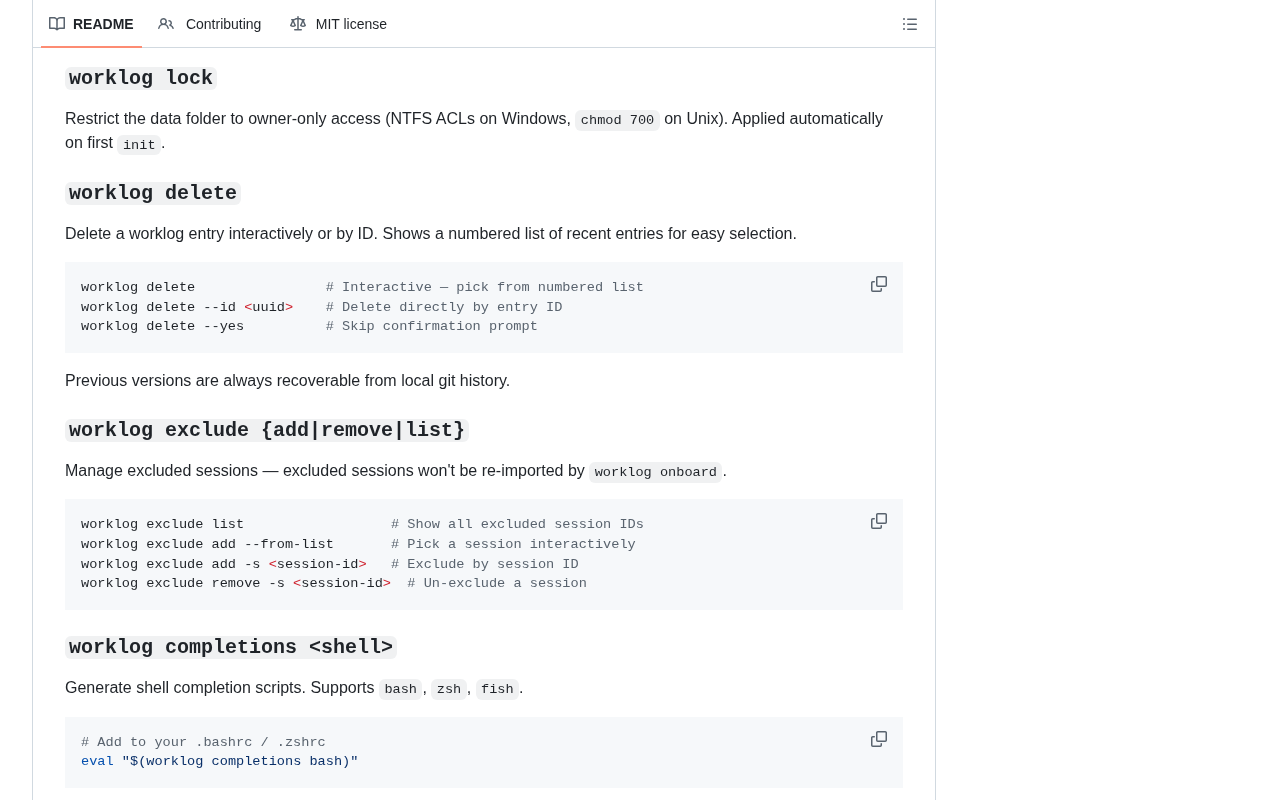
The "local-first" emphasis repeated throughout the project isn't marketing speak — it's a deliberate architectural choice. All data processing happens locally: nothing is uploaded to the cloud, no API keys are required, and no telemetry is collected.
This design is particularly appealing to a specific audience. Work content often involves proprietary code and sensitive information, and any solution that sends data to third-party servers risks running into compliance issues. Local-first means developers don't have to worry about work records being leaked or used to train models — a concrete advantage in enterprise environments.
Of course, local-first comes with trade-offs: capabilities like cross-device sync, team collaboration, and cloud backup are inherently absent and must be handled separately by the user. For privacy-conscious individual developers, this trade-off makes sense. For teams that prioritize collaboration, it may fall short.
"Local-first" is an important software design philosophy that has gained traction in recent years. It was systematically articulated by the Ink & Switch research team in their 2019 paper Local-First Software. The core argument is that a user's data should be stored primarily on their local device, the software should be fully functional without a network connection, and cloud sync should be an optional enhancement rather than a hard dependency. This philosophy partly emerged as a reaction to concerns about "data sovereignty" in the SaaS model — when a service provider shuts down or changes its terms, users often face data loss or restricted access. For tools like ai-worklog that handle potentially sensitive work content, a local-first architecture carries a practical compliance advantage: corporate security policies typically prohibit transmitting source code or work details to unapproved third-party services, and local processing naturally sidesteps that compliance risk.
Project Status and a Realistic Assessment
It's worth being transparent: this project is still in a very early stage. Based on GitHub data, it has only 2 stars and 0 forks, meaning community attention and real-world validation are both minimal. This implies:
- Feature maturity and stability have not been tested by a large user base;
- Documentation and community support may be limited;
- Long-term maintenance is uncertain.
In other words, ai-worklog is more of a proof-of-concept project with an interesting idea than a mature, reliable productivity tool. Its value lies in identifying a genuine need — personal work record management in the AI coding era — not in its current level of completion.
A Direction Worth Watching
Setting aside the project's early-stage status, the trend it represents is worth thinking about. As Agentic workflows become more widespread, developers will interact with multiple AI tools more and more frequently. How to quantify and preserve the value generated by those interactions will become a new tool category in its own right.
Whether for performance management, personal growth tracking, or team efficiency analysis, this kind of "AI work trail" data is likely to become increasingly important. ai-worklog takes a lightweight, privacy-respecting approach to tackling this problem. For developers who enjoy tinkering with CLI tools and care about data ownership, it's worth keeping an eye on how the project evolves. For those looking for a ready-to-use solution, a wait-and-see approach is probably more appropriate.
"Agentic workflows" refer to a mode in which an AI system operates as an autonomous agent executing multi-step tasks — distinct from traditional single-turn question-and-answer interactions. In Agentic scenarios, the AI autonomously plans subtasks, invokes tools, reads and writes files, executes code, and dynamically adjusts its strategy based on intermediate results. The entire process can span minutes or even hours, with human developers playing more of a supervisory role than a step-by-step guiding one. This mode significantly amplifies the problem of fragmented work records: a single Agentic session may span dozens of action steps involving multiple files and modules, making it difficult to reconstruct the full picture after the fact. This is precisely the underlying logic behind why tools like ai-worklog exist — when AI takes over a large portion of the execution-layer work, humans actually need more systematic tools to track "what AI did on my behalf."
Related articles
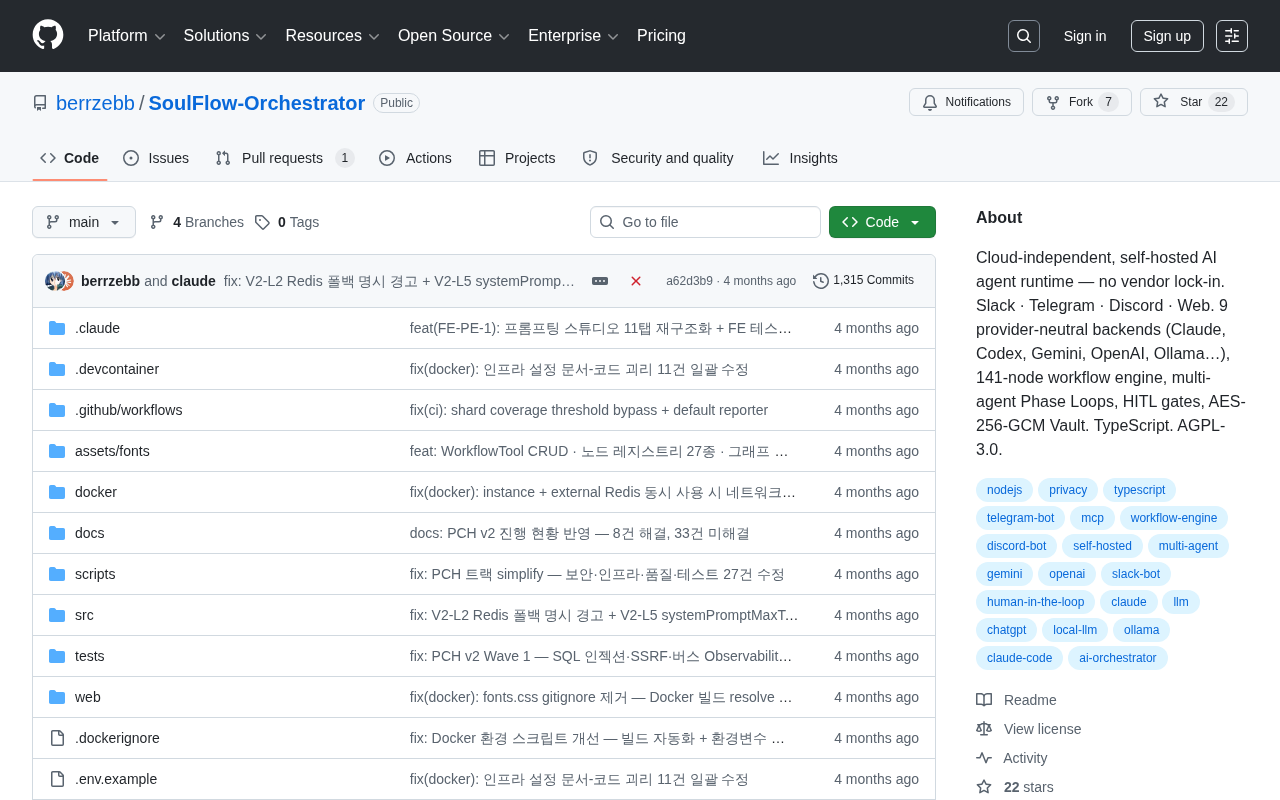
SoulFlow-Orchestrator: A Self-Hosted, Vendor-Lock-In-Free AI Agent Runtime
SoulFlow-Orchestrator is an open-source, self-hosted AI agent runtime with no vendor lock-in. Supports 9 neutral backends (Claude, OpenAI, Ollama), 141-node workflow engine, multi-agent loops, and HITL gates.
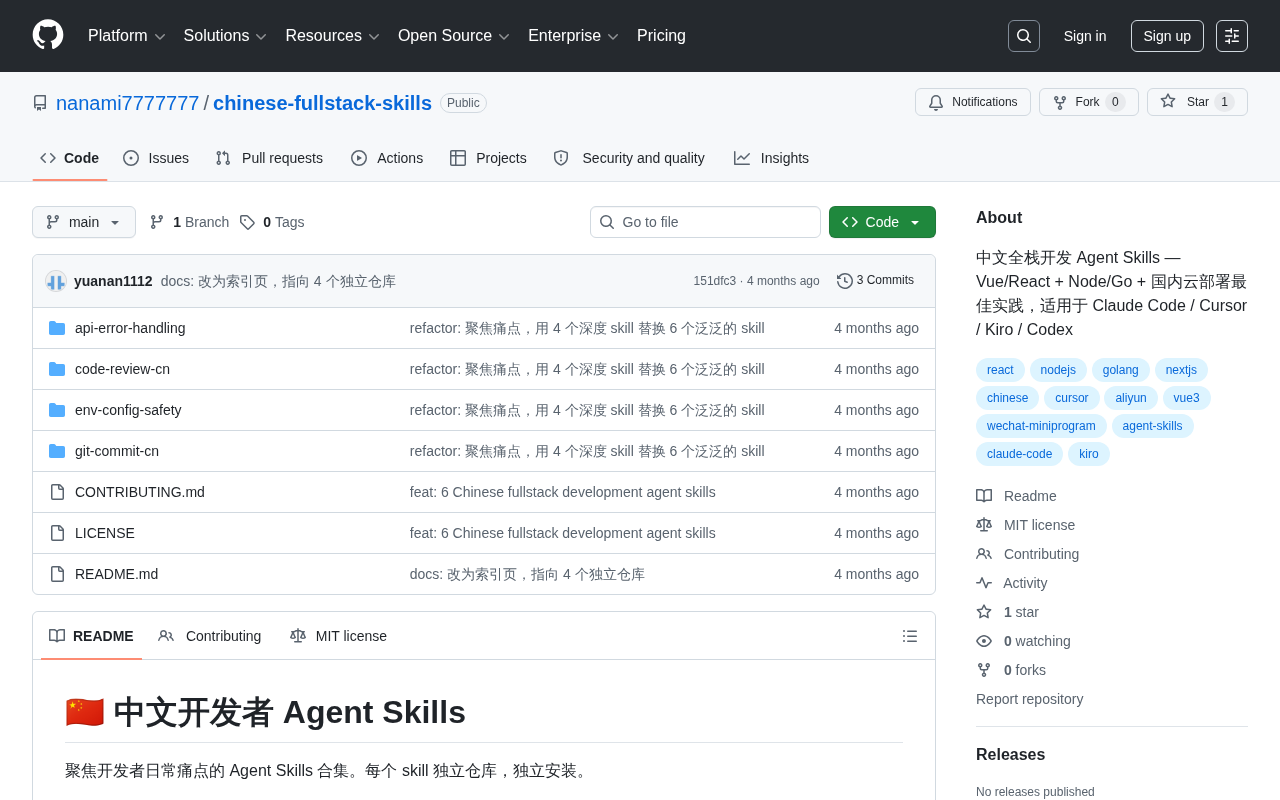
Chinese Full-Stack Agent Skills: A Skill Library Tailored for Domestic AI-Assisted Development
chinese-fullstack-skills is an Agent Skills library for Chinese full-stack development, covering Vue/React, Node/Go, and domestic cloud deployment best practices. Compatible with Claude Code, Cursor, Kiro, and Codex.
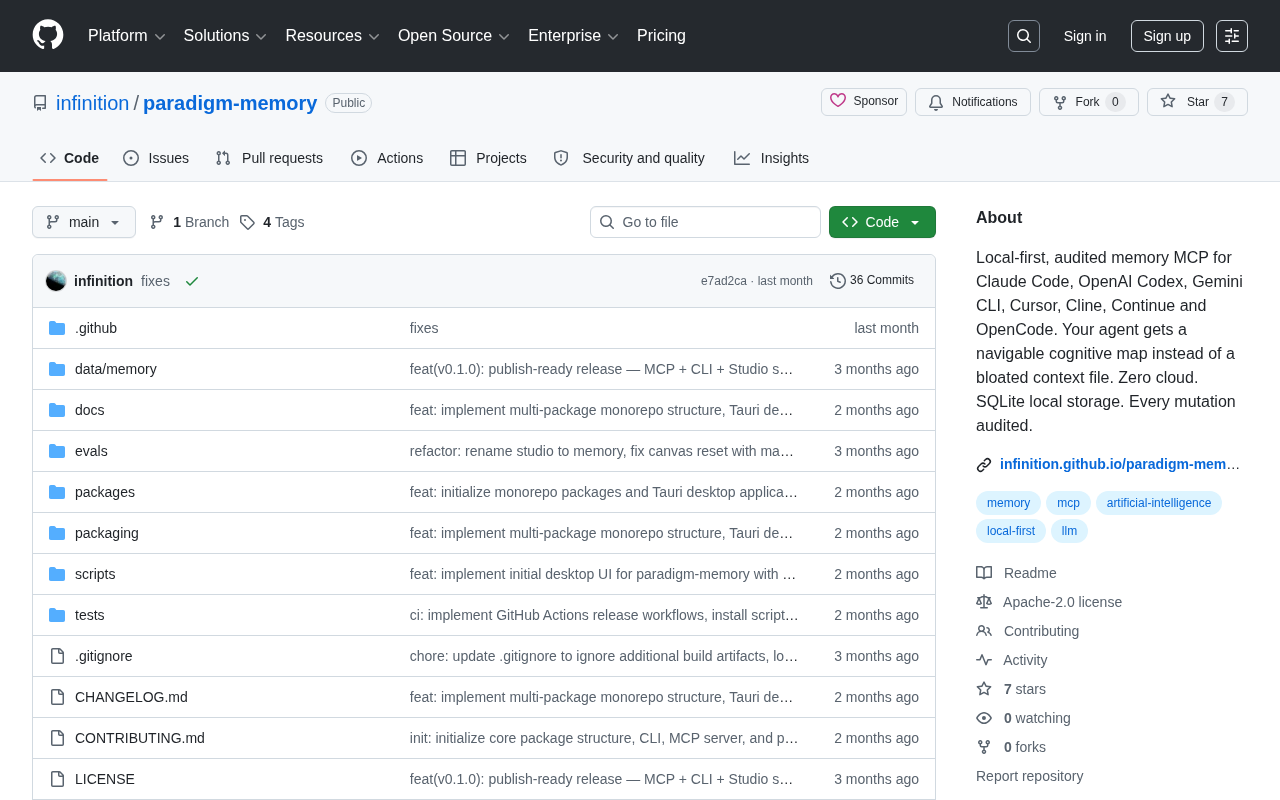
Paradigm Memory: A Local-First Memory System for AI Coding Assistants
paradigm-memory is a local MCP memory tool for Claude Code, Cursor, and Cline. It uses SQLite local storage, zero cloud, full audit trails, and a navigable cognitive map instead of bloated context files.