AI World Cup Legacy Bug Challenge – Group C Round 1: Grok 4.6 Edges Out Kimi K3

Grok 4.6 beats Kimi K3 5:3 in a tiered bug-fixing showdown among four top LLMs.
The AI World Cup Legacy Bug Challenge pitted Kimi K3, Grok 4.6, DeepSeek V4 Pro, and Step 3.7 Flash against three progressively harder code-fix tasks. All four passed the Silver round, but Grok 4.6 pulled ahead with a first-try Gold fix, then held steady on the complex AOP-caching Diamond Bug. Step 3.7 Flash repeatedly underestimated problem complexity and was eliminated. Final result: Grok 4.6 defeats K3 5:3; DeepSeek V4 Pro edges out Step 3.7 Flash. Key insight: consistency and deliberate planning matter more than raw speed in complex debugging scenarios.
A Fresh Take on AI "Legacy Bug" Battles
The "AI World Cup Legacy Bug Challenge" is essentially a head-to-head benchmark experiment that evaluates the coding capabilities of leading large language models through a competitive, gamified format. The rules are straightforward: each "contestant" (i.e., a large model) receives a series of bug-fixing tasks of increasing difficulty, and the goal is to correctly resolve each issue within a limited number of attempts. This sports-style framing turns what would otherwise be a dry model capability test into genuinely engaging viewing.
The four competitors in Group C this round are: Kimi K3, Grok 4.6, DeepSeekAd V4 Pro (affectionately nicknamed "Whispr Meat" in the video), and Step 3.7 Flash. The matchups are K3 vs. Grok 4.6, and DeepSeek V4 Pro vs. Step 3.7 Flash. All contestants had their reasoning/thinking modes set to maximum to showcase each model's peak performance.
Three problems were presented in ascending difficulty: a Silver Bug (S003 — one attempt, 1 point for a correct fix), a Gold Bug (G003 — two attempts, 1–2 points), and a Diamond Bug (D001 — three attempts, 1–3 points). The Diamond problem was singled out as the toughest — it "combines business logic, caching, and AOP aspect concerns" in a classic complex-coupling scenario.
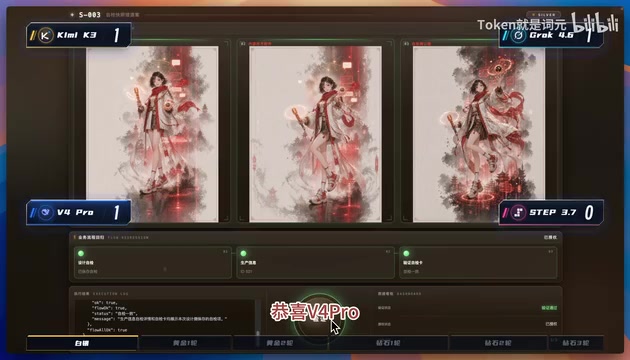
Silver Bug: All Four Contestants Pass
The first Silver-tier question was relatively straightforward, testing each model's ability to quickly locate and patch a simple defect. All four contestants submitted their answers within 10 minutes, though there was a small surprise in the timing: Grok 4.6 — famous for its "Mars-speed" processing and constant emphasis on "Plan" — was actually the slowest this round at 9 minutes and 32 seconds. Step 3.7 Flash, known for its calm demeanor and habit of drafting a To-Do List first, came in fastest at 4 minutes and 26 seconds. DeepSeek V4 Pro finished in 5 minutes and 37 seconds, while Kimi K3 took 7 minutes and 44 seconds.
The verification phase held no surprises — all four contestants answered correctly and each scored one point. The universal pass on the Silver Bug confirms that today's mainstream large models have largely matured when it comes to basic code repair. As the commentator quipped: "All four contestants succeeded on the first half — which means nobody really succeeded yet." The real drama was only just beginning with the Gold question.
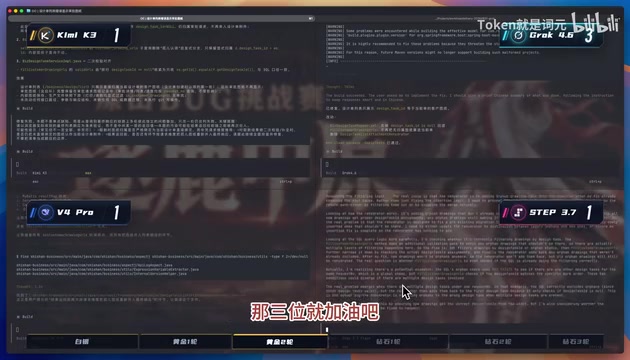
Gold Bug: Scores Begin to Diverge
The Gold question brought a sharp jump in difficulty, and the contestants' performances began to split. Step 3.7 Flash stuck to its routine of drafting a To-Do List and even spun up two sub-agents, signaling that it recognized the problem's complexity. DeepSeek V4 Pro reasoned entirely in Chinese — its thought process was described as "hard to follow" — but its logic was structured.
In the first verification round, only Grok 4.6 nailed it on the first try, immediately banking two points and demonstrating remarkable consistency. The other three — K3, V4 Pro, and Step 3.7 — all "hit the post" and failed to pass. In the second repair attempt, DeepSeek V4 Pro succeeded and earned one point, while Kimi K3 and Step 3.7 Flash exhausted both of their chances without a successful fix, walking away from the Gold round empty-handed.
After this round, the scores had diverged sharply: Grok 4.6 at 3 points, DeepSeek V4 Pro at 2, Kimi K3 at 1, and Step 3.7 at 1. The commentator openly noted this was "not what you'd normally expect," particularly given the high expectations surrounding K3. Notably, starting from the second round of group play, the organizers also began including each contestant's current score in the prompt, attempting to observe whether score-based pressure influences model behavior.
Diamond Bug: The Ultimate Test of Complex Coupling
The Diamond Bug was the hardest challenge of the session — involving tightly coupled AOP aspects, caching mechanisms, and intricate business logic, making it highly deceptive. In the first round, the speed gap between contestants was dramatic: Step 3.7 Flash submitted its answer in just 2 minutes, and this time it didn't write a To-Do List — a detail the commentator flagged as "a bad sign," most likely indicating it had misread this brutal problem as a simple one.
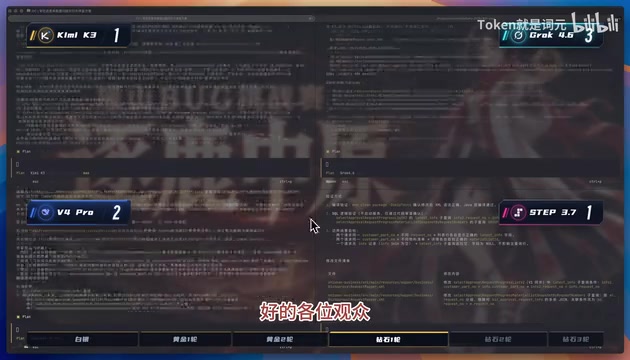
The first-round verification confirmed the prediction: all four contestants failed. This is par for the course with complex coupling bugs. The second round became the turning point: Kimi K3 spent 8 minutes and, leveraging its "2.8 trillion parameter" foundation, successfully fixed the bug and scored two points. Grok 4.6 took 25 minutes and also answered correctly, locking in its lead. DeepSeek V4 Pro (29 minutes) and Step 3.7 Flash (just 1 minute and 20 seconds) both failed in round two — Step 3.7's remarkably short response time once again exposed a serious underestimation of the problem's complexity.
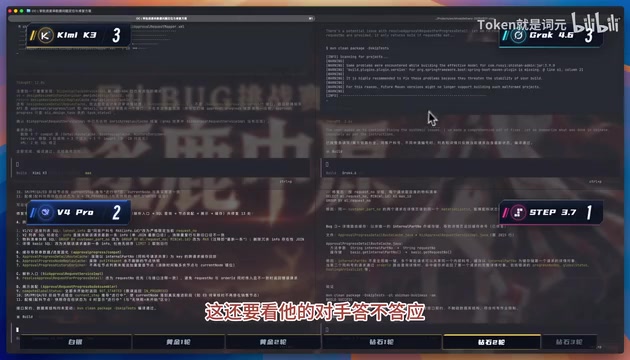
In the bonus third repair round, DeepSeek V4 Pro took roughly 20 minutes to finally crack the Diamond Bug, earning one more point and finishing with a balanced scorecard of one goal each in Silver, Gold, and Diamond. Step 3.7 Flash "hit the post" one final time and was eliminated from contention.
A quick note on AOP: AOP (Aspect-Oriented Programming) is a programming paradigm that separates cross-cutting concerns — such as logging, authorization, transactions, and caching — from core business logic, managing them in a centralized way. In the Java/Spring ecosystem, AOP aspects typically intercept method calls via annotations or configuration, injecting additional logic before or after method execution. When AOP aspects and caching mechanisms coexist, they can easily produce subtle coupling issues around execution order, proxy objects, and cache key generation. For example, an aspect might return early on a cache hit, causing certain business validations to be bypassed; or the timing of cache writes may be inconsistent with transaction boundaries defined by aspects, leading to data inconsistencies. What makes this class of bugs so deceptive is that each component behaves correctly in isolation — the bug only surfaces when all three interact on the same request path, making it nearly impossible to catch through static code review alone. Accurate diagnosis requires a holistic understanding of the entire call chain.
Final Results and Takeaways
Final Group C standings for this round: Grok 4.6 defeats Kimi K3 by 5:3; DeepSeek V4 Pro beats Step 3.7 Flash on aggregate points. Grok 4.6 and V4 Pro each earn 2 points in the standings, while Kimi K3 and Step 3.7 Flash earn 0.
A few interesting observations emerge from this matchup. First, basic coding capability has become table stakes for mainstream models — the universal Silver-tier pass shows that simple bug fixes no longer differentiate the field. Second, consistency beats raw brilliance — Grok 4.6's first-try Gold fix and steady Diamond performance showed no significant errors throughout, embodying what the commentator repeatedly emphasized: "staying consistent across the whole season is what takes you far." Third, Step 3.7 Flash's stumble reveals a fascinating model behavior: submitting an answer too quickly often signals a fundamental misread of the problem's complexity, while deliberate planning — To-Do Lists, sub-agents — turns out to be a prerequisite for success on complex tasks.
A word of caution: this kind of gamified, anthropomorphized benchmark is primarily an entertaining comparative exercise, and results from a single match cannot fully represent a model's true engineering capabilities. Sample size, problem design, and prompt engineering all influence outcomes, as the commentator acknowledged: "One match's result doesn't prove much of anything." That said, as a window into how different large models perform when confronted with genuinely complex, real-world bug scenarios, this kind of comparison still offers meaningful reference value.
Related articles

Workbuddy for Absolute Beginners: How a Desktop AI Agent Fits Into Real Workflows
A beginner's guide to the Workbuddy desktop AI agent: installation, claiming credits, file management, and building automated workflows—compared with CodeX for fit and cost, helping professionals shift from AI question-askers to AI managers.

OpenAI's New Agent Stack: Computer Use, Decisions API, and Ultra-Fast Workflows
OpenAI Dev Day unveiled a new agent stack: Computer Use outperforms humans, Decisions API delivers ultra-low-latency classification via Luna, Agents API opens the same Computer Use capabilities, and GPT-6.1 Sol costs only one-seventh of Astra. Core updates, benchmark data, and developer insights.

Liang Wenfeng Open-Sources DeepInfo Inference Framework, Takes On U.S. Ban
DeepSeek open-sources its DeepInfo inference framework after its models, featuring GPU/CPU cross-pipelining, small-model prediction with large-model verification, and full Huawei Ascend and NVIDIA chip support—facing the U.S. federal ban head-on. This article analyzes its significance for AI deployment and open-source strategy.