AI Writes Better Code Than You — Should Programmers Still Code by Hand or Let Go?

Exploring how programmers should balance AI-assisted coding with maintaining hands-on skills and higher-level judgment.
As AI coding assistants like Claude increasingly produce code that surpasses what individual developers write, programmers face a new dilemma: embrace AI for productivity while risking skill atrophy, or resist and fall behind. This article argues the answer lies in shifting value upward — from writing code to defining problems, making architectural decisions, and exercising human judgment that AI cannot replicate.
An Increasingly Common Dilemma
Recently, a developer posed a question on Reddit that resonated widely: When AI often writes better code than you can yourself, what's the point of writing code by hand?
This engineer admitted that since gaining access to Claude at work, he barely writes code from scratch anymore — especially for ad hoc data analysis or quick charting tasks. He still reviews every line and makes sure he understands the logic, but what unsettles him is that Claude's generated code "is often better than what I'd write myself." When this happens repeatedly, "you can't help but wonder what the point of writing code yourself even is."
AI coding assistants like Claude are built on large language models (LLMs) that have been pre-trained on massive codebases and technical documentation, learning programming language syntax patterns, common algorithm implementations, and software design paradigms. The reason these models can generate high-quality code is that they're essentially performing statistical learning on the code output of millions of excellent developers — what they produce is a probabilistic synthesis of best practices. This also explains why AI-generated code "is often better than what an individual would write": it draws not from one person's experience, but from the collective wisdom of the entire open-source community. At the same time, this means their capabilities drop significantly when facing unprecedented problems or scenarios requiring creative breakthroughs.
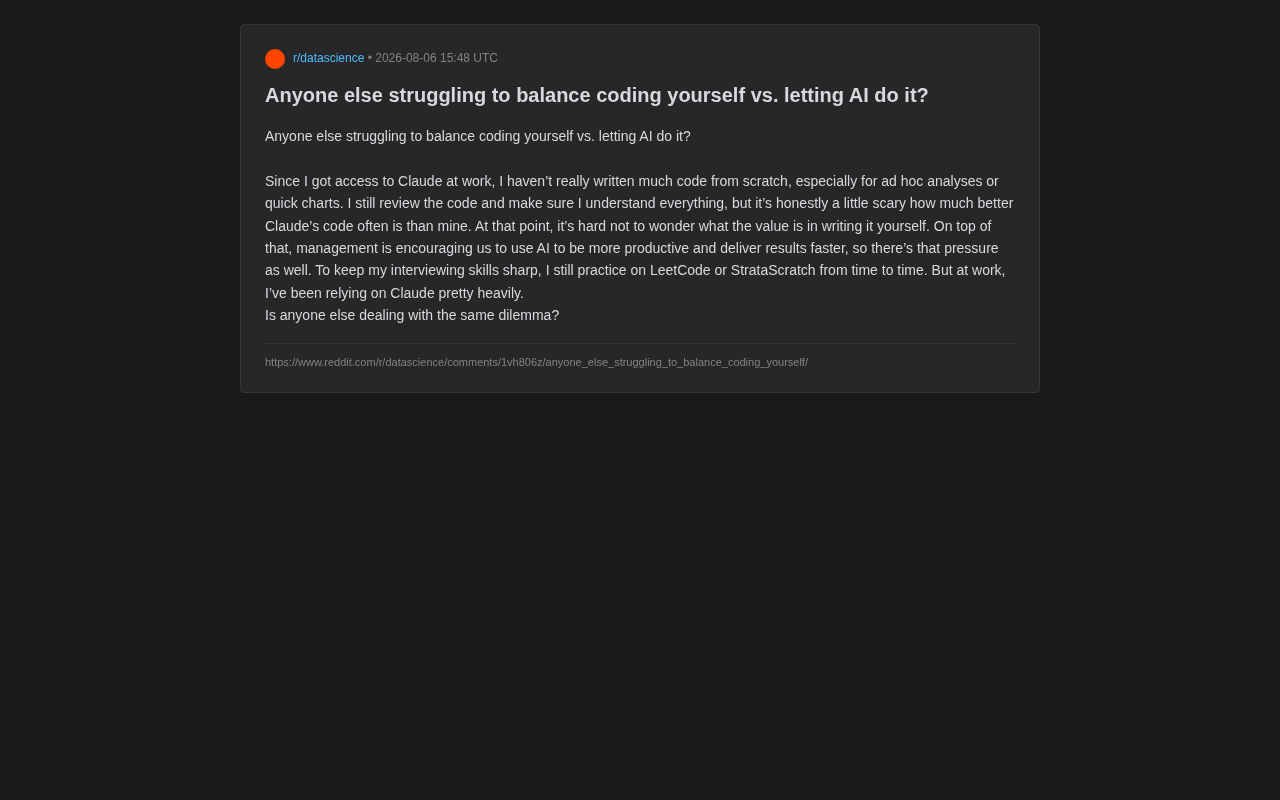
What makes this shift even more nuanced is that it's not entirely voluntary. Management is actively encouraging teams to use AI for efficiency and faster delivery, which means "not using AI" has essentially become a form of falling behind. Programmers are being pushed toward a new equilibrium: making trade-offs between productivity and personal skill growth.
Why This Concern Deserves Serious Attention
This isn't a trivial complaint — it's a real signal that the structural role of software engineers is changing.
The Hidden Worry of Skill Atrophy
This developer mentioned that to stay competitive in interviews, he still occasionally practices algorithm problems on LeetCode or StrataScratch. This detail is telling — it hints at a disconnect: relying on AI coding assistants at work while needing deliberate practice on the side to maintain "raw coding ability."
LeetCode is the world's largest online algorithm practice platform, with over 3,000 programming problems covering core computer science areas like data structures, dynamic programming, and graph theory — it's practically the standard preparation tool for tech company interviews. StrataScratch focuses on data science and SQL problems, simulating real-world data analysis interview scenarios. What these platforms share is that they require developers to solve problems from scratch without external tools — a stark contrast to the daily experience of AI-assisted coding. The fact that developers need to switch between these two radically different working modes itself speaks to the misalignment between current industry evaluation systems and actual work practices.
This is precisely the hidden concern many developers share. When you stop deriving logic by hand for extended periods, when you no longer build from a blank file, does that intuition and command over code's underlying mechanics quietly slip away? It's like people who rely on GPS navigation for too long — they may gradually lose their sense of direction within a city's road network.
"Understanding Code" and "Writing Code" Are Two Different Things
Interestingly, this engineer emphasized that he "still reviews the code and makes sure he understands every part." This is actually a healthy sign. In the era of AI-assisted programming, the mechanical labor of writing code can be outsourced, but the responsibility of understanding, verifying, and judging cannot be outsourced.
The real risk isn't in letting AI write code — it's in "accepting AI output without scrutiny." The former is reasonable tool usage; the latter is where skill atrophy truly begins.
Redefining the Programmer's Core Value in the AI Era
Facing this dilemma, rather than agonizing over "should I write it myself," it's better to rethink the programmer's value coordinates in the AI era.
From "Writing Code" to "Defining Problems"
AI excels at executing well-defined tasks — given clear requirements, it can quickly generate decent implementations. But what it struggles with is: deciding what to do, why to do it, and whether a piece of code makes sense within the broader system.
Handing off ad hoc charts and one-off analyses to AI makes perfect sense because these tasks have clear boundaries and manageable consequences. The term "ad hoc" comes from Latin, meaning "for this purpose." In the data analysis domain, it refers to one-time data queries and analyses conducted for specific questions, rather than being part of regular reports or production pipelines. These tasks typically have well-defined inputs and outputs, short lifecycles, and relatively relaxed code quality requirements — precisely because of their "use and discard" nature, delegating such work to AI represents the lowest-risk use case.
But architectural decisions, trade-off evaluations, requirements clarification, cross-system impact assessment — these are the true moats of senior engineers, and the areas AI currently struggles to replace. System design involves decisions like how to decompose a large software system into manageable components, how to balance consistency versus availability (such as the CAP theorem in distributed systems), and how to design API boundaries that allow systems to evolve — all highly context-dependent decisions. These require understanding business constraints (budget, team size, launch timeline), technical constraints (existing infrastructure, data scale, latency requirements), and organizational constraints (team collaboration patterns, operational capabilities). AI models lack the ability to perceive these implicit constraints and cannot bear responsibility for decision consequences — a bad architectural decision might not surface until a year after launch, by which point the cost of refactoring has become prohibitively high.
Productivity Gains Are the Trend — Don't Fight It
Management pushing AI adoption for efficiency isn't a bad thing. Historically, compilers, IDEs, high-level languages, and open-source libraries have each "replaced" some portion of a programmer's work, yet programmers' overall value hasn't declined — instead, they've taken on increasingly complex problems.
Looking back at the evolution of software development tools, it's actually a history of continuous abstraction. In the 1950s, programmers wrote machine code directly; assembly language replaced manual binary instruction encoding; high-level languages like FORTRAN and C further liberated programmers from low-level hardware details. In the 1990s, integrated development environments (IDEs) like Visual Studio dramatically improved development efficiency through auto-completion, debuggers, and project management features. After the 2000s, open-source ecosystems and package managers (like npm and pip) meant developers no longer needed to reinvent the wheel. Each time the abstraction level rose, it was accompanied by anxiety about "whether programmers would become obsolete" — but the actual result was that software systems became more complex, and demand for engineers increased rather than decreased. Only the skill level required kept moving upward.
AI coding assistants are likely the next node on this curve. The key is: invest the time AI saves into areas that truly require human judgment, rather than letting yourself become a mere "reviewer" who copy-pastes AI output.
Practical Advice for Similarly Conflicted Programmers
Based on this developer's situation, here are some pragmatic balancing strategies:
- Decide by context: Boldly hand off ad hoc analyses, boilerplate code, and repetitive tasks to AI; maintain hands-on involvement for core business logic, complex algorithms, and critical architecture.
- Maintain the habit of "reading and understanding": No matter how well AI writes, you should be able to explain the intent and potential issues of every line. Review capability itself is a higher-order skill.
- Don't abandon deliberate practice: Like maintaining a LeetCode habit, regularly challenge yourself to solve problems without AI to keep your fundamental coding skills active.
- Migrate your capabilities upward: Proactively take on work that AI does poorly — system design, requirements decomposition, performance tuning, and code quality governance.
- Beware the "comfort trap": When you find yourself completely unable to complete tasks without AI, that's a signal you need to actively practice.
Conclusion
This Reddit developer's confusion is essentially the collective adjustment the entire industry is going through. AI writing better code than you doesn't mean your value drops to zero — it means your value coordinates are shifting upward — from "how to implement" to "what to implement, why to implement it, and whether it's correct."
The ones who will truly be left behind aren't "programmers who use AI" or "programmers who don't use AI" — they're those who have both abandoned hands-on ability and failed to develop higher-level judgment. Finding the balance between letting go and maintaining control may well be this era's new requirement for every engineer.
Related articles

Chain of Thought Isn't Just for AI: How Humans Can Use CoT to Improve Thinking Quality
Chain of Thought isn't just a prompt trick for large models. Starting from a Hacker News discussion, this article analyzes why CoT works for human thinking too, breaks down actionable ways to transfer it, and highlights the key differences between human CoT and machine CoT.
Cloudflare Teams Up with OpenAI: Closi…
Cloudflare Teams Up with OpenAI: Closing the Loop from Vulnerability Discovery to Defense with AI
Cloudflare uses OpenAI Daybreak to investigate security vulnerabilities and generate reviewable remediation plans, while developers use Codex to boost coding efficiency and quality.

Orca Multi-Agent Orchestration in Practice: A Guide to Parallel Collaboration with Claude and Codex
Orca is Stable AI's free open-source agent workbench supporting 34 agents like Claude Code and Codex in parallel. Learn its Git worktree isolation, multi-model orchestration, and mobile management.