AI Writes the Code, But Engineers Still Need to Understand It: Sourcegraph Report Analysis

As AI takes over coding, engineers' core value shifts to understanding, reviewing, and gatekeeping code.
Sourcegraph's 2026 Big Code report surveyed 1,028 software development leaders on code comprehension and review amid rising AI-generated code. AI speeds up generation, but the bottleneck shifts from writing to understanding. Reviewing AI code is harder since intent must be reverse-engineered and checked against overall architecture. Engineers shift from authors to reviewers and gatekeepers, making holistic codebase cognition a scarcer skill.
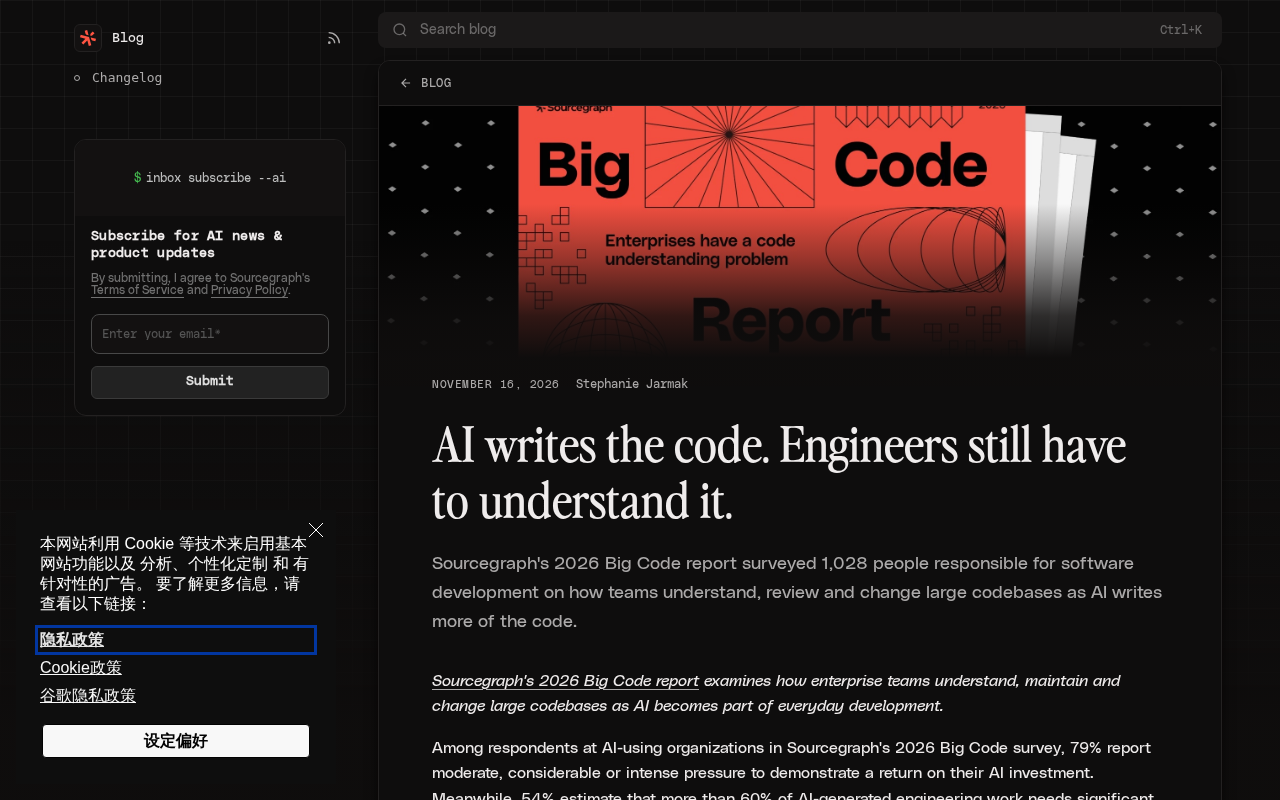
AI is taking over more and more coding work, but that doesn't mean engineers can stand on the sidelines. Sourcegraph's 2026 Big Code report surveyed 1,028 professionals responsible for software development, and the core conclusion is clear: AI can write code, but the responsibility for understanding, reviewing, and modifying it still falls on humans.
Code Volume Surges, Comprehension Becomes the New Bottleneck
When AI takes on the primary role in code generation, the first change teams face isn't "writing less code" but "reading more code." The report focuses on how teams understand, review, and change large codebases—and this framing itself tells the story: once generation speed increases, the bottleneck shifts from "being able to write it" to "being able to understand it."
Reviewing AI-generated code is fundamentally different from reviewing a colleague's code. Human colleagues' code comes with traceable intent and context, whereas AI output often requires reverse-engineering—why it was written this way, whether boundary conditions are covered, whether it's consistent with the existing architecture. The engineer's role thus migrates from "author" to "reviewer and gatekeeper," and a grasp of the codebase's overall structure becomes more critical than the speed of hand-writing code.
Large Codebase typically refers to a collection of code reaching millions of lines, maintained by multiple teams over the long term through collaboration, containing extensive cross-module dependencies and historical legacy decisions. Its core complexity lies not in the logic of any single file, but in implicit architectural conventions, coupling between modules, and technical debt that accumulates over time. Code search and intelligence tools like Sourcegraph are designed for exactly this kind of codebase, helping engineers quickly locate symbols, trace call chains, and assess the blast radius of changes when they can't read through all the code. The ability to understand large codebases thus becomes the key competitive differentiator for engineers in the AI era, setting them apart from code generation tools.
Code Review Challenges Under AI Assistance
The report surveys people who are responsible for large codebases, and this positioning is worth noting. The complexity of a large codebase lies not in the logic of individual files but in cross-module dependencies, implicit conventions, and legacy decisions. An AI-generated code snippet may be locally correct yet create friction with the overall architecture.
Such problems are hard for automated tools to fully catch. Reviewers need sufficient domain knowledge to judge "whether this code belongs here," and that judgment comes precisely from long-term understanding of the codebase. In other words, AI lowers the barrier to writing code but raises the barrier to understanding it.
Mental Model in the software engineering context refers to the internal cognitive representation an engineer forms of system structure, module responsibilities, data flows, and key constraints. It is not line-by-line memorization of code but an abstract understanding of "how the system works," enabling engineers to predict the cascading effects of changes and judge whether code is placed in the right location. AI generating code lacks this mental model and can only output based on local context; if the reviewer lacks a mental model of the codebase, it's difficult to identify changes that look correct but violate the overall architecture. Therefore, maintaining and transferring mental models—through documentation, review discussions, and pair work—becomes an area teams must deliberately invest in under AI-assisted development.
The Shifting Role of Engineers
Judging from the questions the report focuses on, teams are redefining where engineer value lies. Coding speed is no longer the sole metric; the ability to quickly locate the blast radius of changes, assess the reliability of AI output, and build mental models within vast codebases has become a scarcer skill.
This also affects how teams collaborate. Code review processes need to adapt to the pace and characteristics of AI-generated content, and knowledge transfer methods must adjust accordingly—newcomers face not only human colleagues' coding styles but also a large volume of AI output, and the structure of comprehension costs has changed.
Change Impact Analysis is the engineering practice of assessing which modules, tests, and downstream systems a code modification will affect. In scenarios with high-frequency AI code generation, the number of submissions per commit increases and sources become more diverse, significantly raising the importance of impact analysis: a locally correct AI patch may break implicit interface contracts or trigger uncovered boundary paths. Traditionally this work relies on static analysis tools and test coverage, but semantic impact across modules still requires engineers to judge based on their understanding of the codebase. The ability to quickly and accurately define the boundaries of change directly determines whether the net benefit of AI-assisted development is positive or negative.
Implications for Teams
The report doesn't offer simple answers, but it lays out the problem clearly: the higher the proportion of code written by AI, the more organizations cannot afford to skimp on investing in "understanding code." Tools can accelerate generation but cannot replace engineers' judgment about the system. Treating review capability and codebase cognition as core competencies to build may be the most practical message this survey conveys.
This Sourcegraph report is based on a survey of 1,028 development leaders, a data scale sufficient to reflect industry trends. The relationship between AI and engineers is not replacement but a re-division of labor—machines handle output, humans handle understanding and gatekeeping.
One-line Summary
As AI takes over coding, engineers' core value shifts to understanding, reviewing, and gatekeeping code.
Paragraph Summary
Sourcegraph's 2026 Big Code report surveyed 1,028 software development leaders, focusing on code comprehension and review issues amid the rise of AI-generated code. The core conclusion: AI accelerates code generation, but the bottleneck shifts from "being able to write it" to "being able to understand it." Reviewing AI-generated code is harder than reviewing human code because it requires reverse-engineering intent and judging consistency with the overall architecture. The engineer's role thus migrates from author to reviewer and gatekeeper, and holistic cognition of large codebases becomes a scarcer capability. The report recommends teams build review capability and codebase cognition as core competencies rather than expecting tools to replace engineers' judgment about the system.
Related articles

Prompt Engineering for Beginners: From Writing Prompts to Engineering Thinking
Starting from the essence and four functions of prompts, this article systematically explains the six-step process, four success criteria, learning value, and practical limitations of prompt engineering to help you build a complete understanding.

Anthropic Launches Nasdaq IPO: AI Giant's Listing and Risk Disclosures
Anthropic officially launches its Nasdaq IPO under ticker ANT, with market valuation expected to potentially exceed SpaceX's record. The prospectus devotes nearly 100 pages to AI risks, while first-half revenue grew over 14x but net losses widened sharply, reigniting the AI bubble debate.

Rust cURL Clone Uses 4,832 unsafe Blocks—Is the Memory Safety Myth Broken?
A Rust cURL clone uses 4,832 unsafe keywords, challenging Rust's memory safety narrative. We analyze what unsafe really means, compare Fil-C, and examine rewrite motives.