AI Writes Your Code—Do You Still Need to Learn Git? Five Reasons

In an era when AI agents handle Git operations, humans still need to learn Git: for communication, review, fallback, and fun.
The article argues that even though AI coding agents can auto-commit code, open PRs, and resolve merge conflicts, learning Git by hand remains necessary for five reasons: mastering terminology to communicate and participate in technical decisions; reviewing agent PRs and judging whether operations are reasonable; reading commit records and diffs to supervise agents and stop problems before merge; retaining manual fallback capabilities for branch switching, rollback, and conflict resolution when AI services are interrupted; and the sense of participation and enjoyment that understanding brings. It concludes that in the agent era, the focus of learning Git is shifting from command proficiency to conceptual clarity and review judgment, making the barrier lower.
AI coding agents can already auto-commit code, open PRs, and resolve merge conflicts, so many people are starting to wonder: is it still necessary to learn Git by hand? A YouTube creator's answer is a firm yes, and the reasoning is refreshingly down-to-earth—he even compares learners to a "meat suit backup" who steps in when the AI goes on strike.
Reason One: You Need to Know What You're Talking About
The most direct reason is communication. Even if all day-to-day Git operations are handled by an agent, you'll still be talking with your manager, colleagues, and other vibe-coding peers. If you don't understand words like "branch," "merge," and "PR," the conversation simply can't happen.
This isn't about being able to type every command—it's about grasping the terminology and the basic mental model. An agent can execute, but reporting, discussing plans, and assessing risk still fall to humans. Knowing what you're talking about is the minimum bar for participating in technical decisions.
Reason Two: Understand What the Agent Is Doing
The second reason has a bit of a joking tone—"make the agent look up to you." But behind it is real value: only when you're familiar with Git can you judge whether the agent's operations are reasonable.
When an agent opens a PR, you can click in and check whether the scope of changes, commit granularity, and branching strategy are clear. Someone who doesn't know Git can only watch the show; someone who does can spot problems at a glance. This review ability directly determines whether you're the agent's supervisor or just a bystander.
PR (Pull Request) is a mechanism on Git collaboration platforms (like GitHub, GitLab) for requesting that changes from one branch be merged into a target branch. A PR usually contains a set of commits, a diff of the changes, a discussion area, and CI check results. Reviewers can comment line by line on the PR page, request changes, or approve the merge. For an AI agent, a PR is the standard unit of work delivery: it creates a branch, commits code, opens a PR, and waits for human review. So "reading a PR" actually involves multiple layers—looking at the diff to judge what changed, looking at commit granularity to judge whether the changes are atomic, and looking at branch naming and target branch to judge whether the process is standard. Someone who knows Git can complete this scan in seconds; someone who doesn't can only rely on the agent's own description—and that description may well conceal problems.
Reason Three: Keep an Eye on Every Agent Operation
"Monitor your agent" is the most vivid item in the video: see exactly what code it changed, dig up that terrible PR, and maybe even tease it a little.
It sounds like a joke, but it points to a serious issue—AI-generated code needs human oversight. Git history is the best audit trail: who changed what, when, and why. Only if you can read commit records and diffs do you have the ability to stop problems before code is merged.
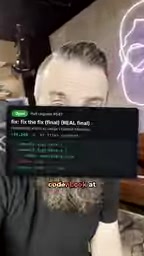
diff is the format used in version control to represent the differences between two versions of a file, marking additions and deletions with +/- lines. Git's git diff can compare the working tree against the staging area, two commits, or two branches. The diff is the basic unit of code review: it is line-precise and shows several lines of context, letting people judge whether a change introduces side effects. For code submitted by an agent, reading the diff is more reliable than reading the agent's natural-language summary, because summaries can omit or gloss over things, while the diff is an objective record. Skilled users also combine git log and git blame to trace the origin of a given line of code, forming an audit chain of "commit history—diff—current code." This is the technical basis for what the article calls "Git history is the best audit trail."
Reason Four: Be the Backup When AI Goes Down
The video puts it bluntly: "AI will go down." Agent service outages, exhausted quotas, network failures—these are not hypothetical. When that moment comes, someone on the team has to be able to manually switch branches, roll back commits, and resolve conflicts.
That's what "meat suit backup" means. It's fine for AI to handle most of the daily work, but human fallback capability cannot drop to zero. Git, as the infrastructure of version control, is precisely the link where manual operation capability most needs to be preserved.
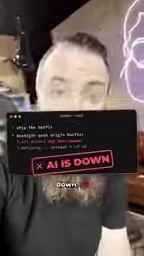
Branches and merge conflicts are key to understanding fallback capability. A branch is a movable pointer to a commit, allowing different lines of work to proceed in parallel without interfering with each other. When two branches modify the same area of the same file, Git cannot automatically decide which version to keep during a merge, so a conflict occurs, requiring manual editing of conflict markers (<<<<<<<, =======, >>>>>>>) and then re-committing. For rollback, people commonly use git revert (which creates a reverse commit and is safe for already-pushed history) or git reset (which moves the branch pointer and may rewrite history). These operations rarely require human intervention when the agent is working normally, but once the service is interrupted, conflicts are complex, or history gets messed up, being able to manually switch branches, identify the scope of conflicts, and choose between revert and reset is the baseline capability that keeps the team from grinding to a halt.
Reason Five: Learning Is Fun in Itself
The last one steps outside the utilitarian view: knowing something is interesting in itself. The video's author asks: how long has it been since you learned something genuinely useful?
Even if the agent handles most of the work, when you watch it operate you can react—"I know what a PR is," "oh, it's doing a Git merge." That sense of participation and pure enjoyment is something you can't get by outsourcing to AI.

The Focus of Learning Git Is Shifting
Put these five reasons together and a common thread emerges: none of them say "you need to type the commands yourself"—they say "you need to understand what's happening."
In the agent era, what's required of Git is not operational proficiency but conceptual clarity and review judgment. You don't need to memorize every parameter, but you do need to know how the branch model works, what commit history tells you, and why a merge went wrong. From this angle, the barrier to learning Git has actually been lowered—the focus shifts from memorizing commands to building a mental model.
The video's author ends with a simple call: it's time to "Git good." For anyone writing code with AI right now, that's worth taking seriously.
Mental model here refers to an understanding of Git's internal data structures: commits form a directed acyclic graph (DAG), branches and HEAD are just pointers to nodes in that graph, and a merge creates a new node with multiple parent commits. Once you build this model, the behavior of many commands becomes predictable—for example, why reset --hard loses changes, why rebase rewrites history, and why commits made in a detached HEAD state are easy to lose. The learning path in the agent era can skip a lot of command memorization and prioritize the four-layer structure of "working tree—staging area—local repository—remote repository" and how to read the commit graph. With a model, you can infer what an unfamiliar command does; without one, even memorized commands won't let you judge whether an agent's operations are safe.
One-line Summary
In an era when AI agents handle Git operations for you, humans still need to learn Git: for communication, review, fallback, and fun.
Paragraph Summary
The article addresses the question "AI coding agents can already auto-commit code, open PRs, and resolve merge conflicts—is it still necessary to learn Git by hand?" It answers yes and lists five reasons: mastering terminology is necessary to communicate with the team and participate in technical decisions; knowing Git is necessary to review PRs submitted by agents and judge whether their operations are reasonable; being able to read commit records and diffs is necessary to supervise agents and stop problems before merge; AI services will be interrupted, so humans need to retain fallback capabilities for manually switching branches, rolling back, and resolving conflicts; and understanding itself brings a sense of participation and enjoyment. The article concludes that in the agent era, the focus of learning Git is shifting from command proficiency to conceptual clarity and review judgment—the barrier is actually lower.
Related articles

Anthropic Reportedly Prices IPO at $83 Per Share, Valuing Company at $1.5 Trillion
Anthropic reportedly prices IPO at $83 per share, above the expected range, with a fully diluted valuation of $1.5 trillion. This article analyzes the signal significance of the pricing and its impact on the AI industry's financing environment.

Open-Source Code Hosting Platform Codeberg Suffers Outage, Sparking Debate in Developer Community
Open-source code hosting platform Codeberg.org suffered an outage, sparking Hacker News debate over nonprofit platform stability and open-source infrastructure dependency risks.

Nadella's Prediction: AI Agents Will Reshape the Rules of the Web Economy
Microsoft CEO Nadella predicts AI agents will reshuffle the web economy, disrupt advertising-driven models, and force platforms like Amazon to rethink how they compete for customers. This article analyzes the agent economy's impact on advertising, e-commerce, and platform competition logic.