Open-Source Code Hosting Platform Codeberg Suffers Outage, Sparking Debate in Developer Community

Open-source code hosting platform Codeberg.org suffered a prolonged outage, sparking community discussion about the stability of nonprofit infrastructure.
Open-source code hosting platform Codeberg.org recently became inaccessible, and its official status account confirmed the incident. A Hacker News discussion thread received nearly 300 points and about 295 comments. Built on Forgejo and operated as a nonprofit, Codeberg emphasizes code ownership and privacy protection, attracting many projects migrating from GitHub. Community reaction was polarized: some understood the resource constraints of a small team running a large service, while others worried about the centralization risks of open-source infrastructure. The article advises developers to keep local repositories in sync, configure multiple remotes, and subscribe to status notifications, and notes that the sustainability of open-source infrastructure requires community-wide support in funding and operations.
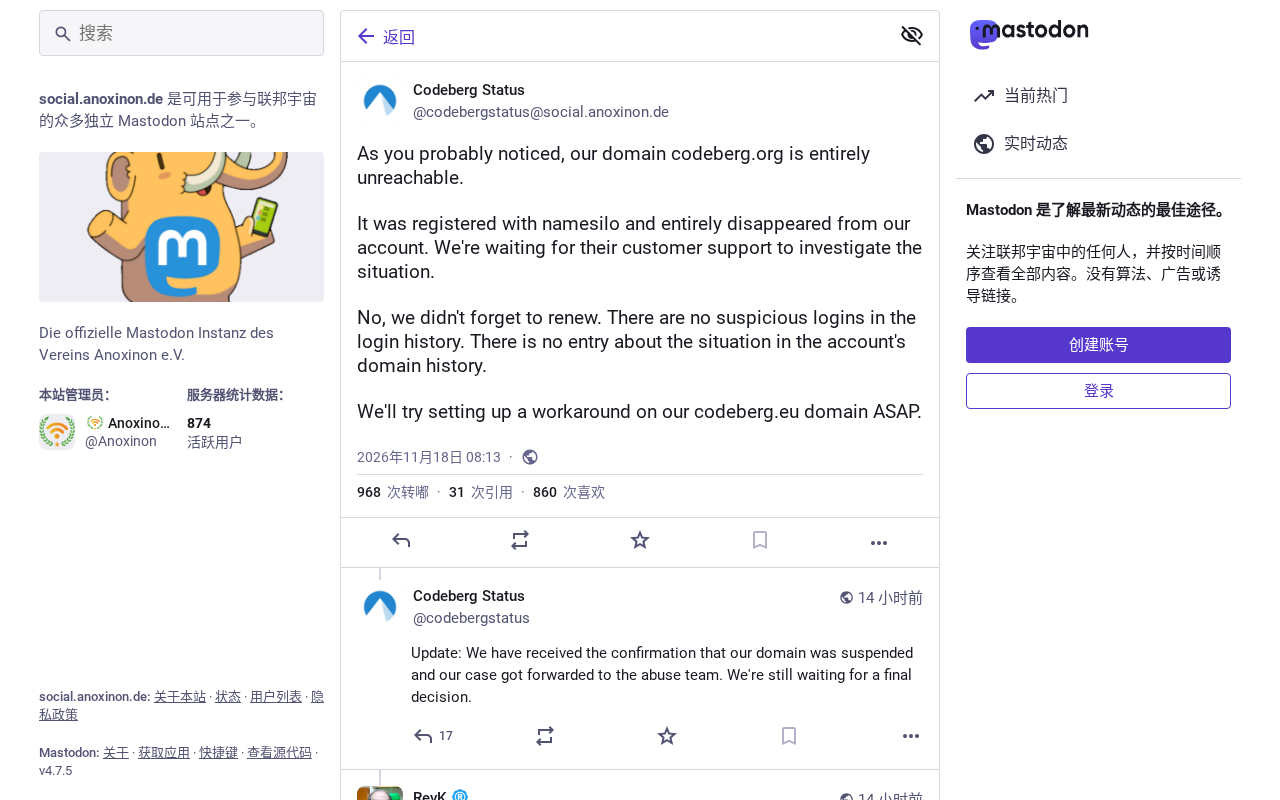
Open-source code hosting platform Codeberg.org recently became inaccessible, drawing widespread attention in the developer community. According to a discussion thread on Hacker News (which received 293 points and 295 comments), along with an announcement from Codeberg's official status account on social media, the outage lasted for an extended period and affected a large number of developers who rely on the platform for code hosting and collaboration.
Incident Recap: Official Status Account Confirms the Outage
Codeberg posted a notice about the service being unreachable through its official status account (@codebergstatus@social.anoxinon.de). Although the original message did not detail the specific cause of the failure, the level of community discussion suggests this was not a brief hiccup. For many open-source teams that host their core projects on Codeberg, platform unavailability means a whole series of workflows—code pushes, pull requests, issue tracking, and CI/CD pipelines—are forced to grind to a halt.
Codeberg, a nonprofit code hosting platform built on Forgejo (a fork of Gitea), has in recent years attracted a considerable number of projects and developers migrating away from GitHub thanks to its commitment to open-source principles and emphasis on privacy. The stability of its infrastructure directly affects these projects' day-to-day operations.
Community Reaction: Understanding and Concern Coexist
In the Hacker News comment section, the discussion was clearly polarized.
On one hand, many developers expressed understanding and support for the Codeberg team. As a platform operated by a nonprofit organization, its resources and manpower are far smaller than Microsoft-backed GitHub or the well-funded GitLab. Some commenters noted that occasional outages are a challenge that small teams running large services can hardly avoid entirely, and what matters is that the team communicates progress transparently.
On the other hand, the incident also sparked discussion about the risks of centralization in open-source infrastructure. Some developers worried that even well-intentioned nonprofit platforms could affect the entire ecosystem through a single point of failure. Some commenters suggested that projects should consider distributed mirrors or self-hosted solutions to reduce dependence on any single hosting platform.
Technical Background: Codeberg's Architecture and Challenges
Codeberg is built on Forgejo, a community-driven Git hosting software. Compared with GitHub, Codeberg lags in feature richness and performance optimization, but its core strength lies in its respect for user data and code ownership. The platform explicitly promises not to use user code to train AI models and not to track user behavior—qualities that are especially valuable in today's technology landscape.
However, the nonprofit model also means limited server resources and operations manpower. When traffic spikes or technical failures occur, the platform's recovery speed may not be as fast as that of commercial platforms. This outage once again reminds us that the sustainability of open-source infrastructure is an issue the entire community needs to pay attention to—not just through code contributions, but also through financial support and operational assistance.
Forgejo is a community-driven Git hosting software forked from the Gitea project in 2022. The fork was prompted by the transfer of Gitea's trademark and governance rights to a commercial company; some core contributors worried the project might move toward a closed-source or commercialized model, so they started fresh with Forgejo and placed it under the nonprofit organization Codeberg e.V. Written in Go, Forgejo offers repository hosting, issue tracking, pull requests, package management, and Actions-based CI/CD, and supports self-hosted deployment. It is licensed under GPLv3, and development decisions are made through a public governance process. Because it inherited from Gitea, Forgejo is highly compatible with Gitea in database structure and APIs, making migration costs low—an important reason Codeberg chose it as its underlying platform.
Git itself is a distributed version control system, and every cloned repository contains the complete history, so a code hosting platform is in theory just a "hub" for synchronizing commits between developers rather than the only copy of the code. But in actual collaboration, "peripheral data" such as issues, pull requests, CI run records, wikis, and releases often exist only on the platform side; once the platform is unavailable, team communication and automation workflows are interrupted. This also explains why the article recommends configuring multiple remotes: by adding multiple remotes with git remote add and pushing to each, you can switch quickly when a platform fails—though mirroring solutions usually only synchronize code and branches, and can hardly fully replicate collaborative data such as issues.
Takeaways for Developers: How to Cope with Hosting Platform Outages
For developers who rely on third-party code hosting platforms, this incident offers several practical lessons:
- Keep local repositories in sync: Regularly pull remote repositories to local so you can keep developing even when the platform is unavailable.
- Configure multiple remotes: Push code to multiple hosting platforms (such as GitHub, GitLab, and Codeberg) simultaneously to achieve redundant backups.
- Follow platform status pages: Subscribe to status notifications for the platforms you use so you can learn about outage progress as soon as possible.
- Participate in community support: For nonprofit platforms, you can help improve their stability by donating or contributing operational resources.
Conclusion
Although Codeberg's outage caused inconvenience for some developers, it also prompted the community to re-examine the fragility and importance of open-source infrastructure. A healthy technology ecosystem needs diverse hosting options, and it also needs developers to give more understanding and support to nonprofit platforms. As the service gradually recovers, we hope Codeberg can learn from this incident and further improve its service reliability.
Related articles

AI Writes Your Code—Do You Still Need to Learn Git? Five Reasons
AI coding agents handle Git operations automatically—is it still necessary to learn Git? Five reasons: team communication, reviewing agent PRs, monitoring code changes, fallback when AI goes down, and the joy of learning—plus how the focus of learning Git is shifting in the agent era.

Anthropic Reportedly Prices IPO at $83 Per Share, Valuing Company at $1.5 Trillion
Anthropic reportedly prices IPO at $83 per share, above the expected range, with a fully diluted valuation of $1.5 trillion. This article analyzes the signal significance of the pricing and its impact on the AI industry's financing environment.

Nadella's Prediction: AI Agents Will Reshape the Rules of the Web Economy
Microsoft CEO Nadella predicts AI agents will reshuffle the web economy, disrupt advertising-driven models, and force platforms like Amazon to rethink how they compete for customers. This article analyzes the agent economy's impact on advertising, e-commerce, and platform competition logic.