AIChipBench: What's Still Missing for LLM Agents Designing AI Chips?

AIChipBench exposes LLM agent gaps in writing RTL: state debugging and holdout generalization are key.
AIChipBench requires LLM coding agents to implement quantized Qwen3.5, Gemma 3, Gemma 4, and Llama 3.2 decoders in synthesizable RTL, scored against an integer reference model. The key finding: hardware design difficulty lies in memory state, not output—feedback pointing to the first state mismatch raised acceptance by 25.0–46.9 points across all 12 agent–task combinations and halved work per accepted design. Yet 45 of 69 accepted designs failed within 32 steps under holdout sequences and conditions, so passing development tests does not mean a design is correct. Over a third of acceleration-track attempts failed to produce qualifying designs. Composite scores lead with Sol 5.6 and Fable 5.1, but absolute scores are low. Conclusion: hardware agent benchmarks must expose state-level debugging feedback and include final tests beyond development cases.
When LLMs Start Writing RTL: The Real Level of Hardware Design Agents
Using large language models to write code is nothing new, but having LLM agents directly design AI accelerators—writing synthesizable register-transfer level (RTL) code—is a different matter. The newly released AIChipBench benchmark raises a sharp question: what does it actually take for LLM coding agents to correctly build this kind of hardware?
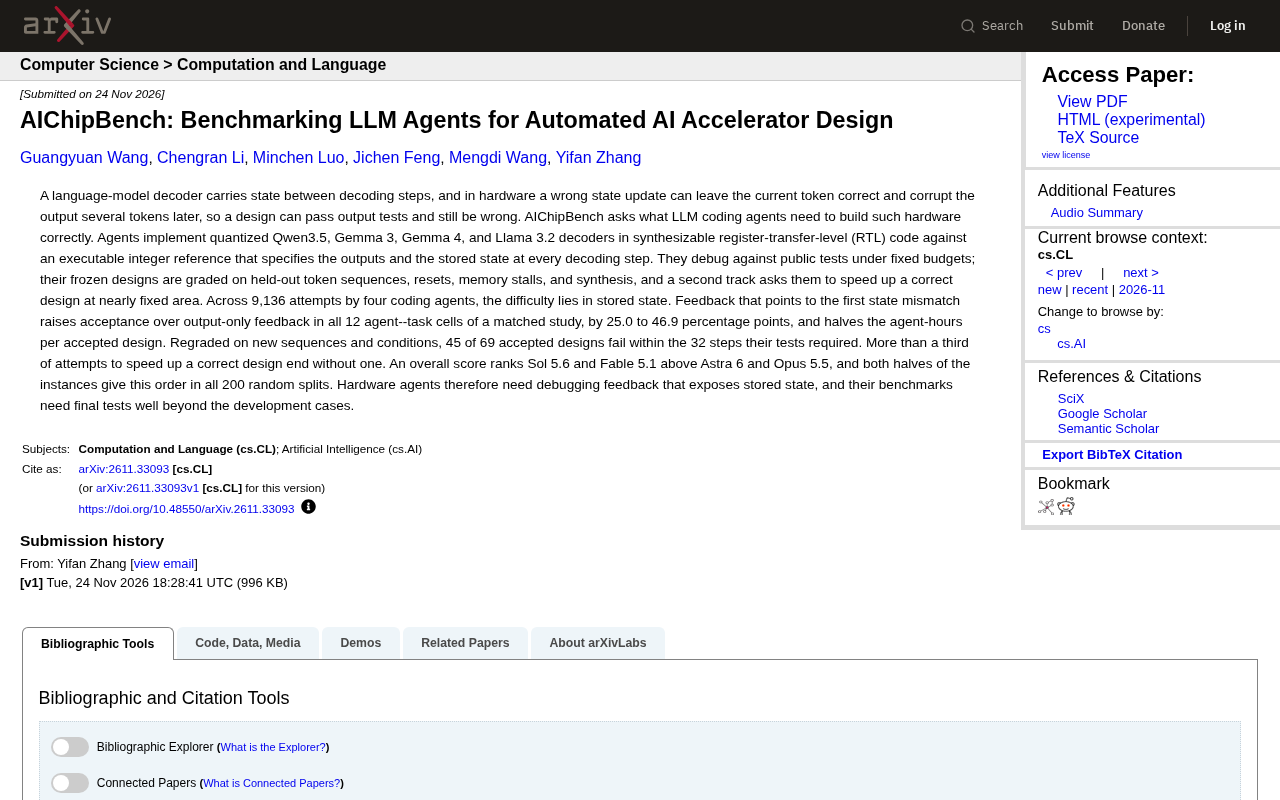
The benchmark requires agents to implement quantized versions of Qwen3.5, Gemma 3, Gemma 4, and Llama 3.2 decoders in synthesizable RTL, checked against an executable integer reference model that specifies the output and memory state at every decoding step. Agents debug using public tests under a fixed budget, and their final frozen designs are scored on holdout token sequences, resets, memory stalls, and synthesis. A separate track requires accelerating an already-correct design under a near-fixed area constraint.
Key Finding: The Hard Part Is "Memory State," Not Output
Language model decoders carry state between decoding steps. In hardware, a single wrong state update can leave the current token correct while corrupting outputs several steps later—meaning a design can pass output tests and still be wrong.
AIChipBench verified this with 9,136 attempts from four coding agents. In a matched study, feedback pointing to the first state mismatch raised acceptance rates by 25.0 to 46.9 percentage points relative to output-only feedback across all 12 agent–task combinations, and halved the agent work required per accepted design. In other words, telling an agent where the state first went wrong is far more effective than telling it only that the output is wrong.
Passing Development Tests ≠ Correct Design
More alarming is the generalization problem. Of 69 accepted designs, 45 failed within 32 steps when re-scored with new sequences and conditions. A green light on development cases does not guarantee a design holds up under real conditions. This points directly to a methodological flaw: benchmarks for hardware agents need final tests that go far beyond development cases.
RTL and synthesizability: Register-transfer level (RTL) is an abstraction level in hardware description, using languages like Verilog or VHDL to describe data flow between registers and combinational logic. "Synthesizable" means the code can be mapped by synthesis tools (such as Synopsys Design Compiler) to a gate-level netlist and ultimately taped out. This differs fundamentally from software code: every assignment in RTL corresponds to real timing and area costs, loops must be unrolled, recursion is unavailable, and dynamic memory allocation does not exist. So even syntactically correct LLM-generated code may fail due to being non-synthesizable (e.g., using unsupported system tasks) or timing violations. AIChipBench requires designs to pass synthesis precisely to rule out false passes that "simulate but can't be built."
Quantized decoders and integer reference models: Quantization compresses model weights and activations from floating point to low-bit integers (e.g., INT8/INT4) to reduce memory and compute overhead. AIChipBench requires implementing quantized decoders checked against an executable integer reference model—one that reproduces the decoding process step by step using pure integer arithmetic, specifying the output token and internal memory state (such as KV Cache) at each step. The value of an integer reference model is that it provides a bit-exact golden standard, so scoring does not depend on floating-point tolerance, and any state deviation is pinpointed precisely.
Holdout tests and overfitting risk: Holdout tests refer to input sequences and operating conditions (e.g., resets, memory stalls, different token sequences) that are invisible during development and used only in final scoring. This mirrors the train/test split in machine learning, aiming to detect generalization rather than memorization. Hardware agents tend to overfit development cases: they may repeatedly patch against public tests so the design is correct on specific sequences without truly implementing a general state machine. The 45/69 holdout failure rate in AIChipBench shows that development tests alone systematically overestimate capability. For benchmark designers, this means reserving sufficiently diverse and out-of-distribution final tests; for agent developers, it suggests grounding debugging feedback in state-level mismatches rather than optimizing only public-case pass rates.
Acceleration Track: Over a Third of Attempts Come Up Empty
The second track tests optimization ability: accelerating a correct design under a near-fixed area constraint. Results show that over a third of acceleration attempts ultimately failed to produce a qualifying design. This indicates that even when agents already have a correct baseline, performance optimization under strict constraints remains a highly difficult task.
Hardware acceleration under area constraints: Hardware optimization typically trades off among three factors: area (gate count/chip cost), power, and timing (frequency). Accelerating a design under a near-fixed area constraint means you cannot simply replicate compute units; you must restructure the datapath—for example, pipelining, operand reuse, reducing state-update latency, or compressing storage. Such optimization requires understanding critical paths and resource conflicts, far beyond the difficulty of "getting the output right." The fact that over a third of attempts failed to produce a qualifying design reflects the shortcoming of LLM agents in constrained optimization: they excel at imitating known structures but struggle to autonomously explore microarchitectural innovation under strict area budgets.
Leaderboard: Sol and Fable Lead, But the Gap Is Small
The composite score ranks Sol (5.6) and Fable (5.1) above Astra 6 and Opus 5.5, and this ordering holds across all 200 random splits and on instances from both halves. The robustness of the ranking shows the scores are not accidental, but the absolute values are not high, reflecting that current agents still have clear shortcomings on hardware design tasks.
Implications for Hardware Agent Benchmarks
AIChipBench's conclusions boil down to two points. First, hardware agents need debugging feedback that exposes memory state—output-only feedback leads agents to iterate repeatedly in the wrong direction. Second, benchmark evaluation must include final tests beyond development cases, otherwise it will systematically overestimate agent capability.
For teams building AI chip design toolchains, this means the granularity of debugging information may matter more than the model's own capability; for researchers evaluating agents, it suggests that metrics like "acceptance rate" are only meaningful when paired with re-evaluation under holdout conditions.
FAQ
What does AIChipBench measure?
It evaluates LLM coding agents' ability to implement quantized decoders (Qwen3.5, Gemma 3, Gemma 4, Llama 3.2) in synthesizable RTL, covering both a correctness track and an acceleration optimization track.
Why is memory state so important?
Decoders carry state between steps, and an incorrect state update may not surface until several tokens later, causing a design to pass output tests while still being wrong.
How do current agents perform?
The highest composite score is Sol's 5.6, and many accepted designs fail under holdout conditions, indicating clear capability gaps remain.
Related articles

Michael Nielsen Takes Down His Classic Neural Network Textbook, Sparking Community Discussion
Michael Nielsen's classic free textbook Neural Networks and Deep Learning has been taken offline, sparking discussion on Hacker News about the reasons and impact.

Inside the AI Training Data Market: The Trade-off Between Exclusivity and Discounts
G2i founder Gabe Greenberg reveals the dual-track pricing of the AI training data market: labs pay a premium for exclusive data or accept discounts that allow others to buy it.

SessionGraph: Unifying All Coding Agent Sessions in One Interactive Graph
SessionGraph aggregates coding agent sessions into an interactive graph, helping developers review, debug, and manage AI coding workflows across sessions. This article examines its positioning, value, and open questions.